
Non-FictionSelf-HelpAnxiety Management
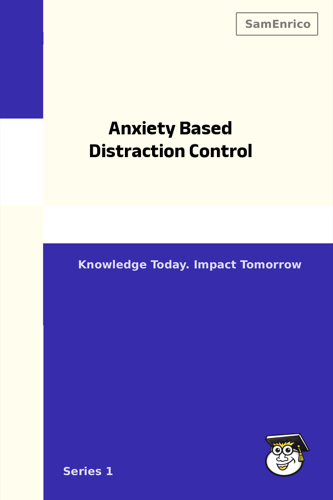
Anxiety Based Distraction Control eBook
Stops worry cycles from interrupting work.
Stops worry cycles from interrupting work.
Formats
Free sample
Chapter 1: The Real Thief...--–- At 2 PM on a Tuesday, I found myself staring at a blank document for the 47th minute. My cursor blinked. My chest tightened. My mind was not blank — it was screaming. "You're going to fail.
They're going to find out you're a fraud. This is the day they finally realize you don't know what you're doing." I wasn't working. I was worrying. And I had no idea the two were different. That Tuesday cost me three hours.
Not because I was distracted by my phone or interrupted by a colleague. Because I was trapped inside my own head, spinning a worry cycle that felt like problem-solving but was actually avoidance. This book is the map out of that loop.If you are holding this book, you have likely experienced some version of that Tuesday. Maybe it happens every Tuesday. Maybe it happens every morning when you open your email.
Maybe it happens the moment a deadline appears on your calendar, or when your manager schedules a "quick chat," or when you sit down to do the creative work that matters most and find yourself suddenly unable to move.You have probably blamed your phone. You have probably blamed your notifications, your open-office floor plan, your chatty colleagues, or the endless pull of social media. You have probably installed website blockers, turned off notifications, and tried to create the perfect distraction-free environment. And yet, the work still did not get done. Because the distraction was never outside you.
It was inside you all along.This chapter makes a provocative claim that will reshape everything you think you know about focus: Your phone is not the problem. Your notifications are not the problem. Your colleagues are not the problem. The real thief of your focus is internal, invisible, and constantly masquerading as productive thinking. It is anxiety.The Great Misdiagnosis: Why Productivity Advice Keeps Failing You For the past decade, the productivity industry has sold you a simple story: distraction comes from outside.
Your environment is cluttered. Your devices are pinging. Your attention is being stolen by algorithms designed to hijack your brain. The solution, therefore, is to build a fortress around your attention. Turn off notifications.
Delete social media apps. Use a website blocker. Work in a room with no windows. Close your door. Put on noise-canceling headphones.This advice is not wrong.
External distractions are real. Notifications do pull your attention. Social media is designed to be addictive. But here is what the productivity industry has failed to tell you: eliminating external distractions does not solve the problem. It only makes the internal distractions louder.Think about the last time you sat down to do important work in a perfectly quiet room.
No phone. No internet. No interruptions. What happened? For many people, the anxiety got louder.
Without external distractions to escape into, you were left alone with your thoughts — and your thoughts were not cooperative. They were catastrophic. They were looping. They were telling you that you were going to fail, that you weren't good enough, that you should be doing something else, that this work was pointless, that you had already missed your chance.That is anxiety. And anxiety is the real thief of your focus.Drawing from Nir Eyal's groundbreaking book Indistractable, we need to understand a fundamental truth: distraction is always a symptom, never the cause.
The cause is the desire to escape discomfort. When work becomes uncertain, demanding, ambiguous, or high-stakes, your brain's threat-detection system activates. That activation feels terrible. It feels like dread, like unease, like the sense that something is wrong. And your brain, being a brilliant problem-solver, immediately looks for an escape.Sometimes the escape is external: you check your phone, open a new tab, get up to make coffee, reorganize your desk, or walk over to a colleague's cubicle.
Sometimes the escape is internal: you enter a worry cycle, replaying the same catastrophic scenarios over and over, mistaking the feeling of thinking for the act of working. Both are forms of avoidance. Both cost you hours of your life. Both leave you feeling exhausted and ashamed at the end of the day.The goal of this book is not to help you eliminate distractions. That is impossible in a connected world, and even if it were possible, it would not work.
The goal is to make you indistractable — to master your internal triggers so that even in the presence of distractions, you can choose where to place your attention. This requires a fundamental reframe: you don't have a focus problem. You have an anxiety problem. Solve the anxiety, and focus follows.External Triggers vs. Internal Triggers Let's get precise about the difference between the two kinds of triggers that pull your attention away from work.External triggers are the ones you can see, hear, and touch.
They come from your environment. Examples include:The ping of a new email or message A notification banner on your phone A colleague stopping by your desk The open tab on your browser The clock reminding you of a deadline The stack of papers on your desk Most productivity advice focuses on eliminating external triggers. Turn off notifications. Close your tabs. Put up a "do not disturb" sign.
Use a website blocker. This advice is useful, but it is not sufficient. Because external triggers are only half the story.Internal triggers are the ones you cannot see. They come from inside your body and mind. Examples include:Boredom: the restless sense that what you're doing isn't stimulating enough Uncertainty: the uncomfortable feeling of not knowing how something will turn out Fatigue: the heavy sensation in your eyes and limbs that makes you want to rest Anxiety: the tightness in your chest, the racing thoughts, the sense of dread Fear of failure: the voice that says, "What if you're not good enough?"Fear of judgment: the voice that says, "What will they think?"Overwhelm: the sense that there is too much to do and not enough time Here is the crucial insight: internal triggers are far more powerful than external triggers.
You can silence your phone, but you cannot silence your anxious mind. You can close your door, but you cannot close the door on uncertainty. You can block every website on the internet, but you cannot block the voice that says you're going to fail.And because internal triggers follow you everywhere, eliminating external distractions only makes the internal ones louder. In a perfectly quiet room, you are left alone with your anxiety. And your anxiety, without anywhere else to go, becomes unbearable.
So you reach for an external distraction — not because you are weak, but because you are human, and humans are designed to escape discomfort.The Discomfort-Escape Loop: How Worry Becomes a Habit Let me introduce you to the loop that runs your life. I call it The Worry Loop, and it is the central framework of this entire book. You will see it again in Chapter 2 (mapped in detail) and Chapter 3 (explained neuroscientifically). For now, understand its basic shape:Trigger → Thought → Emotion → Escape → Relief → Repeat Here is how it works…
This is the end of the free sample. Get the eBook to keep going. Buy now
About this book
Details
- Author
- Anderson Roberto
- Publisher
- SamEnrico
- Language
- English
- Genre
- Non-Fiction, Self-Help, Anxiety Management
- Released
- 2026-06-11
- Pages (approx.)
- 121
- Available as
- eBook, Audiobook

Read better in the ZLOADR app
Your eBooks on your phone or tablet. Sign in with your SamEnrico account and start reading.
More by Anderson Roberto
 Research Proposal Data Management PlanAnderson Roberto$12.99
 Parent Loss Podcast Listening GuideAnderson Roberto$11.99
 Spin for AthletesAnderson Roberto$11.99
 Bipolar Smartphone App GuideAnderson Roberto$11.99
 The Fishing Boat PrisonerAnderson Roberto$11.99
 Obsidian Notes MemoryAnderson Roberto$11.99
 Multiple Choice StrategyAnderson Roberto$11.99
 EQ for Depression Coping GuideAnderson Roberto$11.99
 Child Loss Creative ExpressionAnderson Roberto$11.99
 Socrates and the Art of Questioning: The Birth of Western ThoughtAnderson Roberto$11.99
 The Silk Road Gambit: How a Cabinet Secretary Reshaped Global TradeAnderson Roberto$11.99
 The African Merchants of Rome: Wealth, Trade, and Philanthropy in the Eternal CityAnderson Roberto$11.99
You may also like
 Hong Kong Handover 1997Dunn Johnnie$11.99
 Zumba For Postnatal Recovery CourseNeal Christian$11.99
 Zumba for BeginnersLadner Nikia$11.99
 YouTube Comment Mining GuideHumes Pandora$12.99
 Worry Box MeditationCarlin Rudy$11.99
 Workplace Stress MeditationNguyen Lynn$11.99
 Workplace Stress and Sleep RepairHawley Ivory$11.99
 Workplace Perfectionism CureDelaney Jeffry$11.99
 Workplace Injustice Anger GuideWallen Isabelle$11.99
 Work Addiction and Burnout LinkGreenwood Ester$11.99
 Women in Yoga and WellnessBeattie Galina$11.99
 Women in Stand Up ComedyChun Evangeline$11.99