
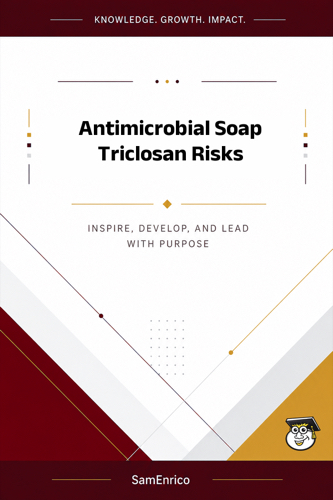
Antimicrobial Soap Triclosan Risks
Avoid antibacterial soaps with triclosan linked to
by Abney Estela
Avoid antibacterial soaps with triclosan linked to hormone disruption.
Formats
About this book
Free sample
Chapter 1: The $1 Billion Mistake...-- In 1964, a Swiss chemist named Max Wehrli filed a patent for a new chemical compound. He called it Irgasan DP 300. It was designed to kill bacteria on surgical instruments and hospital floors. It was never meant to touch your skin. It was never meant to touch your child's skin.
And it was certainly never meant to be used 2.3 billion times per year in American households alone.But that is exactly what happened.By 2005, this same chemical—now rebranded as "triclosan"—had become a $1 billion industry staple. It was found in approximately 75 percent of all liquid hand soaps sold in the United States. It was in toothpaste, deodorants, facial cleansers, cutting boards, children's toys, shower curtains, socks marketed as "odor-resistant," and even the curtains in hospital operating rooms. The average American was exposed to triclosan not once a day, not twice a day, but dozens of times per day, from waking up to washing dishes to brushing teeth before bed.The chemical had escaped the hospital floor and colonized the American bathroom. And no one had asked whether it was safe.The Birth of a Panic To understand how triclosan became ubiquitous, you have to understand the cultural moment that launched it.
The 1990s were a decade of germ panic. The American public had been bombarded with news stories about flesh-eating bacteria, E. coli outbreaks in fast-food hamburgers, the Ebola virus scares, and later the arrival of SARS and H1N1 influenza. Television news programs ran segments titled "The Killer Germs Next Door." Magazines published cover stories with headlines like "Is Your Kitchen Making You Sick?"Into this climate of fear stepped the $200 billion consumer goods industry, and they had a simple, powerful message: You are surrounded by enemies too small to see. But we have a shield.The shield was triclosan.Marketing executives rebranded the industrial disinfectant as a must-have household product.
They gave it friendlier names: Microban, Biofresh, Lexol 300. They embedded it into plastics, fabrics, and foams. They convinced consumers that "antibacterial" meant "safer" and that "sterile" meant "healthy." The advertising was brilliant…
This is the end of the free sample. Get the eBook to keep going. Buy now
Contents
- Chapter 1
- Chapter 2
- Chapter 3
- Chapter 4
- Chapter 5
- Chapter 6
- Chapter 7
- Chapter 8
- Chapter 9
- Chapter 10
- Chapter 11
- Chapter 12
Details
- Author
- Abney Estela
- Publisher
- SamEnrico
- Language
- English
- Genre
- Non-Fiction, Health & Wellness
- Released
- 2026-06-08
- Pages (approx.)
- 155
- Available as
- eBook, Audiobook

Read better in the ZLOADR app
Your eBooks on your phone or tablet. Sign in with your SamEnrico account and start reading.
More by Abney Estela
 The Permanent GuardianAbney Estela$11.99
 Senior Housing Subsidies and VouchersAbney Estela$11.99
 Remote Work Feedback GuideAbney Estela$11.99
 Assertive School AdvocacyAbney Estela$11.99
 Remote Work Daily Shutdown RitualAbney Estela$11.99
 Parent Loss InstagramAbney Estela$11.99
 Success Without Burnout for LawyersAbney Estela$11.99
 The Quantum Poet: How Adonis Transformed Arabic Verse with a Nobel PrizeAbney Estela$11.99
 The Black Power Gang: Undercover in the OutbackAbney Estela$11.99
 How to Produce Liquid Hand SOAPAbney Estela$11.99
 How to Produce Marine Water RepellentAbney Estela$11.99
 Revenue Model One PagerAbney Estela$12.99
You may also like
 Hong Kong Handover 1997Dunn Johnnie$11.99
 Zumba For Postnatal Recovery CourseNeal Christian$11.99
 Zumba for BeginnersLadner Nikia$11.99
 YouTube Comment Mining GuideHumes Pandora$12.99
 Worry Box MeditationCarlin Rudy$11.99
 Workplace Stress MeditationNguyen Lynn$11.99
 Workplace Stress and Sleep RepairHawley Ivory$11.99
 Workplace Perfectionism CureDelaney Jeffry$11.99
 Workplace Injustice Anger GuideWallen Isabelle$11.99
 Work Addiction and Burnout LinkGreenwood Ester$11.99
 Women in Yoga and WellnessBeattie Galina$11.99
 Women in Stand Up ComedyChun Evangeline$11.99