
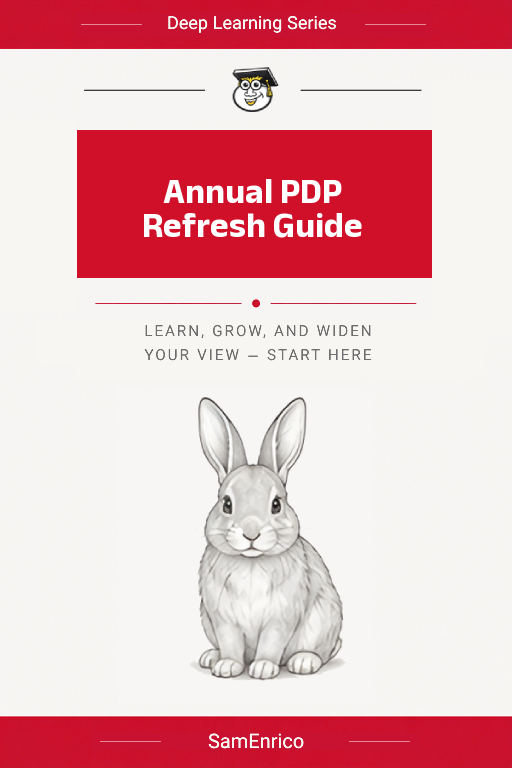
Non-FictionProfessional's Cheat SheetAnnual RefreshPlanning
Annual PDP Refresh Guide eBook
Refresh your personal development plan annually in
Refresh your personal development plan annually including new goal setting and past year accomplishment review.
Formats
Free sample
Chapter 1: The Highlight Reel Is Lying to You--Most people remember their past year as a highlight reel—promotions, vacations, big wins—or a lowlight reel—failures, regrets, crises. Neither is accurate. Memory is a storyteller, not a historian. It smooths over the confusing parts, amplifies the emotional peaks, and quietly deletes the boring middle where most of life actually happens. This is not a character flaw.
It is how human brains evolved. We remember what feels significant and forget what feels ordinary. But when it comes to refreshing your Personal Development Plan, ordinary memory is a dangerous tool.Before you set a single new goal for the coming year, you must conduct an honest, data-informed, emotionally grounded autopsy of the last 365 days. This chapter is that autopsy. It will feel uncomfortable.
It will feel slow. It might even feel like failure. But here is the truth that every best-selling personal development book agrees on: You cannot build a better future on a foundation of self-deception about the past.The exercise you are about to complete is called the "Year in Cinema." Instead of remembering your year as a two-minute trailer of highlights and lowlights, you will watch the full, unedited film—month by month, decision by decision, energy level by energy level. By the end of this chapter, you will have a completed timeline of your past year, a clear distinction between actual progress and mere busyness, and a surprising gift: a list of goals you are officially allowed to stop feeling guilty about.Let us begin.The Problem with Memory: Why Your Brain Lies to You Think back to your last birthday. What do you remember?
Probably one or two vivid moments: a kind gesture, an awkward conversation, a piece of cake. Now think about the other 23 hours and 55 minutes of that day. You remember almost nothing. Your brain deleted it because it was not emotionally or narratively useful. This same process applies to how you remember your entire year.Psychologists call this "peak-end rule." We judge past experiences almost entirely based on how they felt at their most intense moment (peak) and how they felt when they ended.
Everything else is lost. This means your memory of last year is not a reliable record. It is a highlight reel edited by your emotions.When most people sit down to review their year, they unconsciously do one of two things:The Optimist's Trap: They remember only the wins—the promotion, the vacation, the compliment from their boss. They feel good about the year but miss critical data about what actually worked and what did not. Then they set overly ambitious goals based on an inflated sense of momentum.The Pessimist's Trap: They remember only the failures—the goal they abandoned in February, the conflict they handled poorly, the project that went over budget.
They feel defeated and set timid, safe goals designed to avoid future failure. Neither approach serves you.The Year in Cinema method bypasses both traps. Instead of relying on memory, you will rebuild your year chronologically using calendars, journals, photos, and any other artifacts that recorded your actual life. You are not remembering. You are reconstructing.The Year in Cinema: A Step-by-Step Reconstruction Set aside 90 to 120 minutes for this exercise.
You will need:A printed or digital calendar for the past 12 months (work and personal)Your journal or notes app (if you keep one)Your photo gallery (scrolling through photos triggers forgotten events)Email sent folder (for major work milestones)A blank document or notebook with 12 sections (one per month)Do not skip the setup. The physical act of preparing materials signals to your brain that this is important. It is not a casual reflection. It is an audit.Step 1: The Calendar First Pass Open your calendar and scroll month by month from 12 months ago to today. For each month, write down:Major work events: Project launches, deadlines met or missed, performance reviews, client wins or losses, team changes.Major personal events: Birthdays, trips, medical events, moves, relationship milestones, family obligations.Recurring patterns: Did you travel every third week?
Were there months with excessive meetings? Did you take time off?Do not interpret yet. Just record. You are a journalist gathering facts before writing the story.Step 2: The Artifact Scan Now go through your photo gallery, sent emails, and any other digital traces. Add to your monthly timeline any events that your calendar missed.
Photos are particularly powerful because they capture informal moments—lunch with a colleague, a walk after work, a child's school event—that calendars rarely record but that profoundly affect your energy and focus.Most people add 30–50% more events during this step. That is normal. It means you were living a richer life than your calendar captured. It also means your memory alone would have been incomplete.Step 3: Energy and Engagement Scoring For each month, add two scores:Energy Level (1–10): How much physical and mental energy did you have this month on average? (1 = exhausted, barely functioning; 10 = vibrant, waking up without an alarm)Engagement Level (1–10): How engaged and present were you in your work and personal life?
(1 = phoning it in, counting minutes; 10 = flow state, losing track of time)These scores are subjective. That is fine. The goal is not scientific precision. The goal is pattern recognition. Most people discover that energy and engagement are correlated but not identical.
You can have high engagement and low energy (a busy, meaningful month that wore you out). You can have low engagement and high energy (a bored month where you felt rested but unchallenged). Both patterns tell you something.Step 4: The Three Questions For each month, answer three questions:What was the single biggest challenge I faced this month? (Be specific: not "work was hard" but "the Johnson account went into crisis mode.")What was the single biggest decision I made this month? (Decisions include what you chose to do and what you chose not to do.)What did I learn this month that I did not know before?
(If nothing, write "nothing." That is also data.)These questions surface the narrative arc of your year. By the time you finish 12 months, you will see a story—not the highlight reel you remembered, but the actual sequence of challenges, choices, and lessons that shaped you.Winner Goals vs. Zombie Goals: The Critical Distinction Now that you have reconstructed your year, it is time to look at your goals. Most people enter a new year with a list of goals that blend two fundamentally different types of past goals. You cannot refresh your PDP effectively until you separate them.Winner Goals Winner goals are goals that you either completed or kept consistently on track throughout the year.
They do not have to be perfect. A goal that you completed in December after struggling all year is still a winner. A habit goal that you maintained 80% of the time is still a winner. Winner goals receive celebration. They also provide evidence for your future capability.Ask yourself for each winner goal: "What made this one succeed when others did not?" The answers are your winning conditions—the environment, support, skills, or timing that enabled success.
You will want to replicate these conditions for new goals.Zombie Goals Zombie goals are goals that you never started, abandoned…
This is the end of the free sample. Get the eBook to keep going. Buy now
About this book
Details
- Author
- Stanton Ricki
- Publisher
- SamEnrico
- Language
- English
- Genre
- Non-Fiction, Professional's Cheat Sheet, Annual Refresh, Planning
- Released
- 2026-05-30
- Pages (approx.)
- 122
- Available as
- eBook, Audiobook

Read better in the ZLOADR app
Your eBooks on your phone or tablet. Sign in with your SamEnrico account and start reading.
More by Stanton Ricki
 Germany Solar Panel Incentives GuideStanton Ricki$11.99
 Baby Swaddling Techniques GuideStanton Ricki$11.99
 Habit Stacking Weight LossStanton Ricki$11.99
 Swiss Green Incentives ManualStanton Ricki$11.99
 Innocence Project Massachusetts CasesStanton Ricki$11.99
 Wings Over the Sands: The Emirati Dreamers Who Conquered the AtlanticStanton Ricki$11.99
 The Silent Revolution: How Ray Kurzweil Predicted the FutureStanton Ricki$11.99
 Understanding Chromosome 18 RingStanton Ricki$17.99
 How to Start a Motor Tricycle and Parts Business (Beginners Guide)Stanton Ricki$11.99
 Newfoundland PNP for GradsStanton Ricki$12.99Newfoundland PNP for GradsStanton Ricki$12.99
 Brainwave Authentication TechnicianStanton Ricki$11.99
You may also like
 Hong Kong Handover 1997Dunn Johnnie$11.99
 Zumba For Postnatal Recovery CourseNeal Christian$11.99
 Zumba for BeginnersLadner Nikia$11.99
 YouTube Comment Mining GuideHumes Pandora$12.99
 Worry Box MeditationCarlin Rudy$11.99
 Workplace Stress MeditationNguyen Lynn$11.99
 Workplace Stress and Sleep RepairHawley Ivory$11.99
 Workplace Perfectionism CureDelaney Jeffry$11.99
 Workplace Injustice Anger GuideWallen Isabelle$11.99
 Work Addiction and Burnout LinkGreenwood Ester$11.99
 Women in Yoga and WellnessBeattie Galina$11.99
 Women in Stand Up ComedyChun Evangeline$11.99