
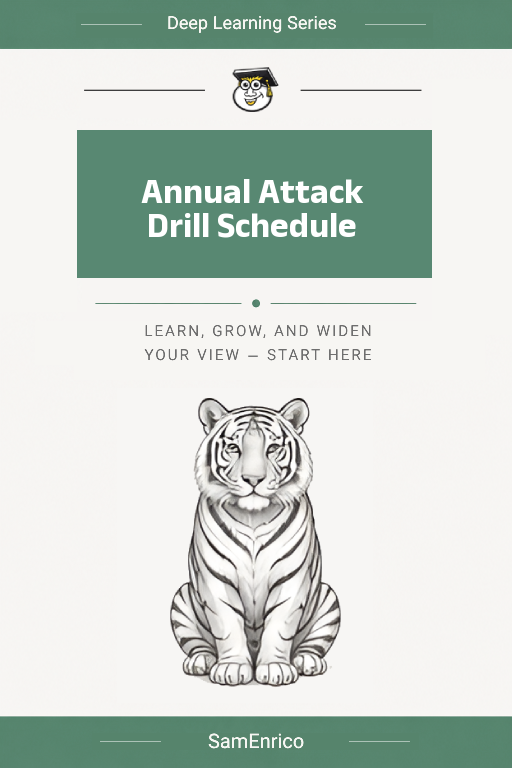
Non-FictionCrisis ManagementDrills
Annual Attack Drill Schedule eBook
Schedule mandatory terrorist attack drills for all
Schedule mandatory terrorist attack drills for all employees annually. Rotate scenarios, announce or unannounced, and track participation rates.
Formats
Free sample
Chapter 1: The Compliance Trap...--The alarm blared at 10:37 AM on a Tuesday. In a mid-sized insurance office in suburban Chicago, four hundred employees followed the procedure they had practiced six times in the past eighteen months. They locked doors. They turned off lights. They moved away from windows.
They silenced their phones. They waited.Seventeen minutes later, the “all clear” was announced. The safety manager posted a sign on the breakroom bulletin board: “Successful lockdown drill – 98% participation.” Everyone went back to work. No one asked the dangerous question: Would any of this have worked in a real attack?Three thousand miles away, in a different office building, a very different drill was taking place. No one had announced it.
No one knew it was coming. When the alert came—a text message that read only “LOCKDOWN – THIS IS A DRILL”—employees hesitated. Some laughed. Some ignored it. Some locked their doors thirty seconds late.
One person opened a locked door to ask a colleague if it was “real or just another drill.”The safety manager of that second building had been reading the same research. She knew something that most compliance-driven organizations refuse to admit: most workplace attack drills are not just ineffective—they are dangerous. They train employees to go through motions without understanding. They create the illusion of safety while building the habits that get people killed when reality deviates from the script.This book exists because of that uncomfortable truth. It exists because the difference between surviving a workplace attack and becoming a statistic often comes down to a single variable: whether the people in that building have been trained to comply or trained to survive.The Body Count of Compliance Culture Let us begin with a number that should disturb every executive, every safety manager, and every employee who has ever sat through a mandatory drill: In more than sixty percent of workplace attacks where the organization had conducted “active shooter training” within the previous twelve months, survivors later reported that their training did not prepare them for what actually happened.This statistic does not appear in glossy safety brochures.
It is not featured in HR compliance presentations. But it appears again and again in post-incident reports, survivor interviews, and litigation depositions. The gap between “we ran a drill” and “our people knew what to do” is where preventable deaths occur.Consider the case of a manufacturing plant in the southeastern United States. The company had an exemplary safety record. They ran quarterly drills.
They tracked participation rates. They had color-coded evacuation maps on every wall. When an active shooter entered the facility, employees did exactly what they had practiced: they locked themselves in designated safe rooms. The shooter, unable to access those rooms, moved on. Six people survived.Then the shooter found a conference room where fourteen employees had also locked the door—but that door had a glass panel.
The shooter saw them. The training had never mentioned glass doors. The drill had never accounted for the difference between solid doors and transparent barriers. Twelve of those fourteen people died.The compliance trap is seductive because it feels like progress. You schedule a drill.
You check a box. You report a high participation rate. You move on. But what did you actually measure? The ability to follow a script that assumes a known threat, a known environment, and a known sequence of events.
Real attacks respect none of those assumptions.The Three Lies We Tell Ourselves About Attack Drills Before we can build a better system, we must name the lies that keep the current broken system in place. These are not malicious falsehoods. They are comfortable simplifications that have hardened into organizational dogma.Lie #1: “Any drill is better than no drill.”This is the most dangerous lie because it sounds so reasonable. Surely, the logic goes, practicing something is better than practicing nothing. But this assumes that practice cannot make you worse.
In fact, research on “negative training” in high-stakes environments—from aviation to emergency medicine—shows that practicing the wrong behaviors creates muscle memory that is harder to unlearn than no training at all.When employees learn that drills are always announced, always the same scenario, and always followed by a clear “all clear” signal, they build a mental model that has no room for ambiguity. In a real attack, when the alarm sounds at an unexpected time, when the scenario doesn’t match the script, when there is no “all clear” because the threat is still present—those employees don’t become neutral. They become actively dangerous, following protocols that no longer apply while the attacker exploits their predictability.Lie #2: “High participation means high preparedness.”The insurance office that reported 98% participation in its lockdown drill celebrated that number. But when a security consultant observed the same drill unannounced the following month, she found that only forty-one percent of employees locked their doors within the first thirty seconds. Another twenty-three percent never locked their doors at all—they assumed someone else would do it.The 98% figure counted people who were present in the building.
It did not measure whether they performed the correct actions. It did not measure whether they performed them quickly enough. It did not measure whether they understood why each action mattered. Participation is a metric of convenience, not a metric of survival.Lie #3: “Trauma-informed drills are soft drills.”This lie has a perverse double effect. On one hand, organizations that ignore psychological safety create drills that retraumatize vulnerable employees, driving them out of the workforce or into silent non-compliance.
On the other hand, organizations that attempt to be trauma-informed often water down their drills to the point of uselessness, assuming that any accommodation reduces rigor.The truth is the opposite. Genuinely trauma-informed drills are more rigorous because they confront the reality that employees have different starting points. A drill that accounts for the veteran with PTSD, the survivor of domestic violence, and the employee with an anxiety disorder is not a weaker drill. It is a more realistic drill, because those people will be present in a real attack, and their responses will shape outcomes for everyone. Ignoring them is not strength.
It is willful blindness.The Mandatory Hierarchy: A New Framework If the compliance trap is the disease, this book offers the cure. But the cure requires accepting a difficult premise: not all drills are created equal, and not all employees can be treated identically.The mandatory hierarchy that governs everything in this book is simple but strict:Tier 1: Announced Drills – No Opt-Out Announced drills are the foundation of procedural learning. Because they are predictable, they carry low risk of trauma. Because they are scheduled in advance, they can be integrated into normal operations. Because everyone knows they are coming, there is no excuse for non-participation.For announced drills, there is no opt-out.
Every employee physically present in the building participates. The only exceptions are documented medical emergencies occurring during the drill itself (in which case the employee is escorted out of the drill area) and approved leave of absence. There is no “I don’t feel like it.” There is no “I have too much work.” Announced…
This is the end of the free sample. Get the eBook to keep going. Buy now
About this book
Details
- Author
- Cardillo Towanda
- Publisher
- SamEnrico
- Language
- English
- Genre
- Non-Fiction, Crisis Management, Drills
- Released
- 2026-06-01
- Pages (approx.)
- 140
- Available as
- eBook, Audiobook

Read better in the ZLOADR app
Your eBooks on your phone or tablet. Sign in with your SamEnrico account and start reading.
More by Cardillo Towanda
 The Boat People ReunionCardillo Towanda$11.99
 Nurse Shift Work StressCardillo Towanda$11.99
 NVC For Anxiety ConversationsCardillo Towanda$11.99
 Crisis Hotline Worker GuideCardillo Towanda$11.99
 The Iron Forges of Meroë: Blacksmiths of the NileCardillo Towanda$11.99
 Warehouse PickerCardillo Towanda$11.99
 How to Produce Billiard Cue CasesCardillo Towanda$11.99
 Ultimate Handbook Guide to Contagem : (Brazil) Travel GuideCardillo Towanda$11.99
You may also like
 Hong Kong Handover 1997Dunn Johnnie$11.99
 Zumba For Postnatal Recovery CourseNeal Christian$11.99
 Zumba for BeginnersLadner Nikia$11.99
 YouTube Comment Mining GuideHumes Pandora$12.99
 Worry Box MeditationCarlin Rudy$11.99
 Workplace Stress MeditationNguyen Lynn$11.99
 Workplace Stress and Sleep RepairHawley Ivory$11.99
 Workplace Perfectionism CureDelaney Jeffry$11.99
 Workplace Injustice Anger GuideWallen Isabelle$11.99
 Work Addiction and Burnout LinkGreenwood Ester$11.99
 Women in Yoga and WellnessBeattie Galina$11.99
 Women in Stand Up ComedyChun Evangeline$11.99