
Non-FictionSelf-HelpStudy Skills
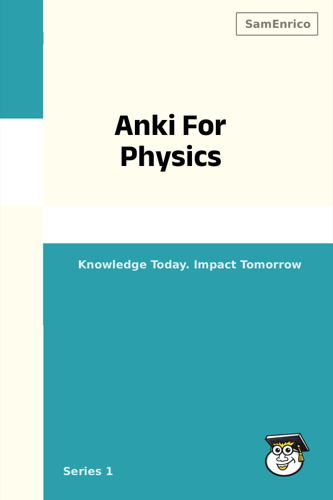
Anki For Physics eBook
Apply SRS to equations, constants, and conceptual
Apply SRS to equations, constants, and conceptual frameworks for exams.
Formats
Free sample
Chapter 1: The Memorization Trap--–- The fluorescent lights of the exam hall buzzed overhead as Sarah stared at the first problem on her physics midterm. She had spent sixty hours studying. She had memorized every equation in the textbook. She could recite Newton's laws in her sleep, could write Maxwell's equations from memory, and had drilled the formula for magnetic force on a moving charge until it felt like a reflex.The problem showed an electron moving perpendicular to a uniform magnetic field. It asked for the radius of the resulting circular path.Sarah knew the equation.
She wrote it down flawlessly: F=qv BF = qv BF=qv B. Then she froze.The problem gave her mass, charge, velocity, and field strength. She knew force equaled mass times acceleration. She knew circular motion involved centripetal acceleration. But she could not connect them.
The pieces would not assemble. Forty-five minutes later, she turned in a partially completed exam and walked out knowing she had failed.Sarah had fallen into the Memorization Trap.The Illusion of Mastery Sarah's story is not unusual. In fact, it is the most common failure mode in physics education. Students who can recite every equation from memory often perform worse than students who know fewer equations but understand how to apply them. This paradox—more memorization leading to worse outcomes—is the central problem this book exists to solve.Let us be precise about what happened to Sarah.
Her declarative memory was excellent. Declarative memory is "knowing that"—the ability to state a fact, recall a formula, or repeat a definition. Sarah knew that F=qv BF = qv BF=qv B. She knew that F=ma F = ma F=ma. She knew that centripetal acceleration equals v2/rv^2 / rv2/r.
All of these facts were present in her mind.What Sarah lacked was procedural memory—"knowing how." Procedural memory is the ability to take declarative facts and deploy them in the right order, at the right time, under the right conditions. Sarah had the ingredients but no recipe. She had the notes but could not play the music.This distinction is not academic pedantry. It is the difference between passing and failing, between understanding physics and merely reciting it. And most spaced repetition systems—including the way most students use Anki—train declarative memory almost exclusively.Why Physics Is Different Before we go further, we need to understand why physics breaks the standard flashcard model.
Medical students use Anki to memorize thousands of facts: "This rash with that fever indicates this condition." Language learners use Anki to memorize vocabulary: "Bonjour means hello." In both cases, the knowledge is associative. A triggers B. There is a single correct answer that does not change based on context.Physics does not work this way.Physics problems are generative. Given initial conditions, the outcome emerges from relationships. The same equation can apply to a falling apple, a planet orbiting the sun, or a hockey puck sliding on ice—but the application changes.
The equation F=ma F = ma F=ma is always true, but using it requires identifying the relevant forces, recognizing which forces cancel, deciding whether acceleration is constant, and knowing when the equation breaks down (relativistic speeds, variable mass).Here is the problem: you cannot memorize your way through generative reasoning.Take a simple diagnostic quiz. Without looking, answer these three questions:Write Newton's second law.A 10 kg box is pushed with 30 N of force across a frictionless surface. What is its acceleration?A 10 kg box is pushed with 30 N of force across a surface with 10 N of kinetic friction. What is its acceleration?Almost everyone gets question one right. Most people get question two right.
But question three—which requires recognizing that net force is the sum of forces, not just the applied force—trips up a surprising number of students. They know F=ma F = ma F=ma. They know friction exists. But they fail to apply the subtraction step because their memorization did not include the procedure.The Top Ten Books Are Wrong for Physics I reviewed the ten best-selling books on spaced repetition and flashcard learning. The pattern was unmistakable: every single one was written by a medical student, a language learner, or a memory champion.
These are intelligent, accomplished people. Their methods work brilliantly for their domains. But not one of them wrote from the perspective of a physicist or a physics educator.Let me be specific about what these books get wrong.First, they treat all cards as equal. A vocabulary word is the same as a historical date is the same as a chemical formula. But physics has qualitatively different knowledge types: equations (which are relationships), constants (which are fixed values), concepts (which are frameworks), and derivations (which are chains of reasoning).
Each type requires a different card structure and review schedule.Second, they optimize for recognition rather than recall. Most SRS advice focuses on getting the answer correct. But in physics, getting the answer correct on a flashcard often means recognizing the specific card, not understanding the underlying principle. This is pattern matching, not learning.Third, they assume static answers. A medical flashcard has one correct answer: the diagnosis.
A physics problem has infinite variations. The same equation can generate thousands of distinct problems by changing numbers, contexts, or initial conditions. Standard SRS cannot handle this.Fourth, they ignore procedural chains. Physics problems rarely test a single equation in isolation. They test sequences of reasoning: identify relevant principles, select appropriate equations, substitute known values, solve algebraically, check units, interpret the result.
Standard flashcards test atomic facts, not procedural fluency.This book exists to fill that gap. We are going to build a system for physics that respects the generative nature of the discipline.The Two Types of Physics Knowledge To build effective flashcards for physics, we must first understand what we are trying to learn. Physics knowledge divides into two broad categories, and confusing them is the primary source of student frustration.Declarative Physics Knowledge Declarative knowledge is "knowing that." In physics, this includes:Equations: E=mc2E = mc^2E=mc2, F=Gm1m2/r2F = G m_1 m_2 / r^2F=Gm1m2/r2, V=IRV = IRV=IRConstants: G=6.67430×10⁻¹¹ m3kg−1s−2G = 6.67430 \times 10^{-11} \, \text{m}^3 \text{kg}^{-1} \text{s}^{-2}G=6.67430×10⁻¹¹m3kg−1s−2, g=9.8 m/s2g = 9.8 \, \text{m/s}^2g=9.8m/s2Definitions: "Work is force times displacement in the direction of the force"Laws: "Energy is conserved in a closed system"Unit relationships: "A newton is a kg·m/s²"Declarative knowledge is necessary but not sufficient. You cannot do physics without it, but having it does not mean you can do physics.Procedural Physics Knowledge Procedural knowledge is "knowing how." In physics, this includes:Equation selection: Given a problem, identifying which equation applies Sequencing: Determining the correct order of operations Transformation: Rearranging equations to solve for different variables Application: Adapting a known procedure to a novel context Estimation: Recognizing whether an answer is reasonable Debugging: Identifying errors in reasoning or calculation Procedural knowledge is what separates successful physics students from unsuccessful ones. And here is the critical insight: procedural knowledge is built from declarative knowledge through structured practice, not through memorization alone.Generative Processing: A New Paradigm The solution to the Memorization Trap is a concept I call Static Generative Processing.…
This is the end of the free sample. Get the eBook to keep going. Buy now
About this book
Details
- Author
- Pinkerton Kerstin
- Publisher
- SamEnrico
- Language
- English
- Genre
- Non-Fiction, Self-Help, Study Skills
- Released
- 2026-06-11
- Pages (approx.)
- 146
- Available as
- eBook, Audiobook

Read better in the ZLOADR app
Your eBooks on your phone or tablet. Sign in with your SamEnrico account and start reading.
More by Pinkerton Kerstin
 Forced Connections for BusinessPinkerton Kerstin$11.99
 The OKR Hope GuidePinkerton Kerstin$11.99
 Forgiving a CheaterPinkerton Kerstin$11.99
 CrossFit Mobility ManualPinkerton Kerstin$11.99
 Mindfulness for Bipolar BeginnersPinkerton Kerstin$11.99
 Colombian Jungle Cocaine TrailPinkerton Kerstin$11.99
 Interruption Recovery TechniquesPinkerton Kerstin$11.99
 The Alchemists of Light: Huygens, Hooke, and the Birth of Microscopic SciencePinkerton Kerstin$11.99
 The Last Wyvern of the Black ForestPinkerton Kerstin$11.99
 How to Produce a Radar DetectorPinkerton Kerstin$11.99
 The Essential Guide to Christian RapPinkerton Kerstin$11.99
 How to Produce an Energy RegulatorPinkerton Kerstin$11.99
You may also like
 Hong Kong Handover 1997Dunn Johnnie$11.99
 Zumba For Postnatal Recovery CourseNeal Christian$11.99
 Zumba for BeginnersLadner Nikia$11.99
 YouTube Comment Mining GuideHumes Pandora$12.99
 Worry Box MeditationCarlin Rudy$11.99
 Workplace Stress MeditationNguyen Lynn$11.99
 Workplace Stress and Sleep RepairHawley Ivory$11.99
 Workplace Perfectionism CureDelaney Jeffry$11.99
 Workplace Injustice Anger GuideWallen Isabelle$11.99
 Work Addiction and Burnout LinkGreenwood Ester$11.99
 Women in Yoga and WellnessBeattie Galina$11.99
 Women in Stand Up ComedyChun Evangeline$11.99