
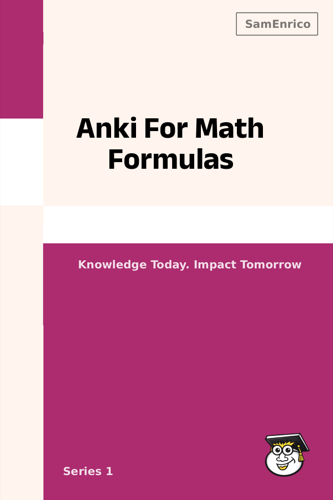
Anki For Math Formulas eBook
Remembers equations with practice.
Remembers equations with practice.
Formats
Free sample
Chapter 1: The 3 AM Panic--–- The fluorescent lights of the all-night study lounge buzzed overhead, casting that sickly green glow that makes everyone look like a zombie. Sarah, a third-year engineering student, stared at her blank exam practice sheet. The formula she had reviewed just two hours ago—the one she had highlighted, rewritten, and repeated like a prayer—had vanished. Not blurred. Not fuzzy.
Gone. Completely and utterly erased from her working memory as if someone had taken an intellectual eraser to her brain.She knew the concept. She understood the derivation. She had even explained it to her study partner earlier that evening. But now, facing a cold problem with no hints, no textbook, and no formula sheet, her mind was a white wall of silence.
The quadratic formula? She could picture where it lived on the page—top right corner, near the coffee stain—but the symbols themselves refused to materialize.This is not a failure of intelligence. It is not a lack of effort. It is a failure of retrieval architecture—and it is the single most common reason that capable students fail math exams.The Illusion of Competence Every student has experienced this paradox: you read a chapter, understand every word, follow every derivation, and close the book feeling confident. Forty-eight hours later, you cannot recall the central equation.
What happened?The answer lies in a cognitive trap called the Illusion of Competence. When you re-read a derivation or watch a professor work through a problem, your brain experiences a small dopamine hit of recognition. "Yes," your neurons fire, "I have seen this before. I know this." But recognition is not recall. Recognizing a formula on a page is like recognizing a celebrity on television—you know their face, but you could not describe them to a police sketch artist.Active Recall is the opposite.
It forces your brain to generate the information from scratch, with no visual cues, no multiple-choice options, no partial credit. This is the difference between passive familiarity and genuine mastery.Consider this experiment from cognitive psychology (Roediger & Karpicke, 2006): students who studied a passage four times scored lower on a retention test one week later than students who studied the passage once and were tested on it three times. The act of pulling information out strengthens the neural pathway far more than the act of putting information in.Yet nearly all math students default to the least effective method: they read, they watch, they highlight, they re-read. They mistake the comfort of repetition for the durability of memory. And then, at 3 AM, they panic.Why Math Formulas Are Different from Vocabulary You might have used Anki or other flashcards for language learning before.
Memorizing "casa = house" in Spanish is relatively straightforward because the word has sensory grounding—you can picture a house, smell coffee brewing inside, hear the creak of the front door. Vocabulary lives in a web of associations.Math formulas live in isolation.Consider the formula for the circumference of a circle: C=2πr C = 2\pi r C=2πr. There is no narrative. No color. No emotion.
Just a sequence of symbols: C, equals, two, pi, r. Your brain was not evolutionarily designed to remember arbitrary symbol sequences. Our ancestors needed to remember which berries were poisonous and which path led to water—not abstract relationships between Greek letters and radii.This is why traditional math studying fails so spectacularly. The very features that make math powerful (abstraction, generality, symbol density) also make it hostile to biological memory systems. You are asking your primate brain to do something it never evolved to do.The solution is not to fight your brain's architecture but to hack it.
You need to build artificial retrieval cues, force frequent low-stakes testing, and space your reviews precisely at the moment your memory begins to fade. This is what spaced repetition software (Anki) does—but only if you use it correctly for math, which is not the same as using it for languages.The Anatomy of a Math Memory To understand why you blank on exams, you need to understand how mathematical memory is structured. A formula is not a single memory—it is a constellation of four distinct components, each of which can fail independently.Component 1: The Symbol Sequence. This is the raw string of characters: ∫u dv=uv−∫v du\int u \, dv = uv - \int v \, du∫udv=uv−∫vdu. This is the most fragile component because symbols have no inherent meaning to your brain.Component 2: The Operational Meaning.
What does the formula do? Integration by parts transforms one integral into another. This is the "job description" of the formula.Component 3: The Conditions of Use. When do you apply this formula? Integration by parts requires a product of functions where one function becomes simpler when differentiated.
This is the "if-then" rule.Component 4: The Relationship to Other Formulas. How does this formula connect to the product rule for derivatives? To u-substitution? To tabular integration? This is the "web" component.Most students focus exclusively on Component 1.
They write the formula repeatedly, chant it like a mantra, and assume that if they can recite the symbols, they have mastered the formula. But an exam problem does not ask you to recite symbols. It presents a situation. You must recognize that Component 3 (conditions) applies, activate Component 2 (meaning), retrieve Component 1 (symbols), and place it within Component 4 (the web of related knowledge).When you "blank," it is rarely a failure of Component 1 alone. More often, you have failed to attach the symbol sequence to the conditions of use.
You know the quadratic formula but do not recognize when to apply it. You know the chain rule but cannot see the composite function hiding inside a problem.Formula Fluency: The Goal Throughout this book, we will use a specific term for the outcome we are building: Formula Fluency.Formula Fluency is the ability to retrieve a formula from memory as quickly and automatically as you recall your own name. It has four measurable characteristics:Speed: You can produce the formula within three seconds of being prompted (more on this in Chapter 7).Accuracy: You produce the exact symbol sequence with no sign errors, missing terms, or misplaced parentheses.Conditional Activation: The formula appears in your mind automatically when you encounter a problem that requires it—you do not have to "search" for it.Interference Resistance: Similar formulas (e.g., standard deviation vs. standard error) do not collide or contaminate each other in your memory.Formula Fluency is not understanding. Understanding is knowing why the formula works.
Fluency is knowing what it is, instantly, without conscious effort. You need both, but they require different training methods. Understanding comes from derivation and explanation (Chapter 5). Fluency comes from retrieval practice and spaced repetition (this chapter and beyond).Why does fluency matter for timed exams? Consider the cognitive load of solving a complex physics problem.
Your working memory can hold approximately four discrete chunks of information at once (Miller, 1956). If you have to derive or search for the formula for centripetal force, you have just consumed one or two of those precious chunks. You have less mental capacity remaining for the actual problem-solving…
This is the end of the free sample. Get the eBook to keep going. Buy now
About this book
Details
- Author
- Correia Eugena
- Publisher
- SamEnrico
- Language
- English
- Genre
- Non-Fiction, Self-Help, Mathematics
- Released
- 2026-06-05
- Pages (approx.)
- 116
- Available as
- eBook, Audiobook

Read better in the ZLOADR app
Your eBooks on your phone or tablet. Sign in with your SamEnrico account and start reading.
More by Correia Eugena
 Spouse Loss Music TherapyCorreia Eugena$11.99
 Copper Dream MeaningCorreia Eugena$11.99
 Self Hypnosis For Evening Wind Down GuideCorreia Eugena$11.99
 Lagos Pricing Pop Up StrategyCorreia Eugena$11.99
 Ayurvedic Season GuideCorreia Eugena$11.99
 Walking Meditation History GuideCorreia Eugena$11.99
 Kobe Yamaguchi Gumi SplitCorreia Eugena$11.99
 Interstitial Cystitis ReliefCorreia Eugena$11.99
 The Vanishing of Flight 195: The Bermuda Triangle's Last SecretCorreia Eugena$11.99
 The Cosmic Forge: How the Dogon People Shaped the SkyCorreia Eugena$11.99
 Whispers in the Wisteria: The Cursed Shrine of AoiCorreia Eugena$11.99
 The Complete Guide to Eat, Drink, Be HealthyCorreia Eugena$11.99
You may also like
 Math Pattern RecognitionMull Lulu$11.99
 Dreaming for Math ProblemsOhara Louie$11.99
 Math Formula PalaceKarr Krysta$11.99
 Benzo Taper Calculator WorkbookNickel Kirstie$11.99
 Pattern Recognition in MathLea Gwenn$11.99
 Memory Palace For MathematicsSinger Cristine$11.99
 Math SRS Card DesignMarch Digna$11.99
 Math Formula Memory GuideAcevedo Francesca$11.99