
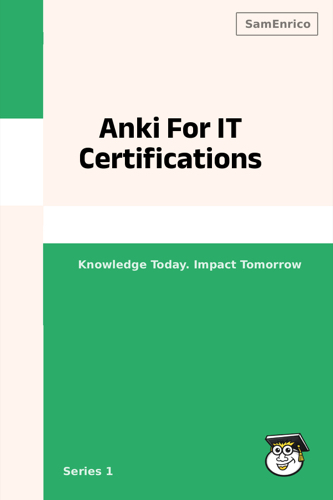
Non-FictionSelf-HelpStudy Skills
Anki For IT Certifications eBook
Drill CompTIA, AWS, and Cisco exam topics with SRS
by Box Wendi
Drill CompTIA, AWS, and Cisco exam topics with SRS.
Formats
Free sample
Chapter 1: The 30-Day Trap--–- The email arrived at 11:47 PM on a Sunday. Jason, a network administrator with seven years of experience, had just finished his third practice exam for the CCNA. His score: 812. The passing score: 825. He was three questions away.
Three questions about OSPF network types, administrative distances, and the difference between an extended ACL and a standard one — topics he had aced in his study guide just four weeks earlier. He had highlighted those pages. He had watched the video lectures twice. He had even built the labs in Packet Tracer. But now, staring at the practice questions, the answers felt like they were buried under six weeks of other priorities, tickets, on-call rotations, and a vacation where he didn't touch a single flashcard.
Jason closed his laptop, opened his phone, and scrolled social media for an hour instead of studying. He did not know it yet, but he had just walked into the 30-day trap.The 30-day trap is the single greatest reason IT professionals fail certification exams on their first attempt. It is not lack of intelligence. It is not lack of effort. It is not even lack of understanding at the time of study.
The 30-day trap is a predictable, measurable, and scientifically inevitable collapse of memory that happens when technical knowledge is not reinforced within a specific window of time. And if you are reading this book, you have already fallen into this trap at least once. You just did not have a name for it until now.This chapter exists to give you that name and, more importantly, to show you exactly how the trap works so you can avoid it forever. We will explore the forgetting curve, why IT knowledge decays faster than almost any other type of learning, the difference between brain dumping and brain architecture, real stories of expensive mistakes caused by forgetting, and finally, the introduction of the solution that the rest of this book will teach you to wield: Spaced Repetition Systems (SRS). By the end of this chapter, you will understand why your current study methods are failing and why a different approach is not just better but necessary.The Science of Forgetting Technical Knowledge Hermann Ebbinghaus, a German psychologist, published his groundbreaking work on memory in 1885.
He did not have IT certifications in mind — he memorized nonsense syllables like "ZOF" and "WUX" to study pure memory decay without the interference of meaning. What he discovered has been replicated hundreds of times across every domain of learning: humans forget exponentially. Within one hour of learning something new, you forget approximately 50 percent of it. Within 24 hours, that number climbs to 70 percent. Within one week, unless you review the material, you retain less than 25 percent of what you originally learned.Now apply this to IT certification study.
You spend a weekend mastering subnetting. You understand VLSM. You can calculate CIDR ranges in your sleep. Then you spend the next week working on a project involving cloud migrations, then a long weekend away from studying, then two evenings dedicated to reviewing a different domain like security controls. By day ten, your subnetting knowledge has decayed to approximately 30 percent of its peak.
By day twenty, you recognize the terms but cannot perform the calculations. By day thirty, you stare at a question asking for the valid host range of 192.168.1.96/27 and feel like you have never seen subnetting before in your life.This is not a character flaw. This is biology. Your brain is optimized to discard information it does not use regularly because keeping everything would be metabolically expensive. Your brain does not know that you have an exam scheduled for six weeks from now.
Your brain only knows that you have not used OSPF metrics in the last fourteen days, so it starts pruning those neural connections to make room for the information you actually use — like how to resolve a printer jam or where the team keeps the spare cables.But here is what makes IT certification knowledge uniquely vulnerable to the forgetting curve compared to other types of learning. Consider a chef learning a new recipe. They taste the dish, smell the spices, feel the texture of the dough. Multiple sensory inputs anchor the memory. Consider a musician learning a song.
They hear the melody, feel the finger positions on the instrument, see the sheet music. Multiple pathways reinforce retention. Now consider you learning the difference between a distance vector routing protocol and a link state routing protocol. You read text on a page. Maybe you watch a diagram.
That is it. One sensory pathway. No taste, no smell, no sound, no tactile feedback beyond the weight of your laptop. Your brain has very little to grab onto, so it lets go quickly.This is the first brutal truth of IT certification study: you are trying to memorize abstract, arbitrary, highly detailed information with almost no sensory hooks, and your brain is actively working against you.Brain Dump versus Brain Architecture There are two fundamentally different approaches to preparing for an IT certification exam. Most candidates use the first.
Almost all successful candidates eventually learn the second. Understanding the difference is the difference between passing on your first attempt and paying for a retake.Brain dumping is the approach you already know. You read a chapter in the official study guide. You highlight key terms. You watch a video lecture.
You take a practice exam. You note your weak areas. You re-read those chapters. You take another practice exam. This cycle continues until the night before the exam, when you stay up late cramming the facts that will not stick.
You walk into the testing center with a head full of recently reviewed information, much of which you did not know 24 hours earlier. You take the exam. You pass, or you fail by a narrow margin. And then, within two weeks, almost everything you crammed is gone. You could not pass that same exam again if someone paid you.Brain dumping treats memory like a bucket you fill before the exam and empty afterward.
It prioritizes short-term performance over long-term retention. It works for some people some of the time, but it is fragile. One bad night of sleep, one domain that you did not review in the last 72 hours, one tricky question that requires you to apply knowledge rather than recognize it — and the whole structure collapses.Brain architecture is the opposite. Brain architecture treats memory like a building you construct over time, one brick at a time, with reinforcement at every stage. You do not cram.
You do not re-read chapters the night before. Instead, you systematically review information at increasing intervals, forcing your brain to strengthen the neural pathways each time you successfully recall a fact. The information becomes durable. It becomes retrievable under stress. It stays with you for months and years, not days and weeks.The difference between these two approaches is not subtle.
Brain dumping asks: "Can I recognize this fact when I see it?" Brain architecture asks: "Can I retrieve this fact from nothing?" Brain dumping optimizes for the practice exam format. Brain architecture optimizes for the real exam and…
This is the end of the free sample. Get the eBook to keep going. Buy now
About this book
Details
- Author
- Box Wendi
- Publisher
- SamEnrico
- Language
- English
- Genre
- Non-Fiction, Self-Help, Study Skills
- Released
- 2026-06-08
- Pages (approx.)
- 133
- Available as
- eBook, Audiobook

Read better in the ZLOADR app
Your eBooks on your phone or tablet. Sign in with your SamEnrico account and start reading.
More by Box Wendi
 Todoist Advanced ProjectsBox Wendi$11.99
 Sinai Desert Exodus RouteBox Wendi$11.99
 Alcohol Recovery First Steps GuideBox Wendi$11.99
 Intrapreneurship GuideBox Wendi$11.99
 The Financial Stress and EducationBox Wendi$11.99
 Sunday Planning RitualsBox Wendi$11.99
 Meditation for Migraine ReliefBox Wendi$11.99
 The Fearless Voyages of Henry Hudson: Charting the New WorldBox Wendi$11.99
 Kush vs. Egypt: The Rise of a Black Pharaoh (747-656 BC)Box Wendi$11.99
 How to Produce an Ettridge CollectionBox Wendi$11.99
 White Cabbage: Head SolidnessBox Wendi$11.99
 The Essential Guide to Reggaeton Y Hip-hopBox Wendi$11.99
You may also like
 Hong Kong Handover 1997Dunn Johnnie$11.99
 Zumba For Postnatal Recovery CourseNeal Christian$11.99
 Zumba for BeginnersLadner Nikia$11.99
 YouTube Comment Mining GuideHumes Pandora$12.99
 Worry Box MeditationCarlin Rudy$11.99
 Workplace Stress MeditationNguyen Lynn$11.99
 Workplace Stress and Sleep RepairHawley Ivory$11.99
 Workplace Perfectionism CureDelaney Jeffry$11.99
 Workplace Injustice Anger GuideWallen Isabelle$11.99
 Work Addiction and Burnout LinkGreenwood Ester$11.99
 Women in Yoga and WellnessBeattie Galina$11.99
 Women in Stand Up ComedyChun Evangeline$11.99