
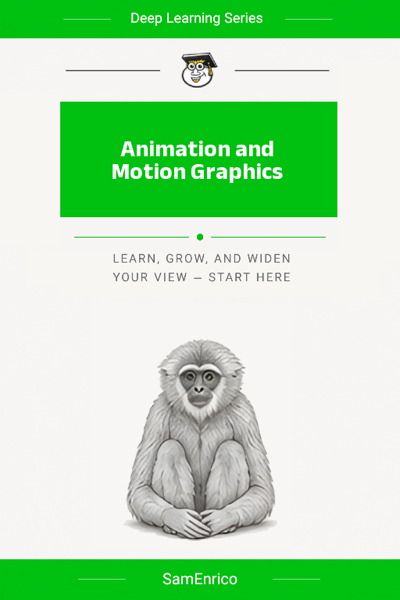
Animation and Motion Graphics
A Coursebook on Animation and Motion Graphics
by Beam Iesha
A Coursebook on Animation and Motion Graphics
Formats
About this book
Free sample
Chapter 1: The Living Frame...--–- Every image you have ever seen move on a screen—from a bouncing logo on a smartphone to a soaring dragon in a cinema—was born from a single, deceptively simple question: How do we make the still image breathe? The answer, you will discover, has almost nothing to do with software and everything to do with vision. Before you click a single keyframe, before you install a single plugin, you must first understand that animation and motion graphics are not two separate disciplines. They are a continuum of the same ancient human impulse: to imbue the static with life. This book will not teach you to chase technical trends.
It will teach you to see the world through the eyes of an animator—to perceive weight where others see shape, to feel rhythm where others hear noise, and to construct narrative where others assemble only decoration. Chapter 1 is your foundation. Here, we abandon the myth that motion graphics is a “simpler cousin” of character animation. We will travel from the caves of Lascaux to the title sequences of Saul Bass, from the twelve principles of Disney’s Nine Old Men to the digital canvases of contemporary motion design. By the end of this chapter, you will understand a truth that separates professionals from amateurs: great motion graphics are not moving design.
They are animated storytelling.1.1 The Common Origin: From Cave Paintings to Cinemagraphs Long before pixels or celluloid, human beings chased motion. The prehistoric cave paintings of Lascaux, dating back over 17,000 years, often feature animals with multiple sets of legs—a primitive attempt to suggest movement across time. A bison drawn with eight legs was not a mistake; it was an early storyboard. The Greeks painted sequential figures on pottery. Medieval monks doodled marginalia that seemed to flicker when pages were turned rapidly.
The thaumatrope (1824), a disk with a bird on one side and a cage on the other, revealed that the human eye retains an image for a fraction of a second after it disappears. This phenomenon—persistence of vision—became the biological…
This is the end of the free sample. Get the eBook to keep going. Buy now
Contents
- Chapter 1
- Chapter 2
- Chapter 3
- Chapter 4
- Chapter 5
- Chapter 6
- Chapter 7
- Chapter 8
- Chapter 9
- Chapter 10
- Chapter 11
- Chapter 12
Details
- Author
- Beam Iesha
- Publisher
- SamEnrico
- Language
- English
- Genre
- Non-Fiction, Informative, Educational
- Released
- 2026-06-03
- Pages (approx.)
- 149
- Available as
- eBook, Audiobook

Read better in the ZLOADR app
Your eBooks on your phone or tablet. Sign in with your SamEnrico account and start reading.
More by Beam Iesha
 Body Scan For ParkinsonsBeam Iesha$11.99
 Self Esteem From Diet Culture Recovery GuideBeam Iesha$11.99
 Grief Counselor Vicarious StressBeam Iesha$11.99
 Social Work Compassion FatigueBeam Iesha$11.99
 Cognitive Dissonance RageBeam Iesha$11.99
 Alaska Brooks Range PackraftBeam Iesha$11.99
 Creative Comparison TrapBeam Iesha$11.99
 Test Anxiety Reduction TechniquesBeam Iesha$11.99
 Dunkin' Donuts and Deion Sanders: The Underdog Endorsement That Changed Sports MarketingBeam Iesha$11.99
 Raven's Gambit: Loki’s Double Game in Asgard’s ShadowsBeam Iesha$11.99
 Returning Home After Chinese StudiesBeam Iesha$12.99
 Gulf B2B Cold Email That WorksBeam Iesha$12.99