
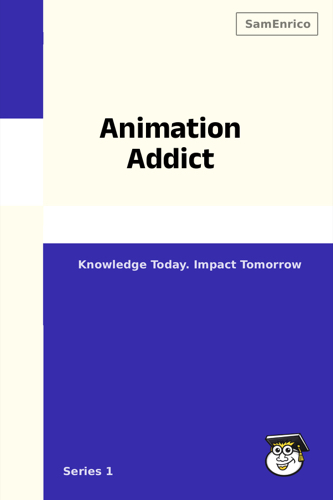
Animation Addict eBook
A voice actor's lifelong obsession with cartoons t
A voice actor's lifelong obsession with cartoons that turned into an unlikely career.
Formats
Free sample
Chapter 1: The Saturday Morning Sanctuary...--–- The smell was always the same. Sugary cereal—Froot Loops, specifically—mixed with the electric warmth of a CRT television warming up. That specific scent of heated dust and ionized air. Saturday morning, 1987. I was seven years old, and I was already an addict.I just didn't know it yet.The television was my altar.
The carpet was my pew. And the cartoons—those sacred, looping rituals of color and sound—were my scripture. Every Saturday, without fail, I would wake before my parents, creep down the stairs in my pajamas, pour a bowl of cereal that was mostly sugar, and plant myself exactly four feet from the screen. Not closer—my mother had warned me about my eyes. Not farther—I needed to see the details.
The brush strokes on the backgrounds. The sweat droplets on a character's brow. The way a mouth shape held for one frame longer than it should, betraying the human hand behind the illusion.I was not a normal child.Normal children watched cartoons. I studied them. There is a difference, and that difference is the subject of this entire book.The Escape Artist Let me tell you about the house I grew up in.
Not because I want your pity—pity is useless to a voice actor, by the way; you learn to transmute it into fuel—but because context matters. My parents fought. Not the occasional raised voices that every family has. I mean the kind of fighting that made the walls feel thin and the air feel thick. The kind where you learn to read footstep patterns to know if it's safe to leave your room.
The kind where you develop a superpower: the ability to make yourself small, quiet, invisible.Cartoons were my antidote to that.When Bugs Bunny outwitted Elmer Fudd, the world made sense. When the Teenage Mutant Ninja Turtles defeated Shredder, justice prevailed. When Optimus Prime gave his heroic speech before dying—and yes, I watched that episode live, and yes, I sobbed—there was meaning. Structure. A beginning, a middle, and an end that resolved into something like hope.Real life didn't have those things.
Real life was messy and loud and unpredictable. But cartoons? Cartoons followed rules. The hero always got up. The villain always monologued.
The laugh track always came at the right moment. For two hours every Saturday morning, I could breathe.I started recording episodes on VHS tapes when I was eight. Not because I wanted to watch them later—though I did—but because I wanted to watch them again. And again. And again.
I would rewind a single scene ten, fifteen, twenty times. My mother thought I was broken. My father thought I was wasting time. Neither of them asked what I was looking for.I was looking for the breath.The Anatomy of a Laugh Here's something most people never notice: cartoon characters breathe. Not in the literal, biological sense—they're drawings.
But the actors who voice them? They breathe. And if you listen closely enough, you can hear where the breath happens. Before a punchline. After a scream.
In the middle of a sentence, when a character is scared or in love or lying.I started cataloging breaths when I was nine.I had a notebook—a spiral-bound thing with a torn cover—and I would write down observations about the cartoons I watched. Not plot summaries. Not character names. Vocal data. Things like:"Bugs Bunny's laugh always starts on an exhale.
He breathes in, then lets the 'ehhh' ride the breath out. It sounds effortless because it is.""Megatron never breathes before a threat. He just starts talking, full volume, no warning. That's why he's scary.""When Gadget Hackwrench gets nervous, she takes three quick inhales before speaking. It makes her sound smaller than she is."I didn't know the terminology.
I had never heard of "vocal placement" or "breath support" or "diaphragmatic engagement." I was a child with a VCR and an obsession. But I was training myself to hear what others missed. I was becoming a deconstructive listener before I knew the word for it.This is the first and most important skill a voice actor can develop. Not a good mic. Not a fancy demo reel.
Not connections in Los Angeles. The ability to hear—really hear—what a voice is doing. To break it down into its component parts. To understand, on a cellular level, why one performance makes you laugh and another makes you cry and a third makes you change the channel.The Silent Test When I was ten, I invented a game. I called it "The Silent Test," though I never told anyone about it.
The rules were simple: I would watch an episode of a cartoon with the sound completely off. No dialogue. No music. No sound effects. Just the pictures.Then I would guess the emotional beats.Where was the pause?
Where was the scream? Where did the character's mouth hang open for an extra beat, signaling shock? Where did the eyes widen before the voice cracked?After I made my guesses, I would rewind and watch the same episode with the sound on. And I would grade myself. Did I predict the laugh?
Did I sense the gasp? Was I right about the moment of hesitation before the lie?At first, I was terrible. Maybe thirty percent accuracy. But over months, as I trained my ear to read visual cues as vocal maps, I got better. Fifty percent.
Sixty. Seventy. By the time I was eleven, I could watch a mute cartoon and predict, with unsettling accuracy, exactly where the vocal beats would land.I didn't know it then, but I was learning to think like a voice actor. Not a fan. Not a critic.
An artist. I was learning to reverse-engineer performance.The First Crack in the Wall There was a specific moment when I realized that my obsession might be something more than a hobby. I was twelve. The show was Batman: The Animated Series. The episode was "Heart of Ice," the one that redefined Mr.
Freeze from a joke villain into a tragic figure. If you haven't seen it, stop reading this chapter and go watch it. I'll wait.Back? Good.There's a scene near the end where Mr. Freeze—voiced by the incomparable Michael Ansara—delivers a monologue about his wife, Nora.
He says: "Think of it, Batman. To never again feel the warmth of the sun. To never again taste a ripe peach. To never again know love."I must have watched that scene forty times.But here's the thing I noticed on the fortieth viewing that I missed on the first thirty-nine: the breath before "love." Ansara takes a half-second inhale—barely audible, almost subliminal—and then lets the word out on a sigh. It's not a performance of sadness.
It's sadness itself, distilled into sound.I rewound that breath. Played it again. Again. Again.And then, for the first time in my life, I tried to copy it.I stood in front of my bedroom mirror—the same mirror where I practiced my school presentation faces, my…
This is the end of the free sample. Get the eBook to keep going. Buy now
About this book
Details
- Author
- Loera Shawnda
- Publisher
- SamEnrico
- Language
- English
- Genre
- Non-Fiction, Biography, Fandom
- Released
- 2026-06-11
- Pages (approx.)
- 118
- Available as
- eBook, Audiobook

Read better in the ZLOADR app
Your eBooks on your phone or tablet. Sign in with your SamEnrico account and start reading.
More by Loera Shawnda
 Foreign Language Learning Stress GuideLoera Shawnda$11.99
 Asset Allocation Retirement GuideLoera Shawnda$11.99
 Tailgating Trigger Management GuideLoera Shawnda$11.99
 Loving Kindness for Nurse ExhaustionLoera Shawnda$11.99
 Mozart: The Divine Fire of ViennaLoera Shawnda$11.99
 Understanding Neuhauser–daly–magnelli SyndromeLoera Shawnda$17.99
 Excel Economics VisualizerLoera Shawnda$12.99
 Kohl's SWOT LibraryLoera Shawnda$12.99
 Indirect TaxLoera Shawnda$11.99
 How to Become a Lay-out TechnicianLoera Shawnda$11.99
You may also like
 Hong Kong Handover 1997Dunn Johnnie$11.99
 Zumba For Postnatal Recovery CourseNeal Christian$11.99
 Zumba for BeginnersLadner Nikia$11.99
 YouTube Comment Mining GuideHumes Pandora$12.99
 Worry Box MeditationCarlin Rudy$11.99
 Workplace Stress MeditationNguyen Lynn$11.99
 Workplace Stress and Sleep RepairHawley Ivory$11.99
 Workplace Perfectionism CureDelaney Jeffry$11.99
 Workplace Injustice Anger GuideWallen Isabelle$11.99
 Work Addiction and Burnout LinkGreenwood Ester$11.99
 Women in Yoga and WellnessBeattie Galina$11.99
 Women in Stand Up ComedyChun Evangeline$11.99