
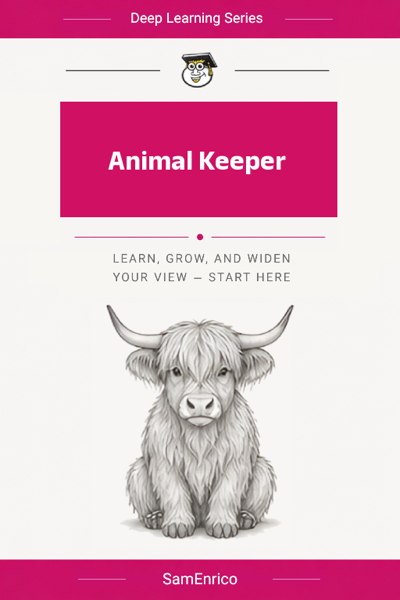
Non-FictionInformativeEducational
Animal Keeper eBook
A Coursebook on Animal Keeper
A Coursebook on Animal Keeper
Formats
Free sample
Chapter 1: The Silent Contract--There is a moment, early in every keeper’s education, when the animal looks at you differently.Not with fear. Not with hunger. Not with the blank indifference of a creature who has learned that humans are unpredictable and best ignored. Differently.I remember mine. It was a twenty-three-year-old quarter horse named Dusty, retired from a lifetime of trail rides and children’s lessons, arthritic and half-blind, living out his final years in a pasture I was responsible for.
I had been feeding him for six months before it happened. Every morning at six, I brought his grain. Every morning, he stood at the gate, ears forward, waiting. That was the transaction.But one morning, I was late. A flat tire, a dead phone, a string of ordinary disasters.
I arrived at seven-fifteen, and Dusty was not at the gate. He was standing in the middle of the pasture, head lowered, facing the direction I always came from. He had been standing there for over an hour.When he heard my truck, he lifted his head. He did not walk to the gate. He just stood there, watching me approach.
I poured his grain, apologized pointlessly, and waited for him to eat. He did not eat. He walked to me—slowly, painfully, each step a small negotiation with his arthritic hips—and pressed his forehead against my chest.That was the moment. Not the grain. Not the routine.
The choice. He had chosen to approach me when he did not have to. He had chosen to make contact when there was no transaction to complete. He had decided, for reasons I will never fully understand, that I was safe.That is the silent contract. You do not sign it.
You do not negotiate it. You earn it, one day at a time, and the animal is the only one who knows when it has been sealed.This book is about earning that contract. And keeping it.What This Chapter Is Not Before we go any further, let me be clear about what this chapter is not. It is not a history of domestication, though that story matters and we will touch on it. It is not a philosophical treatise on animal rights, though that debate has its place.
It is not a series of warm anecdotes designed to make you feel good about your decision to keep animals, though I have told you one already and will probably tell you more.This chapter is an orientation. It is the map you fold into your pocket before you walk into the barn for the first time. It tells you where the traps are, where the tools are stored, and what the terrain looks like when you are lost.If you are a beginner, read this chapter twice. If you are experienced, read it once, but read it honestly. Ask yourself: have I been keeping animals, or have I been going through the motions?The Four Kinds of Keepers In my years of training animal keepers—at shelters, on farms, in zoos, and in private homes—I have noticed that people fall into four broad categories.
You may recognize yourself in one of them. You may move between them over time. But understanding where you are now is the first step toward becoming what you want to be.The Accidental Keeper. You did not plan this. A child begged for a puppy.
A neighbor needed to rehome a goat. A chicken showed up in your backyard and never left. You are doing your best, but you are constantly surprised by how much you do not know. You feel guilty about what you missed yesterday and anxious about what you might miss tomorrow.The Inherited Keeper. You grew up with animals.
Your parents kept them, your grandparents kept them, and you never questioned that you would do the same. You know the routines by heart: when to feed, when to breed, when to call the vet. But you have never asked why you do things a certain way. The answer, when you ask, is usually “because that’s how we’ve always done it.”The Mission-Driven Keeper. You have a purpose.
You rescue animals from bad situations. You breed working dogs for a specific job. You raise livestock to feed your family. You are highly motivated and often well-informed about your specific area. But your focus can become tunnel vision.
You may miss the animal’s experience because you are so focused on the outcome.The Professional Keeper. You have training, experience, and a paycheck. You may be a zookeeper, a veterinary technician, a farm manager, or a sanctuary director. You understand the science and the ethics. Your weakness is not knowledge but fatigue.
You have seen so much suffering, so much incompetence, so many emergencies, that you have built walls to protect yourself. The walls keep out the pain. They also keep out the joy.Every one of these keepers can become a great keeper. Every one can also fail. The difference is not the category.
It is the willingness to ask the question that makes everyone uncomfortable:Am I doing this for the animal, or for myself?The Question That Changes Everything Let me be specific. When you choose to keep an animal—whether that animal is a dairy cow, a backyard chicken, a shelter dog, or a zoo elephant—you are making a series of decisions that will determine every moment of that animal’s life. What it eats. Where it sleeps. Whether it feels pain.
Whether it experiences joy. Whether it dies slowly or quickly, alone or surrounded by its own kind.Those decisions are yours. Not the animal’s. Yours.That is a staggering amount of power. And power, as every keeper learns, corrupts when it is not examined.I am not suggesting that you are a tyrant.
Most animal keepers are kind, well-intentioned people who would never deliberately harm a creature in their care. But kindness without knowledge is not kindness. It is sentimentality. And sentimentality has a body count.I have seen a well-meaning woman feed her horse so many apples that it foundered and had to be euthanized. I have seen a well-meaning man build a “cozy” chicken coop with no ventilation, then wonder why half his flock died of respiratory disease.
I have seen a well-meaning rescue organization take in fifty dogs with no quarantine protocol, then watch distemper sweep through the building like a scythe.These were not bad people. They were people who loved animals and did not know what they did not know. They never asked the hard question. They never said, “Wait. What if I am wrong?”So let me ask you now, before we go any further.
What if you are wrong about something? What if the way you feed your animals is slowly harming them? What if the way you house them is causing chronic stress? What if the way you handle them is teaching fear instead of trust?If those questions make you defensive, this book will be difficult for you. If they make you curious, you are exactly where you need to be.The Myth…
This is the end of the free sample. Get the eBook to keep going. Buy now
About this book
Details
- Author
- Dewitt Cecile
- Publisher
- SamEnrico
- Language
- English
- Genre
- Non-Fiction, Informative, Educational
- Released
- 2026-05-25
- Pages (approx.)
- 156
- Available as
- eBook, Audiobook

Read better in the ZLOADR app
Your eBooks on your phone or tablet. Sign in with your SamEnrico account and start reading.
More by Dewitt Cecile
 Cloud Watching MeditationDewitt Cecile$11.99
 The Assertiveness for Hygienists GuideDewitt Cecile$11.99
 The Police Pullover ProtocolDewitt Cecile$11.99
 Divorce and Addiction RecoveryDewitt Cecile$11.99
 The Hungarian Reformation GuideDewitt Cecile$11.99
 The Healers of Meroë: Africa's Forgotten Medical RevolutionariesDewitt Cecile$11.99
 Understanding Pierre Robin's SequenceDewitt Cecile$17.99
 How to Start a Check Strap Made of Leather Business (Beginners Guide)Dewitt Cecile$11.99
 VA Performance Review TemplateDewitt Cecile$12.99
 JEE Memory Techniques HandbookDewitt Cecile$12.99
You may also like
 Hong Kong Handover 1997Dunn Johnnie$11.99
 Zumba For Postnatal Recovery CourseNeal Christian$11.99
 Zumba for BeginnersLadner Nikia$11.99
 YouTube Comment Mining GuideHumes Pandora$12.99
 Worry Box MeditationCarlin Rudy$11.99
 Workplace Stress MeditationNguyen Lynn$11.99
 Workplace Stress and Sleep RepairHawley Ivory$11.99
 Workplace Perfectionism CureDelaney Jeffry$11.99
 Workplace Injustice Anger GuideWallen Isabelle$11.99
 Work Addiction and Burnout LinkGreenwood Ester$11.99
 Women in Yoga and WellnessBeattie Galina$11.99
 Women in Stand Up ComedyChun Evangeline$11.99