
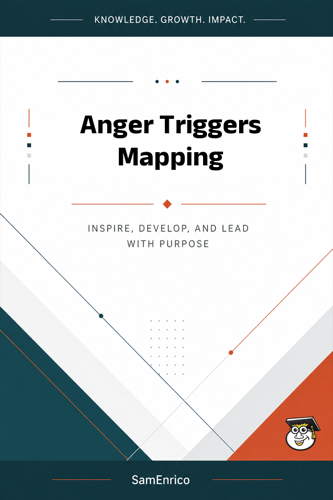
Anger Triggers Mapping eBook
Identify and track specific events that spark your
Identify and track specific events that spark your relationship rage.
Formats
Free sample
Chapter 1: The Check Engine Light--–- The coffee mug shattered against the kitchen wall at 7:43 on a Tuesday morning. The crime? Your partner forgot to buy milk. The punishment? A $12 ceramic mug, three days of silent treatment, and one more crack in a foundation you swore was unshakeable.
You stood there, breathing hard, pieces of pottery scattered across the tile, and thought the same thing millions of people think every single day: Where did that come from? That wasn't me.But it was you. And it will be you again unless you learn to read the warning signs before the explosion.Welcome to the first chapter of Anger Triggers Mapping. Before we talk about tools, worksheets, or any of the practical strategies that fill the pages ahead, we need to have an honest conversation about what anger actually is, what it costs you, and why everything you think you know about your rage is probably wrong.The Real Price of a Snap Let's start with a hard truth. That coffee mug cost you twelve dollars.
But the real price of that snap was incalculably higher.Research published in the Journal of Cardiovascular Nursing found that individuals who experience frequent, uncontrolled anger outbursts have a significantly higher risk of hypertension, heart attack, and stroke. Dr. Redford Williams, a leading researcher in anger and health at Duke University, has shown that hostility and explosive anger are among the strongest behavioral predictors of early mortality—stronger than smoking, obesity, or high cholesterol in some populations. When you explode, your body floods with cortisol and adrenaline. Your heart rate spikes.
Your blood vessels constrict. Your immune system temporarily shuts down. Over time, these micro-storms leave scar tissue on your arteries and exhaustion in your nervous system.But the physiological cost is only the beginning.Every explosion erodes trust. Every sarcastic comment deposits a tiny grain of resentment. Every silent treatment builds a wall that will take ten times longer to tear down than it took to build.
Dr. John Gottman, whose research on relationship stability is unparalleled, identified contempt—the language of rage—as the single strongest predictor of divorce. Not disagreement. Not financial stress. Not even infidelity.
Contempt. The dismissive, angry, "you are beneath me" tone that comes so easily in the heat of a snap.Consider the math of relationship damage. One moment of rage—thirty seconds, maybe two minutes—can undo weeks or months of goodwill. Psychologists call this the negativity bias: negative interactions carry five times more weight than positive ones. That means one angry outburst requires five loving gestures to be forgotten.
But they are never truly forgotten. They are stored in what relationship researchers call the emotional bank account, and each snap is a massive withdrawal.So here is the question this entire book exists to answer: What if you could see the snap coming? What if you could track the specific events, thoughts, and physical sensations that precede your explosions with the same precision a meteorologist tracks a storm? What if anger was not your enemy but a highly imperfect messenger trying to tell you something important about your unmet needs and violated boundaries?That is the promise of trigger mapping.What This Book Is (And What It Is Not)Before we go any further, I need to be completely transparent about what you are holding.Anger Triggers Mapping is not a book about "just breathe" or "count to ten." Those techniques have their place, and we will discuss them in Chapter 8 when we talk about emergency cooling strategies. But they are bandages, not cures.
They stop the bleeding without healing the wound. This book is about finding the wound.This book is not therapy. I am a writer and researcher who has synthesized the best available evidence from cognitive behavioral therapy, trauma-informed care, relationship science, and clinical anger management programs. The tools in these pages have helped thousands of people. But if you are in an abusive relationship, if you have caused physical harm to a partner or child, or if your rage is accompanied by suicidal thoughts or violence, please put this book down and seek professional help immediately.
The National Domestic Violence Hotline (800-799-7233) is available 24 hours a day. These tools are for people in safe relationships who want to stop hurting the people they love—not for situations where safety is already compromised.This book focuses on your half of the dynamic. That is an uncomfortable truth, and I want you to sit with it for a moment. Most people who struggle with rage want to talk about what their partner did wrong. "If they would just listen." "If they would just remember." "If they would just stop doing that thing." I understand that impulse completely.
It is much easier to analyze someone else's flaws than to sit with our own. But here is the reality: you cannot control your partner. You cannot map their triggers. You cannot change their behavior. The only person in this room you can change is the one reading these words.So yes, this book is one-sided.
Intentionally. Deliberately. Because until you understand your own internal machinery—your Rager Profile, your HALT+ state, your cognitive distortions, your early warning signals—no amount of couples therapy or communication技巧 will help. You will just learn more sophisticated ways to blame each other.A critical note for readers in difficult relationships: The tools in this book assume your partner is willing to engage in good faith. If your partner is abusive, controlling, or completely unwilling to acknowledge their own contributions to conflict, these tools will still help you regulate your own nervous system.
You will still benefit from understanding your triggers. But repair requires two willing people. Please do not use this book as a reason to stay in an unsafe situation. Your safety comes first.Now. Let us begin.Reframing Rage: From Moral Failing to Data Signal The single most important shift you will make in this entire book happens right here, in Chapter 1.Most people view anger as a character flaw.
When they snap, they tell themselves: I'm a bad person. I have no self-control. There's something wrong with me. That story, repeated enough times, becomes a self-fulfilling prophecy. You believe you cannot change, so you do not try.
Or you try for a few days, fail once, and conclude the whole effort was pointless.But what if anger was not a moral failing at all? What if it was simply data?Think about the last time you felt genuinely, righteously furious. Not the petty irritation of someone cutting you off in traffic. The deep, hot, blood-pumping rage that made you want to throw something or say something unforgivable. Now ask yourself: what was happening just before that feeling arrived?Almost certainly, you were experiencing one of three things:A boundary violation (someone took something from you, disrespected you, or ignored your needs)A threat to your safety or belonging (real or perceived rejection, abandonment, or criticism)An injustice (something that felt fundamentally unfair or wrong)Anger is not the problem.
Anger is the signal that one of these three things has occurred. It is your brain's alarm system, evolution's way…
This is the end of the free sample. Get the eBook to keep going. Buy now
About this book
Details
- Author
- Hebert Catrice
- Publisher
- SamEnrico
- Language
- English
- Genre
- Non-Fiction, Self-Help, Triggers
- Released
- 2026-06-06
- Pages (approx.)
- 156
- Available as
- eBook, Audiobook

Read better in the ZLOADR app
Your eBooks on your phone or tablet. Sign in with your SamEnrico account and start reading.
More by Hebert Catrice
 Secret Garden SanctuaryHebert Catrice$11.99
 Vitamin K Blood Clotting GuideHebert Catrice$11.99
 Psychedelic Medicine GuideHebert Catrice$11.99
 MBSR for Aging WellHebert Catrice$11.99
 The Construction Site Stress GuideHebert Catrice$11.99
 OCD and Eating DisordersHebert Catrice$11.99
 Emergeny Awakening ScriptsHebert Catrice$11.99
 Time Blocking WorkbookHebert Catrice$11.99
 The Day the Internet Stood Still: How a Single Tweet Broke the WebHebert Catrice$11.99
 Quetzalcoatl's Skybridge: The Feathered Serpent's Lost PyramidHebert Catrice$11.99
 Silent Siege: The Forgotten Stand at the Tehran EmbassyHebert Catrice$11.99
 The 101 Handbook: ConstructionHebert Catrice$11.99
You may also like
 Emotional Triggers WorkbookPalumbo Loria$11.99
 Seeing Other ChildrenHeard Anton$11.99
 The Triggered Parent GuideBerlin Dino$11.99
 The Parent Trigger IdentificationWilke Adam$11.99
 The Aggression Trigger GuideRounds Jetta$11.99
 The MBSR Stress Response WorkbookSchott Johnie$11.99
 Other People's PregnanciesBrunner Frances$11.99