
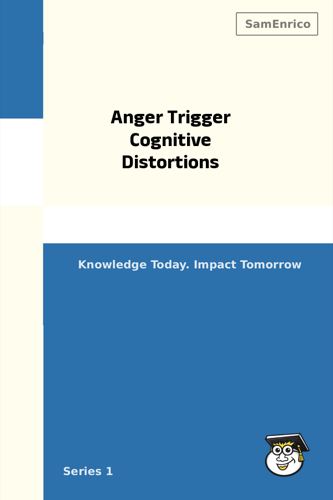
Anger Trigger Cognitive Distortions eBook
Identify thinking errors like catastrophizing or m
by Riddle Nena
Identify thinking errors like catastrophizing or mind reading that fuel anger.
Formats
Free sample
Chapter 1: The Ten Second Gap--–- The explosion does not begin with the shout. It does not begin with the slammed door, the clenched fist, the bitter text message sent at 2:00 AM. The explosion begins ten seconds earlier, in a space so small and so fast that most people never see it coming. That space—the ten seconds between the trigger and the reaction—is where this book lives. And inside that space, invisible and lightning-fast, a thought occurs.
Not a slow, deliberate thought. Not the kind of thinking you do when you are solving a math problem or planning a vacation. This thought is automatic, habitual, and deeply irrational. It is a cognitive distortion. And if you cannot see it, you cannot stop it.Every angry person on earth shares one thing in common: they believe their anger is justified.
No one ever yells at their child, flips off a driver, or storms out of a room thinking, "I am being completely unreasonable right now, but I am going to do it anyway." In the moment of anger, your brain presents you with a story that feels like absolute truth. The story goes something like this: "Something bad has happened. Someone has wronged me. This is unfair. I must react." That story arrives so quickly and so convincingly that you do not question it.
You simply act. And then, twenty minutes later, when your heart rate has returned to normal, you find yourself saying things like "I lost my temper" or "I overreacted" or "I don't know what came over me." But you did know what came over you. A distortion came over you. You just did not see it in time.This book is about learning to see it.The Anatomy of an Angry Moment Let us slow down the ten seconds. Imagine a man named David.
David is driving home from work. He has had a long day. He is tired, slightly hungry, and already thinking about the argument he will probably have with his wife about whose turn it is to make dinner. He is stopped at a red light. The light turns green.
David begins to move forward. At that exact moment, a car from the adjacent lane cuts sharply in front of him, forcing him to slam on his brakes. His coffee spills. His phone slides off the passenger seat onto the floor.What happens next?In the first second, David's body reacts before his mind does. His heart rate spikes.
His palms sweat. His jaw clenches. This is the amygdala—the brain's ancient alarm system—sounding a threat alert. Evolutionarily, this response was designed for predators. Today, it fires for bad drivers.In the second and third seconds, David's brain asks a single, silent question: "Was that intentional?" The answer to that question will determine everything that follows.
If David's brain concludes that the other driver simply made a mistake—that he did not see David, that he was distracted, that it was an accident—David will feel annoyed, perhaps, but not enraged. He might mutter "watch it" under his breath and move on. His heart rate will return to baseline within a minute.But if David's brain concludes that the other driver acted intentionally—that he saw David and cut him off anyway, that he did it on purpose, that he thinks he is better than David—then the third second ignites something entirely different. That conclusion is not a fact. It is an interpretation.
And that interpretation is almost certainly wrong. The other driver, who is a complete stranger, has no idea who David is. He did not cut David off because he thinks he is superior. He cut David off because he did not see him. But David's brain does not know that.
David's brain is doing what human brains evolved to do: it is detecting intent, and it is assuming the worst.In the fourth and fifth seconds, that assumption of malice generates a story. David's internal monologue begins: "Who does this guy think he is? He saw me. He knew I was there. He just doesn't care.
People are so selfish. I am sick of this. No one respects anyone anymore."Notice what just happened. A single ambiguous event—a car changing lanes—was transformed into evidence of a global character flaw in the other driver, a commentary on the state of society, and a personal attack on David himself. The event was small.
The story is enormous. And the story is almost entirely fabricated.In the sixth and seventh seconds, the emotion catches up to the story. David is no longer annoyed. He is furious. His body is now flooded with cortisol and adrenaline.
His prefrontal cortex—the part of the brain responsible for rational decision-making, impulse control, and considering consequences—is being starved of blood flow. The amygdala has taken command. David is, for all practical purposes, driving a two-ton vehicle while in a temporary state of neurological impairment.In the eighth and ninth seconds, David rolls down his window and screams something he will not remember ten minutes from now. He tailgates the other driver. He flashes his high beams.
He makes a hand gesture. He has now committed an act of road rage. And from the outside, it looks like he snapped. But he did not snap. He followed a predictable, step-by-step cognitive pathway that took less than ten seconds from trigger to explosion.In the tenth second, the other driver, who never even noticed David, turns onto a side street and disappears.
David is left alone in his car, heart pounding, hands shaking, angry at a ghost.This is the Ten Second Gap. It is the space between what happens to you and how you respond to it. And within that gap, the only thing that determines whether you will feel mild annoyance or explosive rage is the presence—or absence—of a cognitive distortion.What Is a Cognitive Distortion, Exactly?The term "cognitive distortion" sounds clinical because it is clinical. It comes from cognitive behavioral therapy, or CBT, the most scientifically validated form of psychotherapy for anger, anxiety, and depression. But do not let the term intimidate you.
A cognitive distortion is simply a thinking error. It is a systematic bias in the way your brain interprets information. It is not a sign of mental illness. It is not a character flaw. It is a feature of the human brain that every single person experiences.
The difference between someone who struggles with problem anger and someone who does not is not that one has distortions and the other does not. Everyone has distortions. The difference is that one has learned to recognize them in the Ten Second Gap, and the other has not.Cognitive distortions share three defining characteristics.First, they are automatic. They happen without your permission and without your awareness. You do not decide to have a distortion any more than you decide to have a nightmare.
They rise up from the deep, habitual pathways of your brain, shaped by years of repetition, often tracing back to childhood models of how anger was expressed in your family.Second, they are irrational.…
This is the end of the free sample. Get the eBook to keep going. Buy now
About this book
Details
- Author
- Riddle Nena
- Publisher
- SamEnrico
- Language
- English
- Genre
- Non-Fiction, Self-Help, CBT
- Released
- 2026-06-10
- Pages (approx.)
- 158
- Available as
- eBook, Audiobook

Read better in the ZLOADR app
Your eBooks on your phone or tablet. Sign in with your SamEnrico account and start reading.
More by Riddle Nena
 Financial Stress And Parental RageRiddle Nena$11.99
 Competitive Defense PlaybookRiddle Nena$11.99
 Pomodoro Technique Scheduling GuideRiddle Nena$11.99
 The Thunderbird's Wrath: How the Sky Warrior Shaped the Pacific NorthwestRiddle Nena$11.99The Thunderbird's Wrath: How the Sky Warrior Shaped the Pacific NorthwestRiddle Nena$11.99
 The Silk Road Code: How a 19th-Century Immigrant Built America’s First Tech EmpireRiddle Nena$11.99
 Channel Account ManagerRiddle Nena$11.99
 Telehealth International Expansion OutlookRiddle Nena$12.99
 Career Gap Resume Fix GuideRiddle Nena$12.99
 Understanding Hyperimmunoglobulinemia ERiddle Nena$17.99
 How to Become a Screwdown OperatorRiddle Nena$11.99
You may also like
 Hong Kong Handover 1997Dunn Johnnie$11.99
 Zumba For Postnatal Recovery CourseNeal Christian$11.99
 Zumba for BeginnersLadner Nikia$11.99
 YouTube Comment Mining GuideHumes Pandora$12.99
 Worry Box MeditationCarlin Rudy$11.99
 Workplace Stress MeditationNguyen Lynn$11.99
 Workplace Stress and Sleep RepairHawley Ivory$11.99
 Workplace Perfectionism CureDelaney Jeffry$11.99
 Workplace Injustice Anger GuideWallen Isabelle$11.99
 Work Addiction and Burnout LinkGreenwood Ester$11.99
 Women in Yoga and WellnessBeattie Galina$11.99
 Women in Stand Up ComedyChun Evangeline$11.99