
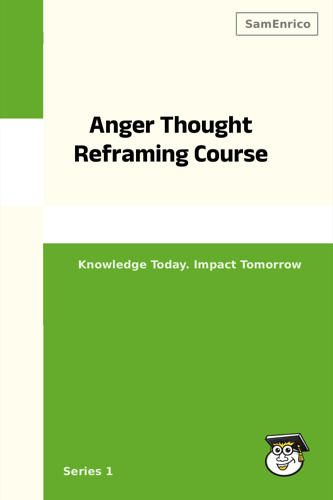
Anger Thought Reframing Course eBook
Replaces automatic angry interpretations with bala
Replaces automatic angry interpretations with balanced, rational alternatives.
Formats
Free sample
Chapter 1: The Caveman Inside--–- You are driving home after a long day. Traffic is crawling. You have been stopped at the same red light for what feels like an eternity. Then it happens. The driver behind you lays on the horn—a loud, aggressive blast that makes you jump.
Before you can even process what is happening, your hands tighten on the steering wheel. Your jaw clenches. Heat rushes up your neck and into your face. A voice in your head snarls: "Who does this guy think he is? What is his problem?" In that moment, you are not thinking about your family, your goals, or the fact that honking is not a crime.
You are not considering that the driver might be rushing to the hospital or simply made a mistake. You are ready for war. Over a horn.This is not a character flaw. This is not evidence that you are a bad person or that you lack self-control. This is your biology doing exactly what it evolved to do.
The problem is that your biology was designed for a world that no longer exists.Let me tell you about a man named David. David came to see me after what he called "the incident." He was a fifty-two-year-old accountant, mild-mannered by his own description, someone who had never been in a physical fight in his entire adult life. One evening, his teenage son left a wet towel on the bathroom floor for the third time that week. David walked past the bathroom, saw the towel, and something inside him broke. He screamed at his son—not just frustration but genuine rage, the kind that makes a sixteen-year-old boy flinch.
He threw the towel across the hallway. He punched the wall. Then he stood there, breathing hard, staring at his own fist-shaped dent in the drywall, and thought: "Who am I right now?"David was not a violent person. He was not abusive. He loved his son more than anything.
And yet, in that moment, a wet towel had transformed him into someone he did not recognize. David asked me the same question you might be asking yourself right now: "Why did I react like that? It makes no sense."The answer, which changed everything for David, is this: your anger is not a choice. Not really. At least not at first.
Your anger is a survival program—an ancient, powerful, automatic system that was installed in your brain millions of years before you were born. And that program is running on software that was written for a completely different world.The Amygdala: Your Brain’s Overzealous Security Guard Deep inside your brain, buried beneath the layers responsible for language, planning, and self-awareness, sits a small, almond-shaped cluster of neurons called the amygdala. Neuroscientists sometimes call it the brain’s "alarm system," but I prefer a different metaphor: the amygdala is a security guard. This guard has exactly one job: to scan the environment for threats and sound the alarm the moment danger appears. The security guard does not ask questions.
It does not gather evidence. It does not wait for a second opinion. It sees a potential threat and it screams.This security guard is incredibly good at its job. In fact, it is too good. The amygdala can detect a threat and trigger a full-body emergency response in as little as three hundred milliseconds—faster than you can consciously register what is happening.
By the time your conscious brain catches up, your body is already in full fight mode: heart racing, blood pumping to your muscles, senses sharpened, digestion halted, and a flood of stress hormones coursing through your veins.Here is what you need to understand about this security guard: it was hired to work in a very dangerous neighborhood. The neighborhood of your evolutionary past was filled with literal predators—saber-toothed tigers, hostile tribes, venomous snakes, and countless other threats that could end your life in seconds. In that environment, a sensitive alarm system was a survival advantage. It was better to mistake a stick for a snake a hundred times than to mistake a snake for a stick once. The amygdala learned to err on the side of overreaction because overreaction kept your ancestors alive.But here is the problem.
You no longer live in that neighborhood. You live in a world of office emails, traffic jams, social media comments, and wet towels on bathroom floors. Your amygdala, however, did not get the memo. It is still using the same threat-detection software it used on the savanna. So when someone cuts you off in traffic, your amygdala does not see a tired driver who made a mistake.
It sees a predator. When your partner forgets to take out the trash, your amygdala does not see an overwhelmed human being with a hundred things on their mind. It sees a threat to your status, your safety, or your survival. And it responds accordingly.This is why you can know, intellectually, that honking is not worth a fight, and still feel your blood boil. This is why you can love your son and still punch a wall over a wet towel.
Your conscious mind knows the truth, but your amygdala does not speak the language of reason. It speaks only the language of threat and survival.The Chemistry of the Blow-Up When the amygdala sounds the alarm, it triggers a cascade of neurochemical events that prepare your body for combat. This is sometimes called the "fight or flight" response, and it is one of the most ancient and powerful systems in your body. Let me walk you through exactly what happens in those few seconds between the trigger and the explosion.First, the amygdala sends a distress signal to the hypothalamus, the command center of your stress response. The hypothalamus then activates the sympathetic nervous system—your body’s accelerator pedal.
Within seconds, your adrenal glands release two powerful hormones: adrenaline (epinephrine) and cortisol.Adrenaline is the quick-response hormone. It increases your heart rate dramatically, sometimes doubling it within seconds. It elevates your blood pressure, shunts blood away from your digestive system and toward your large muscles, and causes your air passages to dilate so you can take in more oxygen. Your pupils dilate to let in more light. Your hearing becomes more acute.
Your hands may shake slightly as your muscles tense in preparation for action. You may notice tunnel vision—a narrowing of your peripheral vision—as your brain focuses entirely on the perceived threat.Cortisol is the longer-acting stress hormone. It floods your system about five to ten seconds after the initial adrenaline surge. Cortisol keeps your body in a state of high alert, releasing glucose (sugar) into your bloodstream for quick energy and temporarily suppressing non-essential systems like digestion, reproduction, and growth. This is why chronic anger is so damaging to your health—when cortisol stays elevated for weeks or months, those suppressed systems never get a chance to recover.Together, these hormones create the experience we call "seeing red." Your conscious mind is still there, somewhere in the background, but it has been shoved aside by a much older, much faster system.…
This is the end of the free sample. Get the eBook to keep going. Buy now
About this book
Details
- Author
- Weston Chantell
- Publisher
- SamEnrico
- Language
- English
- Genre
- Non-Fiction, Self-Help / CBT
- Released
- 2026-06-06
- Pages (approx.)
- 142
- Available as
- eBook, Audiobook

Read better in the ZLOADR app
Your eBooks on your phone or tablet. Sign in with your SamEnrico account and start reading.
More by Weston Chantell
 MBSR for EntrepreneursWeston Chantell$11.99
 Analytical Creativity WorkbookWeston Chantell$11.99
 Temptation Bundling MethodWeston Chantell$11.99
 The Billy Frank Jr BiographyWeston Chantell$11.99
 Snapchat Streak AddictionWeston Chantell$11.99
 Gut Brain Autism ResearchWeston Chantell$11.99
 Affirmations For Surgery RecoveryWeston Chantell$11.99
 The Phantom Crown of Isabella: Spain’s Golden QueenWeston Chantell$11.99
 The Enlightenment's Torchbearers: Voltaire, Diderot, and the Birth of Modern ThoughtWeston Chantell$11.99
 How to Produce Relay BatonsWeston Chantell$11.99
 B2B Sales Contract NegotiationsWeston Chantell$12.99
 Manager Meeting Prep ChecklistWeston Chantell$12.99
You may also like
 Hong Kong Handover 1997Dunn Johnnie$11.99
 Zumba For Postnatal Recovery CourseNeal Christian$11.99
 Zumba for BeginnersLadner Nikia$11.99
 YouTube Comment Mining GuideHumes Pandora$12.99
 Worry Box MeditationCarlin Rudy$11.99
 Workplace Stress MeditationNguyen Lynn$11.99
 Workplace Stress and Sleep RepairHawley Ivory$11.99
 Workplace Perfectionism CureDelaney Jeffry$11.99
 Workplace Injustice Anger GuideWallen Isabelle$11.99
 Work Addiction and Burnout LinkGreenwood Ester$11.99
 Women in Yoga and WellnessBeattie Galina$11.99
 Women in Stand Up ComedyChun Evangeline$11.99