
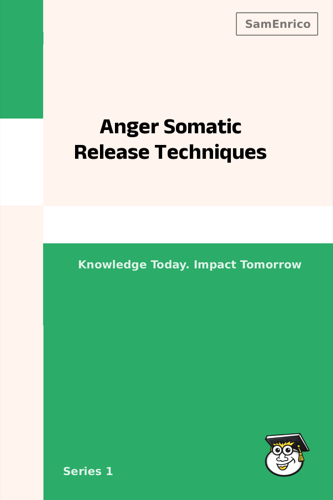
Non-FictionSelf-HelpSomatic Psychology
Anger Somatic Release Techniques eBook
Use body based methods to discharge tension withou
by Root Evonne
Use body based methods to discharge tension without confrontation.
Formats
Free sample
Chapter 1: The Silent Accountant--–- Your jaw aches when you think about your mother-in-law’s comment from three Christmases ago. Your shoulders are permanently raised, as if bracing for a blow that never comes. Your lower back burns after every team meeting, even when the meeting was civil. Your hands curl into fists under the dinner table while you smile and say, “Everything’s fine. Pass the potatoes.”You have been told, probably hundreds of times, that anger is a feeling.
It lives in your head. It is a cognitive event, a thought that went wrong, a misinterpretation of reality. If you just think differently—reframe, reframe, reframe—the anger will dissolve. Maybe you have tried the counting to ten. Maybe you have tried the deep breathing (the shallow kind that does not work).
Maybe you have even tried the “let it go” mantra, which only made you more furious because letting go, as it turns out, is not a cognitive event. You cannot think your way out of a body problem any more than you can think your way out of a broken leg.Here is the truth that no anger management class, no wellness influencer, and no well-meaning therapist ever taught you: Anger is not primarily a feeling. It is a physical event. And your body has been keeping score.Before your prefrontal cortex—the logical, storytelling, “I am a reasonable adult” part of your brain—even knows that you are angry, your body has already responded. The jaw clenched 0.2 seconds after the insult landed.
The shoulders raised 0.4 seconds later. The fists curled at 0.7 seconds. The diaphragm locked at 1.1 seconds. By the time you think, “I am angry right now,” your body has already completed a full physiological response—and then suppressed it, because you are civilized, because you are polite, because you are afraid, because you have learned that expressing anger is dangerous, or shameful, or will get you fired, left, or locked up.This chapter is about reading that physical record. It is about learning where your body has been keeping score, often for decades.
And it is about turning abstract, overwhelming, “I don’t know why I’m so angry all the time” rage into something concrete, locatable, measurable, and ultimately, dischargeable.The Body Is Not a Trash Can Let us start with a metaphor that will run throughout this entire book.Imagine your body is a house. A nice house. You keep it clean. You take out the trash every week. But there is one problem: you have been told, your whole life, that anger is unacceptable.
Anger is the trash you are not allowed to take out. So instead of putting it in the bin and wheeling it to the curb, you shove it into the closet. Just a little bit, every day. A harsh word from your spouse—into the closet. A passive-aggressive email from your boss—into the closet.
A memory of your parent’s criticism—into the closet. A driver who cut you off—into the closet.After a month, the closet is full. The door bulges. After a year, the closet has cracked. After a decade, the entire house is filled with trash, and you cannot walk from room to room without tripping over something you shoved in there years ago.
And then someone says something small—a minor comment, a tiny inconvenience—and you explode. The neighbors call it “road rage” or “anger issues.” But the problem was not the comment. The problem was the decade of trash.This book is the eviction notice for that trash.Your body has been keeping a secret ledger. Every time you swallowed an angry word, that was a debit. Every time you smiled when you wanted to scream, that was a debit.
Every time you apologized for something that was not your fault, that was a debit. Every time you told yourself “it’s fine” when it was very clearly not fine, that was a debit. And your body, being a meticulous and silent accountant, has recorded every single one.The jaw ledger. The shoulder ledger. The diaphragm ledger.
The hip ledger.By the time you reach adulthood, if you are like most people—especially if you are female, or a person of color, or in a subordinate role at work, or in any relationship where your anger has been punished—your body is carrying thousands of undischarged debits. And you wonder why your neck hurts. You wonder why you wake up tired. You wonder why you snap at your children over a lost shoe. You wonder why you feel a low-grade hum of irritation all day, every day.
The ledger has overflowed. The smallest deposit triggers a withdrawal that looks like rage.By the end of this chapter, you will be able to place your hand on the exact spot in your body where your unexpressed anger lives. That spot may be different from your partner’s spot, your mother’s spot, or your best friend’s spot. That is fine. Anger is not generic.
It is personal, architectural, and written into your unique history of suppression, survival, and silence.The Four Prisons of Stored Rage After decades of clinical observation—from Wilhelm Reich’s character armor theory in the 1930s to modern fascia research in the 2020s—we have identified four primary storage zones for suppressed anger. These are not the only zones. Anger can store anywhere: the neck, the lower back, the wrists, even the arches of the feet. But these four chambers account for approximately eighty-five percent of cases. Read each description carefully.
Notice which one makes you hold your breath. Notice which one makes you uncomfortable. That is your body telling you, “Here. Here is where I have been holding.”Prison One: The Jaw (Masseter Muscles)The jaw is the most direct physical expression of the primate rage response. Watch any mammal about to attack: the lips curl back, the teeth bare, the jaw tenses, the neck thickens.
In humans, the masseter muscles—the thick, rectangular muscles you can feel on either side of your face, just below your cheekbones—are among the strongest muscles in the human body, pound for pound. They are designed to bite through bone. They are designed to tear flesh. They are designed to scream.When you suppress the urge to scream—when you hold back the words “I hate you” or “That’s not fair” or “Get away from me” or simply the single, sacred word “No”—the masseters contract. And because suppression is a habit, not a one-time event, they stay partially contracted.
You do not even notice. You have been clenching your jaw for so long that you have forgotten what a relaxed jaw feels like.Days turn into weeks. Weeks turn into years. Eventually, you develop what dentists call bruxism (teeth grinding, usually at night) or TMJ disorder (pain and clicking in the jaw joint). You wake up with a sore jaw, as if you have been chewing leather in your sleep.
You clench your teeth during meetings, during phone calls, during sex. You have headaches that start at your temples and radiate forward into your eyes.…
This is the end of the free sample. Get the eBook to keep going. Buy now
About this book
Details
- Author
- Root Evonne
- Publisher
- SamEnrico
- Language
- English
- Genre
- Non-Fiction, Self-Help, Somatic Psychology
- Released
- 2026-06-07
- Pages (approx.)
- 157
- Available as
- eBook, Audiobook

Read better in the ZLOADR app
Your eBooks on your phone or tablet. Sign in with your SamEnrico account and start reading.
More by Root Evonne
 Indian Support Center SecurityRoot Evonne$11.99
 Closed Door Policy Implementation GuideRoot Evonne$11.99
 Theology Essay PromptsRoot Evonne$11.99
 The Testosterone Replacement Therapy GuideRoot Evonne$11.99
 Stonewall Jackson: The Phantom General of the ShenandoahRoot Evonne$11.99
 Blockchain ForensicsRoot Evonne$11.99
 How to Become a Commercial DesignerRoot Evonne$11.99
 Travel Spending Recovery Patterns ReportRoot Evonne$12.99
 YouTube Brand Collaborations GuideRoot Evonne$12.99
 Understanding PolyarthritisRoot Evonne$17.99
You may also like
 Hong Kong Handover 1997Dunn Johnnie$11.99
 Zumba For Postnatal Recovery CourseNeal Christian$11.99
 Zumba for BeginnersLadner Nikia$11.99
 YouTube Comment Mining GuideHumes Pandora$12.99
 Worry Box MeditationCarlin Rudy$11.99
 Workplace Stress MeditationNguyen Lynn$11.99
 Workplace Stress and Sleep RepairHawley Ivory$11.99
 Workplace Perfectionism CureDelaney Jeffry$11.99
 Workplace Injustice Anger GuideWallen Isabelle$11.99
 Work Addiction and Burnout LinkGreenwood Ester$11.99
 Women in Yoga and WellnessBeattie Galina$11.99
 Women in Stand Up ComedyChun Evangeline$11.99