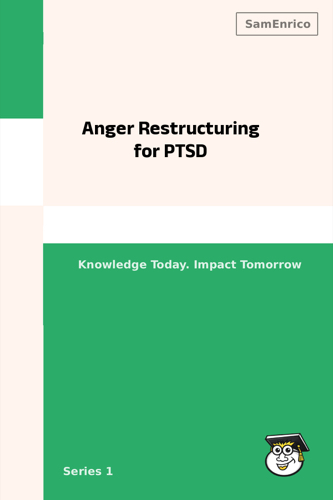
Anger Restructuring for PTSD eBook
Applies CBT to anger as a trauma response.
by George Andy
Applies CBT to anger as a trauma response.
Formats
Free sample
Chapter 1: The Protective Fire--The first time I realized that anger might not be my enemy, I was sitting in a cold emergency room with my right hand wrapped in gauze and my three-year-old son’s tears still wet on my shirt. I had punched a hole through my bedroom wall because the dishwasher made an unexpected metallic clank. Not because the dishwasher was broken. Not because anyone was in danger. Because a sound—a single, ordinary sound that millions of people hear every day without reaction—triggered something so deep and so fast inside me that I was through the wall before I knew I had moved.
I am a trauma therapist. I have spent years studying the neuroscience of fear, the architecture of the amygdala, and the evidence-based treatments for post-traumatic stress disorder. I have helped veterans, survivors of abuse, and first responders rebuild their lives. And none of that knowledge stopped me from putting my fist through drywall because of a household appliance.That moment changed everything. Not because I stopped being angry—I didn’t.
Not because I found a magical cure that erased my rage—no such cure exists. What changed was the question I started asking myself. For years, I had been asking the wrong question. I asked, “Why am I so broken?” I asked, “Why can’t I control myself like normal people?” I asked, “What kind of monster hurts the people he loves?” Those questions led nowhere except deeper into shame, deeper into isolation, deeper into the next explosion. But on that cold emergency room floor, with my knuckles throbbing and my son’s face floating behind my eyes, I finally asked a different question.
I asked, “What was my anger trying to do?”That question changed my life. And it is the question at the heart of everything you are about to read.This chapter will give you a completely new way to understand your anger. Not as a character flaw, not as evidence that you are a bad person, not as proof that you are broken beyond repair—but as a neurobiological survival response that once kept you alive and now needs a software update. You will learn why standard anger management advice often fails for people with PTSD. You will learn the crucial difference between hot anger and cold anger, and why that distinction matters more than you might think.
You will learn how shame interacts with anger in three distinct ways, and how to tell which one is happening for you. And you will take the first small but essential step toward restructuring your relationship with the fire that lives inside you.Let us begin with a radical statement that may contradict everything you have been told about yourself: Your anger is not the problem.The Central Paradigm Shift: Anger as Survival, Not Sin If you have PTSD, your anger is not a moral failure. It is not a lack of willpower. It is not evidence that you are secretly a bad person or that you have become just like the people who hurt you. Your anger is a neurobiological survival response.
It is your brain doing exactly what it evolved to do in the face of perceived threat: mobilizing energy, sharpening focus, preparing your body for combat. The problem is not the anger itself. The problem is that your threat-detection system is calibrated for a danger that no longer exists.Let me explain what happens inside your brain when you get angry. Deep in the center of your skull, about the size and shape of an almond, sits a structure called the amygdala. Its primary job is to scan your environment for threats.
It does this constantly, automatically, below the level of conscious awareness. When your amygdala detects something dangerous, it sounds an alarm. That alarm triggers a cascade of physiological changes: your heart rate spikes, your breathing quickens, blood rushes to your muscles, your pupils dilate, and stress hormones like cortisol and adrenaline flood your system. This is the fight-or-flight response, and it is exquisitely designed to save your life.In a person without PTSD, the amygdala calms down when the threat passes. The prefrontal cortex—the logical, planning part of your brain located just behind your forehead—says, “The threat is gone.
We can relax now.” The alarm shuts off. The body returns to baseline. The person goes back to washing dishes or answering emails or playing with their children.In a person with PTSD, the amygdala does not fully shut off. Trauma has changed your brain’s threat-detection system. Your amygdala has become hypervigilant, scanning constantly for anything that might resemble the original danger.
And because the amygdala now responds more quickly and more intensely than it should, the prefrontal cortex cannot easily override the alarm. Think of it like a radio station with static. The signal—your logical brain—is still there. But you cannot hear it clearly over the noise of the alarm. Your prefrontal cortex has not disappeared.
It has been shouted down.This is why you might explode at a partner for sighing, or a coworker for asking a simple question, or a child for leaving a toy on the floor. Your brain is not reacting to the sigh, the question, or the toy. It is reacting to what those triggers represent. The sigh is not a sigh. It is the sound your abuser made before the beating.
The question is not a question. It is the interrogation that preceded the humiliation. The toy is not a toy. It is the loss of control that led to chaos. Your brain is treating a present-moment trigger as if it were the original trauma, because the neural pathways that were forged in that trauma have not been updated.Your anger is trying to protect you from a danger that is no longer there.
It just does not know that yet.This is the central paradigm shift of this entire book. Throughout these pages, when we use the word restructuring, this is what we mean: changing the relationship between a trigger and a response. We are not erasing your anger. That is impossible and undesirable. Anger is a legitimate human emotion that serves important functions.
It signals boundary violations. It mobilizes energy for self-protection. It communicates urgency. The problem is not that you have anger. The problem is that your anger is running on outdated software.
It is operating system 1.0, designed for life-threatening danger, and it keeps booting up in response to traffic jams, text messages, and the sound of a partner breathing. This book is your software update.Hot Anger vs. Cold Anger: A Crucial Distinction Before we go any further, we need to make a distinction that will save you from unnecessary shame and confusion. Not all anger is the same. In the clinical literature, and throughout this book, we distinguish between two fundamentally different types of anger: hot anger and cold anger.Hot anger is the impulsive, amygdala-driven fight response triggered by perceived threat.
It comes on fast, often without warning. It feels overwhelming, almost volcanic. It is followed, almost always, by shame and regret. Hot anger is reactive, not planned.…
This is the end of the free sample. Get the eBook to keep going. Buy now
About this book
Details
- Author
- George Andy
- Publisher
- SamEnrico
- Language
- English
- Genre
- Non-Fiction, Self-Help / PTSD
- Released
- 2026-06-11
- Pages (approx.)
- 150
- Available as
- eBook, Audiobook

Read better in the ZLOADR app
Your eBooks on your phone or tablet. Sign in with your SamEnrico account and start reading.
More by George Andy
 Engineers Sketching GuideGeorge Andy$11.99
 Stillbirth Recovery WorkbookGeorge Andy$11.99
 IBD Abdominal Pain PracticeGeorge Andy$11.99
 Gaming and Financial ImpactGeorge Andy$11.99
 Wholesaling Real Estate WorkbookGeorge Andy$11.99
 Shoes Off at HomeGeorge Andy$11.99
 Gut Brain Axis And Eating DisordersGeorge Andy$11.99
 The Battle of Nakano: Yamato's Last Stand Against the WaGeorge Andy$11.99
 The Opium King of Marseille: Europe's Forgotten Cartel War (1920s)George Andy$11.99
 The Essential Guide to AfricaGeorge Andy$11.99
 A Collector's Handbook to the Alfa Romeo 6c-2500 Super SportGeorge Andy$11.99
 Co-Founder Skills Audit HandbookGeorge Andy$12.99