
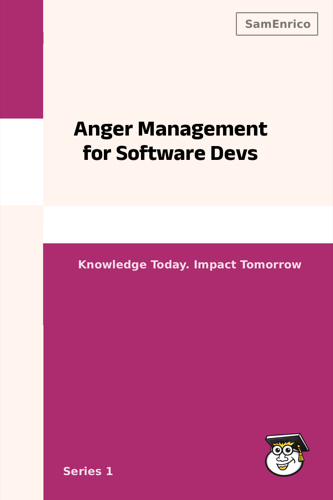
Anger Management for Software Devs Audiobook
Teaches handling code reviews, bugs, and deadline
Teaches handling code reviews, bugs, and deadline pressure without rage.
Formats
Free sample
Chapter 1: The Ego Trap--–- On a Tuesday afternoon in a brightly lit open-plan office, Dave, a senior software engineer with twelve years of experience, stared at a comment on his pull request. The comment, posted by a junior developer named Sarah, read: "Why did you use a singleton here?" Dave's jaw tightened. His fingers hovered over the keyboard. His heartbeat accelerated. Within ninety seconds, he had closed his laptop, walked to his manager's desk, and said, "I'm going home.
I need to think about whether I want to work here anymore." He never returned to that job. When his manager asked him months later, in an exit interview, what had happened, Dave said: "I realized I couldn't work with people who didn't respect my expertise." Sarah, the junior developer who asked the question, had not intended disrespect. She had been trying to learn. She had seen a singleton pattern in the codebase, remembered reading that singletons could complicate testing, and asked a genuine technical question. Dave heard something else entirely.
He heard: "You are incompetent. You don't know what you're doing. A junior is questioning your authority."This is the ego trap.The Anatomy of a Psychological Wound Software development is unique among professions in the intimacy of its relationship between creator and creation. A surgeon does not write their name on a patient's organ. A bridge builder does not feel that a crack in concrete is a personal insult.
But a software engineer's code is a direct, unmediated expression of their thinking. Every function, every variable name, every algorithm is a piece of the engineer's cognitive process made visible. When someone criticizes that code, it feels, neurologically, like someone has criticized the engineer's capacity to think.The phenomenon has a name in computer science literature. In The Psychology of Computer Programming, published in 1971 and still cited today, Gerald Weinberg identified what he called "egoless programming" as the single most important differentiator between productive and dysfunctional teams. Weinberg observed that programmers who attached their self-worth to their code became defensive, brittle, and ultimately less effective.
They could not hear feedback. They could not improve. They broke under the weight of their own ego.Decades of neuroscience have explained why this happens. The brain does not distinguish clearly between a threat to your physical body and a threat to your social standing or competence. When you receive a critical code review…
This is the end of the free sample. Get the Audiobook to keep going. Buy now
About this book
Details
- Author
- Perkins Antoinette
- Publisher
- SamEnrico
- Language
- English
- Genre
- Non-Fiction, Self-Help, Tech
- Released
- 2026-06-07
- Pages (approx.)
- 131
- Available as
- eBook, Audiobook

Listen in the VoxFlicks app
Audiobooks and audio dramas wherever you go. Sign in with your SamEnrico account and press play.
More by Perkins Antoinette
 Work Addiction in Law EnforcementPerkins Antoinette$11.99
 Nonprofit Professional ConfidencePerkins Antoinette$11.99
 Governance Premium AnalysisPerkins Antoinette$11.99
 Bergman Existential CinemaPerkins Antoinette$11.99
 School Emergency Kit and PlanPerkins Antoinette$11.99
 Tech Industry Burnout FixPerkins Antoinette$11.99
 Elizabeth I's Image Control ManualPerkins Antoinette$11.99
 Past Trauma Anger LinkPerkins Antoinette$11.99
 The Yellow Fever Breakthrough: The Triumph of Walter Reed and American Medical SciencePerkins Antoinette$11.99
 The Silk Road Heist: How a Teen Hacker Outsmarted the Dark WebPerkins Antoinette$11.99
 The Great Thaw: How the 2012 Siberian Heatwave Reshaped the ArcticPerkins Antoinette$11.99
 Ultimate Handbook Guide to La Paz (administrative) : (Bolivia) Travel GuidePerkins Antoinette$11.99
You may also like
 Technology Anger TriggersJustus Hank$11.99
 Incognito Mode AccountabilityFaber Kayleen$11.99
 Work Addiction in Tech IndustryKroll Nu$11.99
 TM App and Timer GuideTownes Wei$11.99
 Outsourcing for Tech StartupsDevries Janette$11.99
 The Software Engineer Crunch ModeCarrington Cassidy$11.99
 The Breath Counting App SupplementDonnell Lavelle$11.99
 Anger for Software EngineersRatcliff Claris$11.99
 Food Addiction Recovery for Software EngineersLusk Deirdre$11.99
 Remote Work VPN GuideBlaine Melisa$11.99
 Technology for Caregivers GuideOtis Norine$11.99Technology for Caregivers GuideOtis Norine$11.99