
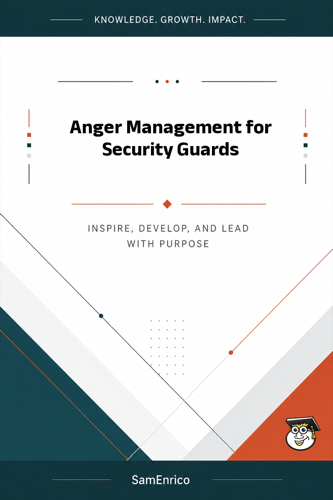
Anger Management for Security Guards eBook
Stay composed during provocations and long, boring
by Muniz Tess
Stay composed during provocations and long, boring shifts.
Formats
Free sample
Chapter 1: The Oxygen Tank...--–- I threw an oxygen tank through a plate-glass window at 3:17 on a Tuesday morning. The man in the wheelchair had called me a "rent-a-cop bitch" three times. On the fourth time, something in my chest snapped—not like a twig, but like a cable under tension for years finally breaking. I don't remember picking up the tank. I don't remember letting go.
I remember the sound of glass exploding across the hospital parking lot and the sudden, horrible silence that followed. Then the handcuffs. Then the termination letter. Then the four months of sitting in my garage at 2 AM, trying to figure out how a guy who just wanted to pay his rent became someone who could have killed a man over four words.This book is not theory. It is not a collection of "best practices" written by someone who has never worn a polyester uniform in August or worked a sixteen-hour shift in a concrete booth with no bathroom.
This book is what I learned from the bottom—from the unemployment line, from the divorce that almost happened, from the therapist who finally asked me, "Do you even like yourself when you're working?" The answer, at the time, was no. I had become the angry guard. The one other guards avoided. The one supervisors wrote up. The one who went home and screamed at his family because a drunk in a wheelchair had called him a name eight hours earlier.If you are reading this, you might be that guard too.
Or you might be afraid you are becoming that guard. Or you might have already done something you can't take back and you are trying to understand why. Here is the truth no one tells you in security training: the job does not make you angry. The boredom, the disrespect, the long hours, the low pay—those are conditions. What makes you angry is the gap between who you want to be and who you have become on the clock.
This chapter is about closing that gap. It is about understanding why boredom is more dangerous than a physical threat, why "easy" shifts are actually the hardest on your brain, and why the most important skill in security has nothing to do with handcuffs or radios.The Myth of the Easy Shift Every security guard has heard it from friends, family, and even supervisors: "You've got it easy. You just sit there." The implication is that sitting is rest. That a slow shift is a gift. That you should be grateful for the quiet.This is wrong.
And not just wrong—dangerously wrong.Let me tell you about Marco. Marco worked the overnight gate at a data center in northern Virginia. Twelve-hour shifts, four nights on, three nights off. His post was a small booth with a heater, a chair, and a camera monitor. On paper, it was the easiest post in the company.
Nothing ever happened. Marco would wave in the same six employees every night, log the same three delivery trucks, and then sit for ten hours waiting for sunrise. Management considered him lucky. Marco considered himself bored out of his skull.After eighteen months at that post, Marco got into a fight with a pizza delivery driver who parked three inches over the line. Not a major violation.
Not a safety issue. Three inches. Marco screamed at the driver, punched the driver's side mirror off the car, and then threw his badge at the supervisor who responded to the call. When asked why, Marco couldn't explain. "I just snapped," he said.
"I don't know why."Here is why: Marco's brain was starving. Ten hours of nothing, night after night, had put his amygdala into a state of low-grade threat detection. Without stimulation, his brain began treating small anomalies—like a car parked three inches over a line—as major events. The cortisol built up. The irritability rose.
And when the delivery driver gave him even the slightest pushback, Marco's brain dumped adrenaline like the guy had pulled a knife.Marco is not weak. Marco is not a bad person. Marco is a normal human whose brain was placed in an abnormal environment—an environment of prolonged, passive boredom—and then asked to remain professional. That is not a reasonable request. It is like asking someone to hold their breath for an hour and then blaming them for gasping.What Boredom Actually Does to Your Brain To understand why boredom makes you angry, you need to understand a concept called vigilance decrement.
This is a well-documented phenomenon in neuroscience and human factors research. Here is what it means: after approximately thirty minutes of monotonous monitoring—watching a camera feed, scanning an empty parking lot, sitting at a gate—your brain's ability to detect subtle threats drops by nearly fifty percent.Think about that. Half your effectiveness, gone in half an hour.But here is the part that matters for anger management: vigilance decrement does not just affect threat detection. It also affects emotional regulation. When your brain is under-stimulated, your prefrontal cortex—the part of your brain responsible for impulse control, decision-making, and emotional regulation—begins to downregulate.
It essentially goes into power-saving mode. Meanwhile, your amygdala (the fear and threat detection center) becomes hypersensitive to any new input. The result is a brain that is both less able to control impulses and more likely to interpret neutral events as threatening.This is why small provocations feel enormous after hours of nothing. This is why a tossed cigarette butt or a slightly raised voice can trigger a full adrenaline response. Your brain is not overreacting.
It is starved. And it will latch onto anything—anything—that feels like an event.Let me give you a concrete example from my own career. Before the oxygen tank incident, I worked a post at a pharmaceutical warehouse. My job was to log license plates of trucks entering the loading dock. That was it.
Eight hours of license plates. After about three months, I noticed I was getting angry at drivers who took too long to present their ID. Angry at drivers who had dirty trucks. Angry at drivers who smiled at me. None of these things were reasonable reasons to be angry.
But my brain was not operating reasonably. My brain was operating in survival mode, treating every minor inconvenience as a potential threat because it had nothing else to process.The solution is not to "toughen up" or "learn to relax." The solution is to understand that passive boredom is a form of stress—and to treat it as such.The Danger of Passive Monitoring Let me draw a critical distinction that will matter throughout this book. There is a difference between passive boredom and low-demand productivity.Passive boredom is what happens when you sit and wait for something to happen. You are not engaged. You are not learning.
You are not even really observing—you are simply present, watching time pass. This is the state that leads to vigilance decrement, cortisol buildup, and eventual anger outbursts. Passive boredom is not rest. It is a slow-acting poison for your emotional regulation.Low-demand productivity…
This is the end of the free sample. Get the eBook to keep going. Buy now
About this book
Details
- Author
- Muniz Tess
- Publisher
- SamEnrico
- Language
- English
- Genre
- Non-Fiction, Self-Help, Security
- Released
- 2026-06-06
- Pages (approx.)
- 148
- Available as
- eBook, Audiobook

Read better in the ZLOADR app
Your eBooks on your phone or tablet. Sign in with your SamEnrico account and start reading.
More by Muniz Tess
 The Vagus Nerve Stress LinkMuniz Tess$11.99
 Cross Border Franchise Privacy PolicyMuniz Tess$11.99
 Dual Diagnosis in ElderlyMuniz Tess$11.99
 The Budget Creative ChallengeMuniz Tess$11.99
 The Quantum Leap: How a 1989 Experiment Changed the Future of ComputingMuniz Tess$11.99
 Understanding Sacral AgenesisMuniz Tess$17.99
 Supply Chain Finance vs FactoringMuniz Tess$12.99
 Safe Harbor for CTAMuniz Tess$12.99
 Optometrist AssistantMuniz Tess$11.99
 How to Start a Circular or Reciprocating Saws Business (Beginners Guide)Muniz Tess$11.99
You may also like
 Hong Kong Handover 1997Dunn Johnnie$11.99
 Zumba For Postnatal Recovery CourseNeal Christian$11.99
 Zumba for BeginnersLadner Nikia$11.99
 YouTube Comment Mining GuideHumes Pandora$12.99
 Worry Box MeditationCarlin Rudy$11.99
 Workplace Stress MeditationNguyen Lynn$11.99
 Workplace Stress and Sleep RepairHawley Ivory$11.99
 Workplace Perfectionism CureDelaney Jeffry$11.99
 Workplace Injustice Anger GuideWallen Isabelle$11.99
 Work Addiction and Burnout LinkGreenwood Ester$11.99
 Women in Yoga and WellnessBeattie Galina$11.99
 Women in Stand Up ComedyChun Evangeline$11.99