
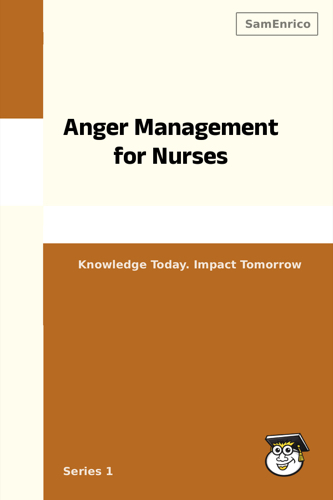
Anger Management for Nurses eBook
Handle understaffing, difficult patients, and phys
Handle understaffing, difficult patients, and physician frustration professionally.
Formats
Free sample
Chapter 1: The Hidden Burn...--You are standing at the medication dispensing station, scanning labels you no longer see, when it happens again. Your chest tightens. Your jaw clenches. A familiar heat rises from your sternum to your throat, and for one terrifying, honest second, you imagine throwing the entire medication cart against the wall. You don't, of course.
You smile at the passing nursing assistant. You draw the next syringe. You keep going. But something inside you has just recorded another small death.This is not a failure of character. This is not evidence that you chose the wrong profession.
This is a physiological, psychological, and systemic reality shared by more than three million nurses in the United States alone. The anger you feel—the suppressed rage, the simmering resentment, the occasional explosive moment you later replay with shame—is not a personal flaw. It is a rational response to an irrational working environment. The problem is not that you get angry. The problem is that no one ever taught you what to do with that anger when the next bed alarm sounds, when the physician dismisses your concern, when the second admission arrives twenty minutes before shift change.This chapter is about understanding what actually happens inside you during those moments.
Not vague advice to "calm down" or "take a deep breath." The actual neurobiology, the predictable sequence of events, and the critical distinction that will structure this entire book: the difference between rational and irrational anger. By the time you finish these pages, you will never again ask yourself "Why did I overreact?" without being able to answer with precision.The Paradox of the Nice Nurse Let us name what the profession refuses to say aloud. Nursing has a cultural script, and that script demands endless patience, unconditional compassion, and emotional labor that would exhaust a saint. You are expected to absorb the anger of patients in pain, the frustration of families in crisis, the impatience of physicians under pressure, and the indifference of administrators who have never held a bedpan. And you are expected to do all of this while smiling.The data on what this does to nurses is not ambiguous.
According to the American Nurses Association, more than sixty percent of nurses report experiencing workplace violence. The same surveys show that nurses are twice as likely to experience burnout as other healthcare professionals. And the suppressed rage that accompanies these conditions correlates directly with hypertension, substance abuse disorders, depression rates, and early departure from the profession. A 2022 study in the Journal of Clinical Nursing found that nurses who reported high levels of suppressed anger had cortisol profiles similar to combat veterans.This is the paradox. You entered nursing because you care.
That caring is now slowly destroying you, not because caring is wrong, but because the system in which you care is broken. And the first step toward surviving that system is to stop blaming yourself for feeling angry about it.The Distinction That Changes Everything: Rational vs. Irrational Anger Before we examine the neurology of a trigger, we must establish the framework that will organize every subsequent chapter. Anger is not a single phenomenon. It is a category of emotional experience that ranges from adaptive and healthy to maladaptive and destructive.
The difference lies in proportion.Rational anger is a proportional response to a real threat, injustice, or violation. When you are short-staffed and a patient falls because you could not answer the call light in time, your anger at the administrator who cut the budget is rational. When a physician publicly humiliates you for a lab result that was not your fault, your anger is rational. When a patient's family member physically blocks you from leaving a room, your anger is rational. Rational anger is a signal.
It tells you that something is wrong and needs to change. It energizes action. It is the emotional equivalent of a fire alarm.Irrational anger is a disproportionate response to a minor irritant, or a response amplified by factors unrelated to the present situation. When you snap at a new graduate for asking a reasonable question because you are exhausted and overwhelmed, that disproportionate reaction may be irrational. When you spend an entire day fuming about a scheduling change that was communicated clearly and fairly, that rumination may be irrational.
When you react to a physician's neutral question as if it were an attack because your father was critical and dismissive, that transference is irrational. Irrational anger is noise. It interferes with signal. It is the emotional equivalent of a smoke detector triggered by burnt toast.Here is what most anger management resources get wrong. They treat all anger as irrational.
They tell you to breathe, count to ten, or attend a mindfulness seminar. These interventions are useful for irrational anger. They are useless and even harmful for rational anger, because rational anger should not be suppressed. It should be channeled. You do not need to stop being angry about unsafe staffing ratios.
You need to learn what to do with that anger so it becomes advocacy instead of burnout.This book will explicitly label each chapter's focus. Chapters addressing understaffing, patient abuse, physician bullying, and lateral violence will treat anger as predominantly rational. Chapters addressing transference, rumination, and disproportionate reactivity will treat anger as predominantly irrational. And chapters addressing documentation, alliance-building, and quitting will provide tools for both.The Anatomy of a Trigger: What Happens in Your Brain Let us walk through the sequence. You are completing morning assessments.
A call light activates from room 214, a patient who has already complained three times about the temperature of the coffee. Before you can reach the room, the charge nurse tells you that your eleventh patient (because your unit is running at a six-to-one ratio instead of the mandated four-to-one) has arrived from the emergency department. Simultaneously, the physician for room 212 appears and tells you, in a voice loud enough for the family in room 210 to hear, that the blood pressure reading you charted fifteen minutes ago is "completely worthless" because you took it on the wrong arm.In the span of thirty seconds, you have experienced three distinct threats. Your brain does not distinguish between a physical threat and a social threat. The same amygdala that evolved to detect predators now detects a physician's raised voice.
The same cortisol that prepares you to run from a bear now prepares you to run from a patient's family member.The sequence unfolds in milliseconds. First, the thalamus processes sensory input from the environment. Second, the amygdala evaluates that input for potential threat. This evaluation happens before conscious awareness. You feel the flash of heat, the surge of adrenaline, the urge to fight or flee, before you can even name what caused it.
Third, if the amygdala perceives threat, it activates the hypothalamic-pituitary-adrenal axis. Cortisol floods your system. Your heart rate increases. Blood shifts from your digestive system to your large muscle groups. Your peripheral vision narrows.
Your prefrontal cortex—the part of your brain responsible for reasoning, planning, and impulse control—is partially suppressed. You are literally less intelligent in the moment of anger.Fourth, you respond. The response may be…
This is the end of the free sample. Get the eBook to keep going. Buy now
About this book
Details
- Author
- Stratton Lissa
- Publisher
- SamEnrico
- Language
- English
- Genre
- Non-Fiction, Self-Help, Nursing
- Released
- 2026-06-07
- Pages (approx.)
- 138
- Available as
- eBook, Audiobook

Read better in the ZLOADR app
Your eBooks on your phone or tablet. Sign in with your SamEnrico account and start reading.
More by Stratton Lissa
 Sports Supplements GuideStratton Lissa$11.99
 Fear Of Failure In GovernmentStratton Lissa$11.99
 Dual Diagnosis Integrated TreatmentStratton Lissa$11.99
 The Self Hypnosis for Medical ProceduresStratton Lissa$11.99
 The Birth of Modern Football: The 18th-Century Roots of the World CupStratton Lissa$11.99
 Understanding Roy–maroteaux–kremp SyndromeStratton Lissa$17.99
 How to Become a Stand-inStratton Lissa$11.99
 Invoice Factoring Morocco GuideStratton Lissa$12.99
 Australia BOI RegisterStratton Lissa$12.99
 Neutral Good Turing Machine OperatorStratton Lissa$11.99
You may also like
 Hong Kong Handover 1997Dunn Johnnie$11.99
 Zumba For Postnatal Recovery CourseNeal Christian$11.99
 Zumba for BeginnersLadner Nikia$11.99
 YouTube Comment Mining GuideHumes Pandora$12.99
 Worry Box MeditationCarlin Rudy$11.99
 Workplace Stress MeditationNguyen Lynn$11.99
 Workplace Stress and Sleep RepairHawley Ivory$11.99
 Workplace Perfectionism CureDelaney Jeffry$11.99
 Workplace Injustice Anger GuideWallen Isabelle$11.99
 Work Addiction and Burnout LinkGreenwood Ester$11.99
 Women in Yoga and WellnessBeattie Galina$11.99
 Women in Stand Up ComedyChun Evangeline$11.99