
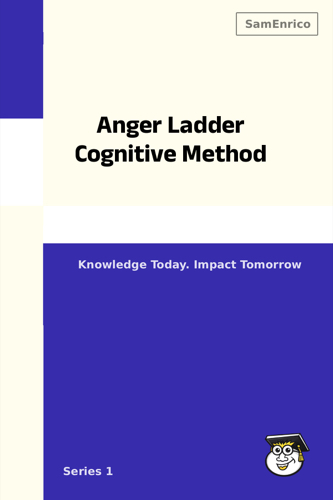
Non-FictionSelf-HelpEmotional Regulation
Anger Ladder Cognitive Method eBook
Scale your anger intensity and match cognitive int
by Cass Zandra
Scale your anger intensity and match cognitive interventions to each level.
Formats
Free sample
Chapter 1: The Leaking Reactor--–- Every morning, James woke up with a tightness in his chest that he couldn't name. It wasn't anxiety, exactly. It wasn't sadness. It was something hotter, something that hummed beneath his skin like a low-voltage current. By the time he reached his car, the slightest inconvenience—a slow driver, a notification ping, a coffee spill—would send him into a spiral of muttered curses and clenched fists.
By noon, he would be exhausted. By evening, ashamed. And by bedtime, he would promise himself that tomorrow would be different. But tomorrow always arrived with the same humming, buzzing, leaking pressure.James is not real. But his pattern is.Millions of people live inside this exact cycle: chronic low-grade irritation that flares into unexpected explosions, followed by guilt, followed by suppression, followed by another explosion.
They have tried everything. They have punched pillows (catharsis). They have counted to ten (suppression disguised as patience). They have walked away (avoidance). They have read books about "anger management" that treated all anger as the same enemy, to be fought with the same blunt weapon.
Nothing has worked—not because these people are broken, but because the tools they were given were designed for the wrong problem.This book offers a different premise: Anger is not one thing. It is a ladder.At the bottom rungs, anger whispers. At the middle rungs, it speaks in complete sentences. At the top rungs, it screams—and when it screams, your brain's reasoning centers go offline. Trying to use the same technique at rung 8 that worked at rung 2 is not just ineffective; it is impossible.
It would be like trying to put out a house fire with a drinking straw because the straw worked on a candle.The Anger Ladder Cognitive Method (ALCM) is a precision-based system that does three things no other anger approach has done before. First, it teaches you to identify exactly which rung of the ladder you are standing on in any given moment. Second, it provides a specific cognitive intervention matched to that rung—no more guessing, no more one-size-fits-all advice. Third, it gives you a clear path downward: from rage to fury to resentment to frustration to irritation to calm.This chapter introduces the core problem with conventional anger management, the three laws of the ALCM, and the first self-assessment that will change how you see your own anger forever.The Catharsis Lie For decades, popular psychology sold us a dangerous story: that anger is like steam in a pressure cooker, and if you don't let it out, it will explode. The solution, according to this story, was to "vent"—to punch pillows, scream into a car, hit a heavy bag, or "get it all out" in a cathartic release.The research tells a very different story.In study after study, catharsis has been shown to increase aggressive behavior, not decrease it.
When you punch a pillow while imagining someone who angered you, your brain strengthens the neural pathway that connects anger with physical aggression. You are not releasing pressure. You are training your brain to make anger into violence more efficiently. One landmark study found that participants who engaged in cathartic anger expression (e.g., punching a bag while ruminating on a perceived injustice) were subsequently more aggressive toward the person who had angered them, not less.The pressure cooker metaphor is wrong. A better metaphor is a river.
Suppressing anger is like building a dam—eventually, the pressure builds and the dam breaks. But venting is like digging channels that make the river flow faster and more destructively. The correct intervention is neither suppression nor explosion. It is navigation: learning where the river is shallow (low rungs), where it is deep (high rungs), and which tools work at each depth.The Suppression Trap If catharsis is one failed extreme, suppression is the other. Suppression means pushing anger down, pretending it isn't there, smiling through clenched teeth, and telling yourself that "good people don't get angry." Suppression feels mature.
It feels controlled. It feels like the right thing to do.But suppression comes with a hidden cost.Decades of research on emotional suppression have shown that pushing anger down does not make it disappear. It makes it persist—and it leaks out in other ways. Chronic suppressors report higher rates of physical tension, headaches, insomnia, and digestive problems. They are more likely to experience "anger attacks"—sudden, seemingly unprovoked explosions that happen after weeks or months of silent endurance.
And they are more likely to develop relationship problems, not fewer, because suppressed anger often emerges as passive aggression, withdrawal, or unexplained coldness.The problem with suppression is that it confuses behavior with feeling. You can choose not to act on anger. That is wise. But you cannot choose not to feel anger without paying a physiological and psychological price. Suppression attempts to kill the messenger.
The ALCM, by contrast, learns to read the message.The Ladder: A New Way to See Anger The Anger Ladder is a 10-rung ordinal scale. "Ordinal" means the order of the rungs matters (rung 5 is more intense than rung 4), but the gaps between rungs are not mathematically equal—the jump from rung 2 to rung 3 may feel very different from the jump from rung 8 to rung 9. That is by design. Human emotion does not follow a ruler; it follows a ladder with uneven steps.Here is the ladder in its simplest form:Rungs 1–2: Irritation & Annoyance Slight edge of impatience Brief flash of displeasure Easily distracted from the feeling Prefrontal cortex fully online Rungs 3–4: Frustration & Exasperation Repeated goal-blocking"Oh, come on" moments Rising physiological arousal Amygdala beginning to activate Rungs 5–6: Resentment & Indignation Narrative-driven anger ("He always does this")Rigid beliefs about fairness and respect Longer duration (hours to days)Rumination begins Rungs 7–8: Fury & Hostility High physiological arousal (racing heart, tunnel vision)Desire to harm or humiliate Cognitive window narrowing Reasoning still possible but difficult Rungs 9–10: Rage & Explosion Amygdala hijack (prefrontal cortex offline)Loss of impulse control Destructive behavior likely without intervention Post-crisis shame and confusion The single most important insight of the ALCM is this: You cannot use a rung 2 tool at rung 9. Trying to "reframe your thoughts" when you are in a rage is like trying to do calculus during a heart attack.
It is not that you are weak. It is that the part of your brain required for reframing is temporarily offline.Conversely, using a rung 9 tool at rung 2 (like splashing cold water on your face because you are mildly annoyed) is overkill. It works, but it is exhausting and unnecessary. The goal is precision: the smallest effective intervention at the lowest possible rung.The Three Laws of the Anger Ladder Cognitive Method The ALCM rests on three foundational principles. Everything else in this book—every worksheet, every case study, every technique—is an application of these three laws.Law 1: Intervene at the Lowest Possible Rung Anger is like a fire.
A small fire can be extinguished with a cup of water. A large fire requires a fire extinguisher. A raging inferno requires calling professionals and evacuating the building.If you intervene when you are at rung 2 (mild irritation), a simple…
This is the end of the free sample. Get the eBook to keep going. Buy now
About this book
Details
- Author
- Cass Zandra
- Publisher
- SamEnrico
- Language
- English
- Genre
- Non-Fiction, Self-Help, Emotional Regulation
- Released
- 2026-06-06
- Pages (approx.)
- 154
- Available as
- eBook, Audiobook

Read better in the ZLOADR app
Your eBooks on your phone or tablet. Sign in with your SamEnrico account and start reading.
More by Cass Zandra
 Walking Meditation For Multiple Sclerosis HandbookCass Zandra$11.99
 Support Group Memory SharingCass Zandra$11.99
 Jhansi Rani Lakshmibai BiographyCass Zandra$11.99
 The Forgiveness for Narcissistic AbuseCass Zandra$11.99
 Love and Ambush: The Siege of Dien Bien Phu (1954)Cass Zandra$11.99
 How to Become a Order DetailerCass Zandra$11.99
 Production Sequencing AlgorithmsCass Zandra$12.99
 German Student Banking GuideCass Zandra$12.99
 Trophy and Award EngraverCass Zandra$11.99
 Understanding Ocular AlbinismCass Zandra$17.99
You may also like
 Hong Kong Handover 1997Dunn Johnnie$11.99
 Zumba For Postnatal Recovery CourseNeal Christian$11.99
 Zumba for BeginnersLadner Nikia$11.99
 YouTube Comment Mining GuideHumes Pandora$12.99
 Worry Box MeditationCarlin Rudy$11.99
 Workplace Stress MeditationNguyen Lynn$11.99
 Workplace Stress and Sleep RepairHawley Ivory$11.99
 Workplace Perfectionism CureDelaney Jeffry$11.99
 Workplace Injustice Anger GuideWallen Isabelle$11.99
 Work Addiction and Burnout LinkGreenwood Ester$11.99
 Women in Yoga and WellnessBeattie Galina$11.99
 Women in Stand Up ComedyChun Evangeline$11.99