
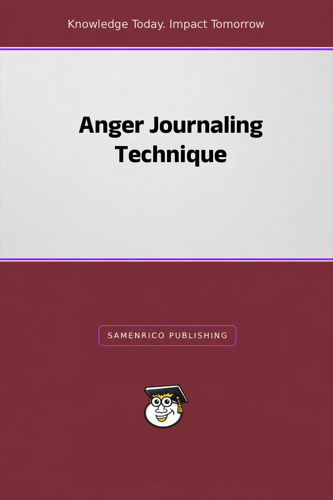
Non-FictionSelf-HelpJournaling
Anger Journaling Technique eBook
Write out rage to process it without acting destru
Write out rage to process it without acting destructively, then burn or save.
Formats
Free sample
Chapter 1: The Volcano and the Pen--–- Every human being on earth has stood at the same terrifying crossroads: the moment just before rage becomes destruction. Your jaw locks. Your chest compresses into a fist of heat. Words gather behind your teeth like a mob demanding release. In that half-second, you will either hand the megaphone to your most wounded self, or you will find another way.
This book is that other way.–- But before we can build a single sentence on the page, you need to understand what anger actually is—not what your parents told you, not what religion or culture or your third-grade teacher implied, but what the biology and psychology of your own nervous system know to be true. Anger is not a sin. It is not a weakness. It is not a sign that you are broken or unspiritual or failing at life. Anger is an alarm system.
And like any alarm, the problem is never the sound itself. The problem is what the sound is trying to tell you before the building burns down.–- For decades, popular psychology has sold us a lie disguised as wisdom. “Just let it go,” they say, as if anger were a suitcase you could set down at the gate. “Count to ten,” they advise, as if arithmetic could calm a flooded amygdala. “Punch a pillow,” they suggest, turning your living room into a simulation of violence that trains your brain to associate anger with physical release.
None of these strategies work reliably because none of them address the fundamental architecture of rage. You cannot think your way out of a feeling that evolved over sixty million years to keep your ancestors alive. But you can write your way through it.–- This chapter lays the foundation for everything that follows. You will learn what anger really is, why the three most common myths about anger are silently ruining your relationships, and how the simple act of putting a pen to paper can short-circuit the neural pathways that lead to explosions or shutdowns. By the end of this chapter, you will have a completely new relationship with your own rage—not as an enemy to defeat, but as a signal to decode.The Neurobiology of a Storm–- Close your eyes for a moment and recall the last time you truly lost your temper.
Not the time you were mildly annoyed at a slow checkout line, but the time you felt actual heat moving up your neck. The time your voice changed, or you threw something, or you said something that you knew—even as the words left your mouth—you would spend weeks apologizing for. What did your body feel? Most people describe the same constellation: racing heart, shallow breathing, tunnel vision, a sensation of pressure behind the sternum. Some feel cold hands and a hot face.
Others notice that their hearing seems to sharpen, as if the world has been turned up by several decibels.–- These physical sensations are not random. They are the work of your amygdala, two small almond-shaped clusters of neurons deep inside your brain that act as a twenty-four-hour threat detection system. The amygdala does not think. It does not reason. It does not care about your career, your reputation, or your five-year plan.
The amygdala has one job: to determine whether you are safe or in danger. And it makes that determination in approximately three hundred milliseconds—far faster than your conscious mind can form a single thought.–- Here is what happens inside your skull when someone cuts you off in traffic, or dismisses your feelings in front of others, or breaks a promise they swore was sacred. First, your sensory systems (eyes, ears, skin) send raw data to the thalamus, a relay station in the center of your brain. The thalamus instantly forwards that data to the amygdala along a “low road”—a fast, dirty, and remarkably inaccurate pathway. The amygdala gets the message: something is happening.
It scans its memory banks for similar past events. If it finds a match, it sounds the alarm before you even know what the threat is.–- Simultaneously, the amygdala activates your hypothalamus, which in turn signals your pituitary gland to flood your body with stress hormones: adrenaline and cortisol. Your heart rate spikes. Blood rushes to your large muscles. Your pupils dilate.
Your digestive system shuts down (which is why you can’t eat when you’re truly furious). Your prefrontal cortex—the rational, planning, future-thinking part of your brain—begins to go offline. This is not a metaphor. Functional MRI studies show that during intense anger, blood flow decreases to the prefrontal cortex. You literally become less intelligent in the grip of rage.–- About five hundred milliseconds after the amygdala first sounded the alarm, your sensory data finally reaches the prefrontal cortex via a slower, more accurate “high road.” Now you can consciously assess: Is that actually a threat?
Or is it just a driver who didn’t see me? But by then, the physiological firestorm has already begun. You are already breathing fast. Your heart is already pounding. Your muscles are already tense.
And now your rational brain has to play catch-up, trying to calm a body that has already declared war.–- This is why “just calm down” is such useless advice. You cannot reason your way out of a biological cascade that evolved to keep you alive on the savanna. In the ancestral environment, that fast, intense anger response was essential. If a rival tribe member reached for a spear, you didn’t have time to deliberate. You needed to act.
The problem is that modern threats rarely require physical aggression. Your boss’s passive-aggressive email is not a spear. Your partner’s thoughtless comment is not a predator. But your amygdala doesn’t know the difference. It only knows pattern matching: disrespect, exclusion, betrayal—these social threats light up the same neural circuits as physical danger.–- This is the first great truth this book asks you to hold: your anger is not broken.
It is working exactly as designed. The design is just outdated for the world you actually live in.The Three Myths That Keep You Stuck–- If anger itself is neutral—a biological alarm system—then why do so many people believe their anger is a moral failure? The answer lies in three destructive myths that circulate through families, churches, workplaces, and self-help books. These myths are so deeply embedded in our culture that you probably believe at least one of them without ever having examined it. Let us pull them out into the light.–- Myth One: Anger Is Bad.
This is the most common and the most insidious. From childhood, many of us receive the message that anger is ugly, sinful, or shameful. Little girls are told they sound “bossy” or “shrill.” Little boys are told that “nice boys don’t get angry.” Religious teachings often conflate anger with wrath, one of the seven deadly sins. Well-meaning parents send their children to their rooms for angry outbursts, inadvertently teaching that the feeling itself is punishable.–- The truth is…
This is the end of the free sample. Get the eBook to keep going. Buy now
About this book
Details
- Author
- Manning Benny
- Publisher
- SamEnrico
- Language
- English
- Genre
- Non-Fiction, Self-Help, Journaling
- Released
- 2026-06-10
- Pages (approx.)
- 135
- Available as
- eBook, Audiobook

Read better in the ZLOADR app
Your eBooks on your phone or tablet. Sign in with your SamEnrico account and start reading.
More by Manning Benny
 Workload Sanity ManualManning Benny$11.99
 The Cyclist Mindset WorkbookManning Benny$11.99
 The Loneliness of Chronic IllnessManning Benny$11.99
 Meditation for Herniated Disc PainManning Benny$11.99
 The Grid That Changed Everything: How the Manhattan Plan Redefined Urban LifeManning Benny$11.99
 The Great Penguin Highway: March of the EmperorsManning Benny$11.99
 Understanding Diamond–blackfan AnemiaManning Benny$17.99
 Agency NurseManning Benny$11.99
 CTA Legal Challenges UpdateManning Benny$12.99
 CTA For Small BusinessesManning Benny$12.99
 How to Start a Hobby in JugglingManning Benny$11.99
You may also like
 Hong Kong Handover 1997Dunn Johnnie$11.99
 Zumba For Postnatal Recovery CourseNeal Christian$11.99
 Zumba for BeginnersLadner Nikia$11.99
 YouTube Comment Mining GuideHumes Pandora$12.99
 Worry Box MeditationCarlin Rudy$11.99
 Workplace Stress MeditationNguyen Lynn$11.99
 Workplace Stress and Sleep RepairHawley Ivory$11.99
 Workplace Perfectionism CureDelaney Jeffry$11.99
 Workplace Injustice Anger GuideWallen Isabelle$11.99
 Work Addiction and Burnout LinkGreenwood Ester$11.99
 Women in Yoga and WellnessBeattie Galina$11.99
 Women in Stand Up ComedyChun Evangeline$11.99