
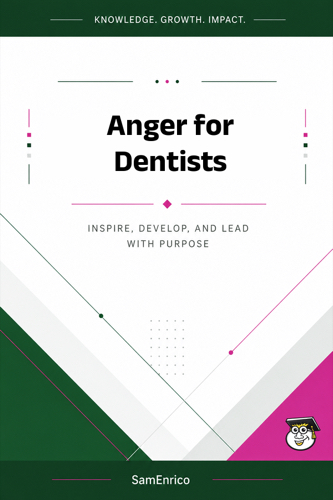
Anger for Dentists eBook
Handle anxious patients and procedure stress witho
Handle anxious patients and procedure stress without frustration.
Formats
Free sample
Chapter 1: The 82% Majority...--–- The dental operatory is the only medical setting in the developed world where two human beings regularly trigger each other's fight-or-flight response simultaneously, and the profession has silently agreed never to discuss it. The patient feels it as a racing heart and sweaty palms. You feel it as a clenched jaw, a shortened temper, and a rising sense of irritation that you cannot quite name. You have been told this is normal. You have been told to manage your stress.
You have been told that anger is unprofessional. But no one has ever told you why it keeps happening, or what to actually do about it. This chapter is not about fixing your anger. It is about understanding why you have it in the first place—and why that understanding is the single most important clinical skill no dental school ever taught you.The Statistic That Should Have Been a Wake-Up Call In 2019, the British Dental Association published a workforce survey that should have stopped the profession cold. Eighty-two percent of dentists reported chronic stress levels significantly higher than the general workforce.
Not occasional stress. Not the normal pressure of a demanding job. Chronic, unrelenting, physiologically damaging stress that correlated directly with reports of irritability, outbursts of anger, and regrettable interactions with patients and staff.Let that number sit with you for a moment. Eighty-two percent.To put that in perspective, air traffic controllers—routinely cited as one of the most stressful jobs on earth—report chronic stress at approximately fifty-six percent. Emergency room physicians hover around sixty percent.
Combat soldiers returning from deployment report post-traumatic stress at roughly twenty percent. Dentists sit at eighty-two percent, and the profession has largely accepted this as normal.It is not normal. And the most undiscussed symptom of that chronic stress is anger.Not burnout, though burnout is a close cousin. Not depression, though depression often follows. The immediate, day-to-day, chair-side experience that dentists report with startling consistency is a low-grade, simmering irritability that occasionally erupts into something uglier.
A snapped comment to a hygienist. A curette thrown into a sink. A silent, seething resentment toward a patient who has done nothing wrong except flinch at the wrong moment.This chapter is called "The 82% Majority" because that number is the honest diagnosis. You are not broken. You are not uniquely incapable of handling stress.
You are not a bad person who somehow lacks the patience required for clinical dentistry. You are part of an eighty-two percent majority in a profession that has been designed—structurally, neurologically, and culturally—to make you angry.The question is not whether you feel anger. The question is whether you understand why.The Cockpit Without an Ejector Seat Dentists have a dark metaphor they share with one another in conferences and online forums, rarely in public. They compare the operatory to a cockpit without an ejector seat. The pilot of a commercial airliner faces enormous stress, yes.
But the pilot has layers of protocol, co-pilots, autopilot, air traffic control, and the unambiguous authority to declare an emergency and land the plane. The dentist has none of that.You sit three inches from a person who is, by the very nature of the situation, in a state of heightened arousal. That person may be afraid. That person may be in pain. That person may be suspicious of you because of a bad experience twenty years ago with a different dentist.
That person may be economically stressed about the cost of treatment. That person may simply hate the sound of the drill. And all of that emotional turbulence happens while you are holding a high-speed rotating instrument millimeters from a nerve.You cannot pause the drill and walk away. You cannot declare an emergency and land the plane. You cannot pull over to the side of the road.
You are in the cockpit, the patient is in the cockpit with you, and there is no ejector seat.This is not a complaint. It is a description of the structural reality of dental practice. And that structural reality has direct, measurable effects on your nervous system.The average dentist makes approximately twelve hundred clinical decisions per day. Each of those decisions carries consequences—some trivial, some significant. A slightly underfilled composite.
A margin that is 0.1 millimeters less than ideal. A patient who feels a brief moment of sensitivity. These are not failures. They are the normal variance of human performance. But to a nervous system already operating at elevated baseline arousal, each small deviation feels like a threat.This is the first thing to understand about anger in dentistry: it is not primarily a psychological problem.
It is a physiological problem with psychological consequences. Your anger is not a sign of moral weakness. It is a sign that your nervous system has been operating in survival mode for too long, and it is sending you urgent signals that something needs to change.Healthy Frustration versus Destructive Anger: A Critical Distinction Before we go any further, we need to draw a line that will run through every chapter of this book. That line separates healthy frustration from destructive anger.Healthy frustration is brief. It is pre-verbal.
It is a signal—nothing more than a dashboard warning light—that some boundary is being approached or crossed. You feel it as a moment of tension, a quickening of the breath, a subtle clenching of the jaw. It lasts seconds. It does not impair your judgment. It does not damage your relationships.
It is, in fact, a useful evolutionary adaptation. Frustration tells you that something in your environment requires attention.Destructive anger is something else entirely. Destructive anger is sustained. It is verbal or behavioral. It is the eruption of that initial signal into action that you later regret.
It lasts minutes or hours. It impairs your clinical judgment. It damages trust with patients and staff. And crucially, destructive anger is almost never about the immediate trigger. The flinch that made you want to throw the hemostat was not the cause of your anger.
It was the final straw on a pile that had been building for hours, days, or weeks.Here is the distinction that will matter for the rest of this book: healthy frustration is a signal. Destructive anger is a symptom.A signal is information. It tells you that something needs to be adjusted—your posture, your schedule, your communication with a patient, your own physical state. A symptom is a sign that the underlying system has been malfunctioning for some time. You do not treat a fever by ignoring the thermometer.
You treat the infection. In the same way, you do not treat destructive anger by trying to suppress it in the moment. You treat the conditions that allowed it to build up in the first place.Throughout this book, we will return to this distinction. When you feel frustrated, that is not a problem to eliminate. That is data to use.
When you feel destructive anger rising, that is a signal that the data has been ignored for too long. Your job is not to become a person who never feels frustrated. Your job is…
This is the end of the free sample. Get the eBook to keep going. Buy now
About this book
Details
- Author
- Liles Mckenzie
- Publisher
- SamEnrico
- Language
- English
- Genre
- Non-Fiction, Self-Help, Dentistry
- Released
- 2026-06-08
- Pages (approx.)
- 151
- Available as
- eBook, Audiobook

Read better in the ZLOADR app
Your eBooks on your phone or tablet. Sign in with your SamEnrico account and start reading.
More by Liles Mckenzie
 Gluten Challenge ProtocolLiles Mckenzie$11.99
 Internal Comms Outsourcing GuideLiles Mckenzie$11.99
 Workaholism in Customer SupportLiles Mckenzie$11.99
 The Habit Response SimplificationLiles Mckenzie$11.99
 The Lost Champions: North Africa's Forgotten Horse Racing Legends of the RenaissanceLiles Mckenzie$11.99
 Student Exam Nervous SystemLiles Mckenzie$12.99
 AI Accounting Tools Small BusinessLiles Mckenzie$12.99
 Understanding Sspe (Subacute Sclerosing Panencephalitis)Liles Mckenzie$17.99
 BellhopLiles Mckenzie$11.99
 How to Start a Dog Soap Business (Beginners Guide)Liles Mckenzie$11.99
You may also like
 Hong Kong Handover 1997Dunn Johnnie$11.99
 Zumba For Postnatal Recovery CourseNeal Christian$11.99
 Zumba for BeginnersLadner Nikia$11.99
 YouTube Comment Mining GuideHumes Pandora$12.99
 Worry Box MeditationCarlin Rudy$11.99
 Workplace Stress MeditationNguyen Lynn$11.99
 Workplace Stress and Sleep RepairHawley Ivory$11.99
 Workplace Perfectionism CureDelaney Jeffry$11.99
 Workplace Injustice Anger GuideWallen Isabelle$11.99
 Work Addiction and Burnout LinkGreenwood Ester$11.99
 Women in Yoga and WellnessBeattie Galina$11.99
 Women in Stand Up ComedyChun Evangeline$11.99