

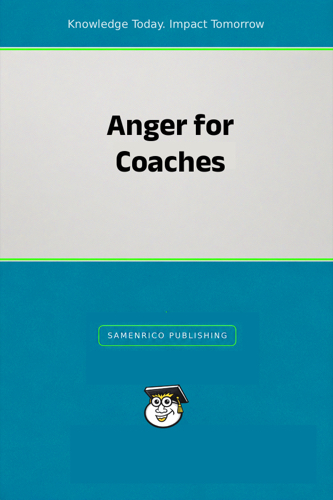
Anger for Coaches eBook
Motivate athletes without yelling or punitive ange
by Manzo Billye
Motivate athletes without yelling or punitive anger.
Formats
Free sample
Chapter 1: The Three-Second Window--–- The whistle is still in your mouth when you see it happen. Your star player, the one you stayed up late planning plays for, the one who practiced that move a hundred times this week—just threw the ball directly to the opposing team. Not a bad pass. A catastrophic pass. The kind that makes parents in the bleachers cover their mouths.
The kind that makes assistant coaches look at their shoes. The kind that makes something hot and fast rise up from your stomach into your throat.You have between three and five seconds before you speak. In that sliver of time—shorter than it takes to tie a shoe—everything that matters will be decided. Not the game. The game is already happening.
What will be decided is who you are as a coach. Not who you want to be. Who you actually are when the pressure is real and the mistake is right there in front of you and every single person in the gym is waiting to see what you will do.Most coaches never notice this window. They go from trigger to reaction so fast that it feels like a single event. Mistake happens.
Yell follows. They tell themselves there was no time to think, no space to choose. This is a lie. The window is always there. You just have to learn to see it.
And once you see it, everything changes.This chapter is about that window. It is about what happens inside your body and brain during those three to five seconds. It is about why some coaches use that window to coach and others use it to destroy. And it is about a single question—a question so powerful that it can stop a yell mid-breath and turn a potential disaster into the best coaching moment of your career.By the time you finish this chapter, you will understand something that most coaches never learn: anger is not a force that sweeps you away. It is a wave, and waves can be surfed.
You just need to know when to paddle and when to stand up.The Anatomy of a Hijack To understand the window, you need to understand what happens inside your brain in the milliseconds after a mistake. This is not abstract neuroscience. This is the story of why you have said things you regret and why you will say them again unless you build a different path.Deep in the center of your brain, tucked behind your eyes and between your ears, sits a small cluster of neurons shaped like an almond. This is your amygdala. Its only job is to detect threats.
It does not think. It does not reason. It does not care about your coaching philosophy or your relationship with your players. It scans the environment constantly, looking for danger, and when it finds danger, it sounds the alarm.Here is what your amygdala considers dangerous: a sudden loud noise, a fast-moving object toward your face, a loss of status in front of a group, a challenge to your authority, a mistake that makes you look incompetent in front of people whose opinions matter to you.Notice that last one. Your amygdala does not know the difference between a physical threat and a social threat.
A missed layup that makes you look bad in front of your athletic director triggers the exact same biological cascade as a car swerving into your lane. Your body does not distinguish between "I might die" and "I might lose my job." It just sounds the alarm.When the alarm sounds, your hypothalamus activates your sympathetic nervous system—the gas pedal we discussed in Chapter One. Your adrenal glands release a flood of epinephrine (adrenaline) and norepinephrine. Your heart rate spikes. Your breathing becomes shallow and fast.
Your pupils dilate. Blood rushes away from your digestive system and toward your large muscle groups. Your non-essential systems—including large parts of your prefrontal cortex—begin to power down.This entire process takes less than half a second. By the time you consciously notice that you are angry, your body has already been in full fight-or-flight mode for hundreds of milliseconds. Your prefrontal cortex—the part of your brain responsible for planning, impulse control, and strategic thinking—is playing catch-up.
It is trying to put the brakes on a car that is already doing ninety miles per hour.This is the amygdala hijack, a term coined by psychologist Daniel Goleman. And here is the cruelest part: the hijack feels like a choice. It feels like you are deciding to yell because the mistake was so bad, because the player needed to hear it, because someone had to say something. But the decision was made before you decided. Your amygdala decided for you.
Your job—the entire purpose of this book—is to take back the wheel.The Three-Second Window Between the trigger (the mistake) and the response (the yell), there is a gap. Neuroscientists have measured this gap. It is between three and five seconds long. In that gap, your prefrontal cortex has just enough time to catch up to your amygdala. Your thinking brain can, if it is trained, override your survival brain.
You can choose a different response.The problem is that most coaches do not know the gap exists. They have never been taught to look for it. They have spent years reinforcing the neural pathway from trigger to yell, building it into a superhighway. The gap is still there—it is always there—but it has become so narrow, so overgrown with habit, that it might as well not exist.Your job is to widen the gap. You cannot make it longer than three to five seconds—that is fixed by your neurobiology.
But you can learn to notice it. You can train yourself to see the window opening and step through it before it closes.How? You start with a question. One question. The most important question you will ever ask yourself as a coach.The Only Question That Matters In the three-second window, when the heat is rising and your jaw is clenching and you can feel the yell building in your chest like a wave about to break, you ask yourself one thing:"Is this about coaching or my ego?"That is it.
Four words. They take less than a second to think. And they will save you from more mistakes than any other practice in this book.Here is why this question works. Every single urge to yell falls into one of two categories. It is either about coaching—genuinely trying to improve an athlete's performance—or it is about ego—trying to protect your own status, prove you are in charge, or vent your own frustration.
There is no third category. Every yell is either a coaching moment or an ego moment.Here is the hard truth that most coaches will never admit: the vast majority of yells are about ego. You are not yelling because the athlete needs to hear a correction. You are yelling because you are embarrassed. You are yelling because you feel disrespected.
You are yelling because the mistake makes you look bad in front of parents or administrators or the other coach…
This is the end of the free sample. Get the eBook to keep going. Buy now
About this book
Details
- Author
- Manzo Billye
- Publisher
- SamEnrico
- Language
- English
- Genre
- Non-Fiction, Self-Help, Coaching
- Released
- 2026-06-06
- Pages (approx.)
- 114
- Available as
- eBook, Audiobook

Read better in the ZLOADR app
Your eBooks on your phone or tablet. Sign in with your SamEnrico account and start reading.
More by Manzo Billye
 Internal Comms Roadmap TemplateManzo Billye$11.99
 Food Intolerance at WorkManzo Billye$11.99
 Workaholism in Gig EconomyManzo Billye$11.99
 The Implementation Intention GuideManzo Billye$11.99
 Ian Thorpe: The Torpedo of Sydney - Breaking Records and BarriersManzo Billye$11.99
 Understanding SporotrichosisManzo Billye$17.99
 Sleep Micro Break ProtocolManzo Billye$12.99
 Cooperative Education GuideManzo Billye$12.99
 How to Become a Drop-wire AlignerManzo Billye$11.99
 Automotive ManagerManzo Billye$11.99
You may also like
 Hong Kong Handover 1997Dunn Johnnie$11.99
 Zumba For Postnatal Recovery CourseNeal Christian$11.99
 Zumba for BeginnersLadner Nikia$11.99
 YouTube Comment Mining GuideHumes Pandora$12.99
 Worry Box MeditationCarlin Rudy$11.99
 Workplace Stress MeditationNguyen Lynn$11.99
 Workplace Stress and Sleep RepairHawley Ivory$11.99
 Workplace Perfectionism CureDelaney Jeffry$11.99
 Workplace Injustice Anger GuideWallen Isabelle$11.99
 Work Addiction and Burnout LinkGreenwood Ester$11.99
 Women in Yoga and WellnessBeattie Galina$11.99
 Women in Stand Up ComedyChun Evangeline$11.99