
Non-FictionSelf-Help / Communication
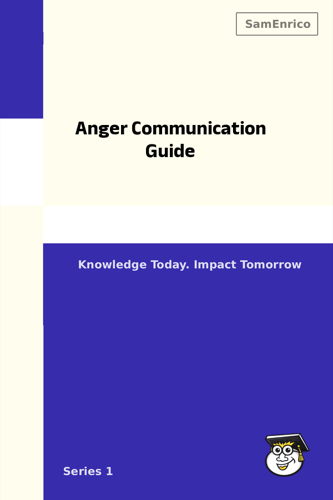
Anger Communication Guide Audiobook
Replaces yelling with I-statements and active list
Replaces yelling with I-statements and active listening during conflicts.
Formats
Free sample
Chapter 1: The Yell Trap--Most people who yell do not believe they have an anger problem. They believe they have a listener problem.If you picked up this book, you have likely found yourself in the following situation at least once in the past month: You are in the middle of a disagreement. You have asked nicely. You have repeated yourself. You have felt the slow, hot rise of frustration building behind your sternum.
And then—despite every promise you made to yourself after the last fight—your voice rises. Words come out sharper, faster, louder than you intended. You see the flinch on the other person’s face. And in that moment, two things happen simultaneously: a part of you feels a dark relief (finally, you are being heard), and another part of you feels the immediate, sinking dread of damage done.You tell yourself: If they had just listened the first time, I wouldn’t have had to yell.This is the Yell Trap. And it is the most expensive self-deception in human communication.The Anatomy of a Cultural Default Let us begin with an uncomfortable truth.
Yelling is not a failure of character. It is a failure of default programming. Most human beings learn how to handle conflict not from studied curricula or evidence-based training, but from two deeply unreliable sources: our families of origin and popular media. In both arenas, yelling is presented not as a breakdown but as a tool.Think about the films and television shows that have shaped your unconscious understanding of conflict. When does the hero finally get through to the stubborn ally?
After raising their voice. When does the parent finally command respect from the wayward teenager? After an explosion in the kitchen. When does the partner finally express the depth of their hurt? After a screaming monologue in the rain.
Our culture has taught us that volume equals sincerity, that intensity equals importance, and that the person who yells last—or loudest—wins the argument.This is a lie. And it is a lie with measurable, devastating consequences.Why Yelling Feels Effective (And Why That Feeling Is a Trap)Let us examine the physiology of a yell. When you raise your voice beyond a certain threshold—typically around eighty-five decibels, roughly the volume of heavy traffic—your body undergoes a specific chemical cascade. The amygdala, your brain’s threat-detection center, interprets the act of yelling as either an attack…
This is the end of the free sample. Get the Audiobook to keep going. Buy now
About this book
Details
- Author
- Vanover Lieselotte
- Publisher
- SamEnrico
- Language
- English
- Genre
- Non-Fiction, Self-Help / Communication
- Released
- 2026-06-06
- Pages (approx.)
- 151
- Available as
- eBook, Audiobook

Listen in the VoxFlicks app
Audiobooks and audio dramas wherever you go. Sign in with your SamEnrico account and press play.
More by Vanover Lieselotte
 DBT For Parental EmotionVanover Lieselotte$11.99
 Decompress Without DistanceVanover Lieselotte$11.99
 Assertiveness In JournalismVanover Lieselotte$11.99
 NASCAR Rivalry ManagementVanover Lieselotte$11.99
 Sleep Consolidation Memory GuideVanover Lieselotte$11.99
 Benzodiazepine Detox UseVanover Lieselotte$11.99
 Refugee Therapy Access ManualVanover Lieselotte$11.99
 The Plague Walls of Venice: Engineering a City Against the Black DeathVanover Lieselotte$11.99
 The Golden Stride: The Untold Story of Joana Coimbra's Olympic TriumphVanover Lieselotte$11.99
 How to Produce Football Face MasksVanover Lieselotte$11.99
 Understanding Cerebral Autosomal Dominant Arteriopathy With Subcortical Infarcts and Leukoencephalopathy (Cadasil)Vanover Lieselotte$11.99
 Stock Footage Channel Scalability PlanVanover Lieselotte$12.99
You may also like
 Hong Kong Handover 1997Dunn Johnnie$11.99
 Zumba For Postnatal Recovery CourseNeal Christian$11.99
 Zumba for BeginnersLadner Nikia$11.99
 YouTube Comment Mining GuideHumes Pandora$12.99
 Worry Box MeditationCarlin Rudy$11.99
 Workplace Stress MeditationNguyen Lynn$11.99
 Workplace Stress and Sleep RepairHawley Ivory$11.99
 Workplace Perfectionism CureDelaney Jeffry$11.99
 Workplace Injustice Anger GuideWallen Isabelle$11.99
 Work Addiction and Burnout LinkGreenwood Ester$11.99
 Women in Yoga and WellnessBeattie Galina$11.99
 Women in Stand Up ComedyChun Evangeline$11.99