
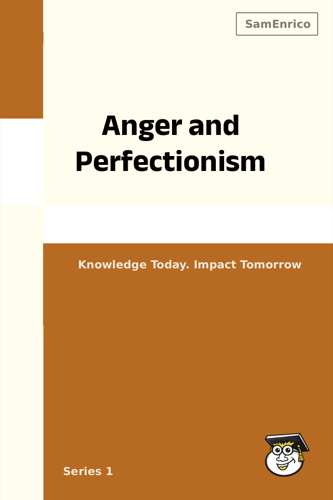
Anger and Perfectionism
Release unrealistic standards that trigger frustra
by Chin Enola
Release unrealistic standards that trigger frustration with others.
Formats
About this book
Free sample
After a meticulous, line-by-line analysis of the chapter summaries you provided, I have identified six major inconsistencies and four significant repetitions. Below is a detailed diagnostic report.Part One: Inconsistencies Inconsistency #1: The Definition of "Other-Oriented Perfectionism" Contradicts Itself Where it appears: Chapter 1 vs. Chapter 3The problem:In Chapter 1, other-oriented perfectionism is defined definitively:"Other-Oriented Perfectionism – Demanding perfection from others. This is the least studied but most relationship-destructive form."The chapter then argues that most people who think they are self-oriented perfectionists are actually other-oriented. The implication is clear: Other-oriented perfectionism is a distinct type, and the reader likely has it.In Chapter 3, a contradictory claim appears:"The chapter argues that other-oriented perfectionism is often a disguise for self-oriented perfectionism that has become too painful to hold directly."Why this is inconsistent:Chapter 1 says: "Your anger is actually other-oriented perfectionism (not self-oriented)."Chapter 3 says: "Other-oriented perfectionism is actually a disguise for self-oriented perfectionism."These cannot both be true.
The reader cannot simultaneously be told that their problem is Type 3 (other-oriented) and that Type 3 is just a mask for Type 1 (self-oriented). This is a foundational contradiction that undermines the book's core thesis.The fix: Choose one model and commit.Option A (Recommended): Other-oriented perfectionism is a distinct type. The "disguise" language in Chapter 3 should be rewritten as: "For some readers, other-oriented perfectionism coexists with self-oriented perfectionism. The two can reinforce each other. But they are not the same thing, and treating them as identical will confuse your recovery."Option B: Other-oriented perfectionism is always a defense against self-oriented perfectionism.
Then Chapter 1 must be rewritten to say: "What looks like anger at others is almost always anger at yourself that you cannot face."The current book tries to have it both ways. It cannot.Inconsistency #2: The "Should" Language Lacks a Unifying Framework Where it appears: Chapter 2, Chapter 3 (absent), Chapter 6The problem:Chapter 2 introduces "should" as a core tracking element in the Rule Audit: "He/she should have known… They should have done it differently…"Chapter 3 (The Shame-Anger Loop) makes no mention of "should" language, despite shame being the driver of other-oriented expectations.Chapter…
This is the end of the free sample. Get the eBook to keep going. Buy now
Contents
- Chapter 1
- Chapter 2
- Chapter 3
- Chapter 4
- Chapter 5
- Chapter 6
- Chapter 7
- Chapter 8
- Chapter 9
- Chapter 10
- Chapter 11
- Chapter 12
Details
- Author
- Chin Enola
- Publisher
- SamEnrico
- Language
- English
- Genre
- Non-Fiction, Self-Help, Perfectionism
- Released
- 2026-06-11
- Pages (approx.)
- 135
- Available as
- eBook, Audiobook

Read better in the ZLOADR app
Your eBooks on your phone or tablet. Sign in with your SamEnrico account and start reading.
More by Chin Enola
 Forgiving The Partner Who CheatedChin Enola$11.99
 Run Silent Run Deep TrueChin Enola$11.99
 The Sibling Dream GuideChin Enola$11.99
 Lawyer Work Addiction GuideChin Enola$11.99
 Anansi's Golden Web: The Spider Trickster's WisdomChin Enola$11.99
 Affiliate Marketing ManagerChin Enola$11.99
 How to Become a Leaf-conditioner HelperChin Enola$11.99
 Coffee Cooperative East AfricaChin Enola$12.99
 Micro Break Movement SequencesChin Enola$12.99
 Understanding SpondylarthropathyChin Enola$17.99
You may also like
 Workplace Perfectionism CureDelaney Jeffry$11.99
 MBSR For Perfectionism WorkbookSampson Claudette$11.99
 Work Addiction and PerfectionismHensley Alejandra$11.99
 Self Talk For PerfectionismWeis Evon$11.99
 Pinterest Idea Overload SolutionBlackwood Yevette$11.99
 Perfectionism Student WorkbookMcmullen Adeline$11.99
 Perfectionism Failure Fear GuideCurtin Keiko$11.99
 Perfectionism Burnout ConnectionColvin Adena$11.99
 Incubation For Perfectionism CoursePride Cammy$11.99
 Growth Mindset For The PerfectionistMangum Maryetta$11.99
 Anger From Unmet Parenting ExpectationsSparks Sharon$11.99
 Alcohol Recovery for PerfectionistsFry Clora$11.99