
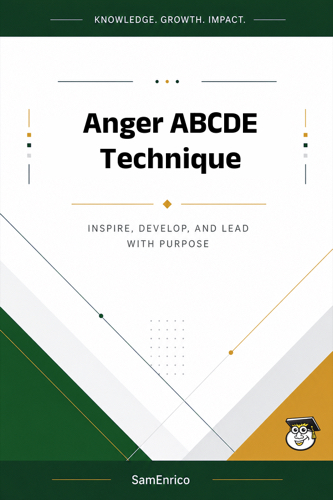
Anger ABCDE Technique eBook
Apply Albert Ellis's model to Activating events, B
Apply Albert Ellis's model to Activating events, Beliefs, Consequences, Dispute, Effect.
Formats
Free sample
Chapter 1: The Last Straw--I want you to imagine something. You are standing in line at a coffee shop on a Tuesday morning. You have been waiting for four minutes. You are next. Then, without apology, without eye contact, a man in a gray coat steps directly in front of you and orders a latte.
What do you feel?Most people answer this question with a single word: angry. Some say furious. A few, if they are being honest, say something closer to homicidal. But here is the question the coffee shop scenario never asks: Why? What actually caused that anger?
The natural answer seems obvious. The man cut in line. That is what made you angry. But I am going to spend this entire chapter convincing you that this obvious answer is completely wrong.The man cutting in line did not make you angry. Your belief about what his behavior meant made you angry.
And if you can grasp this single distinction, you have already taken the first and most important step toward mastering the Anger ABCDE Technique. Everything else in this book is simply practice.The common sense model of anger says this: Event causes Emotion. He cuts, you rage. Cause and effect. Simple.
Clean. And entirely misleading. Because if events caused emotions directly, then every person who experienced the same event would feel the same emotion. But they do not. Two people cut in line.
One explodes. One shrugs. One files a complaint with the manager. One buys the line-cutter a latte and wishes him well. Same event.
Different emotions. The only variable that changed was what each person believed about what had just happened.This is not a new idea. The ancient Stoic philosopher Epictetus wrote it plainly two thousand years ago: "Men are disturbed not by things, but by the views which they take of them." The Roman emperor Marcus Aurelius said it another way: "Your mind takes the shape of what you hold in it." The psychologist Albert Ellis, who developed the ABCDE model that this book is built upon, said it most directly: "People are not disturbed by things, but by their view of things." These men lived across two millennia, spoke different languages, and arrived at the same conclusion because they all noticed the same truth. Between every event and every emotional reaction, there is a split second in which the human brain interprets what just happened. That interpretation is a belief.
And that belief, not the event, determines whether you feel annoyed or enraged, irritated or homicidal, concerned or consumed.Here is the experiment that proves it. Imagine two students in a classroom. Both are caught cheating on an exam. The evidence is identical. The teacher's response is identical.
But the two students react completely differently. The first student feels shame and remorse. He lowers his head, accepts responsibility, apologizes, and asks what he can do to make it right. The second student explodes in rage. He accuses the teacher of unfair treatment, claims other students cheat worse, threatens to involve the principal, and storms out of the room slamming the door.
Same event. Opposite emotions. The only difference between these two students is what they believed about what had just happened. The first student believed: "I did something wrong. I am responsible.
This is uncomfortable but fair." The second student believed: "This teacher is persecuting me. Everyone cheats. I am being singled out unfairly." Same A. Different B. Radically different C.This is the moment where most people nod along intellectually but continue to live as if they never heard it.
You will leave this coffee shop, get cut off in traffic, and feel the surge of rage before you remember a single word of this chapter. That is normal. That is human. That is also changeable. The Anger ABCDE Technique is not about becoming a robot who never feels anger.
It is about learning to see the split second between A and C, recognizing the belief that lives there, and deciding whether that belief is helping you or destroying you.The first step is learning to name the two models. The Common Sense Model says: Event → Emotion. He insults me, so I am angry. She ignores me, so I am hurt. They cheat me, so I am furious.
This model feels true because it happens so fast. The gap between A and C is milliseconds. Your brain has been practicing this shortcut your entire life. It is efficient. It is automatic.
And it is wrong. The Cognitive Model says: Event → Belief → Emotion. He insults me, I believe "He should not have said that," and that belief produces my anger. She ignores me, I believe "She must respect me," and that belief produces my hurt. They cheat me, I believe "This is unbearable," and that belief produces my fury.
The Cognitive Model adds one hidden step. That step is where your freedom lives. If you cannot see the belief, you are a puppet on a string pulled by every event that happens to you. If you can see the belief, you become the one holding the strings.Let me show you how this works with a real example from my own work with clients. A woman I will call Diane came to see me after an incident that frightened her.
She had been driving home from work, exhausted after a twelve hour shift, when a truck cut her off so closely that she had to swerve onto the shoulder to avoid a collision. She described what happened next with shame in her voice. She chased the truck for three miles, tailgating, flashing her lights, screaming insults she could not remember. When the truck finally pulled away, she pulled over and cried for ten minutes. She told me, "I am not that person.
I do not do that. But he made me so angry." Notice the language. He made me. The Common Sense Model, spoken aloud. I asked her what she was thinking in the second after the truck cut her off.
She said, "I was thinking that he could have killed me. That he is a reckless monster. That he should lose his license. That he has no right to put my life at risk." Every single one of those thoughts is a belief. Not one of them is automatically true.
The truck driver was reckless. That is a fact. But "he is a monster" is not a fact. It is a label. "He should lose his license" is not a fact.
It is a demand. "He has no right" is not a fact. It is a moral command directed at a universe that does not take orders. Diane's rage did not come from the truck. It came from the beliefs she attached to the truck in the milliseconds after the event.
And because she could not see those beliefs in the moment, she had no choice but to act as if they were true. She chased a stranger for three miles because her own brain told her a story that demanded revenge.Here is the good news. You do not need to eliminate beliefs. You cannot. The human brain is a…
This is the end of the free sample. Get the eBook to keep going. Buy now
About this book
Details
- Author
- Mccane Georgette
- Publisher
- SamEnrico
- Language
- English
- Genre
- Non-Fiction, Self-Help, ABCDE, REBT
- Released
- 2026-06-08
- Pages (approx.)
- 138
- Available as
- eBook, Audiobook

Read better in the ZLOADR app
Your eBooks on your phone or tablet. Sign in with your SamEnrico account and start reading.
More by Mccane Georgette
 Intern Frustration Anger GuideMccane Georgette$11.99
 Homelessness and AddictionMccane Georgette$11.99
 Stop Living Paycheck to PaycheckMccane Georgette$11.99
 The Work Guilt GuideMccane Georgette$11.99
 The Ghost in the Print: How Fingerprints Solved Prohibition's Deadliest CrimeMccane Georgette$11.99
 Pre Seed Government Grants GuideMccane Georgette$12.99
 Certification Stacking StrategyMccane Georgette$12.99
 Understanding Urbach–wiethe DiseaseMccane Georgette$17.99
 Foreign Exchange TradingMccane Georgette$11.99
 Ultimate Handbook Guide to Aleppo : (Syria) Travel GuideMccane Georgette$11.99