
Non-FictionHealth & WellnessCultural
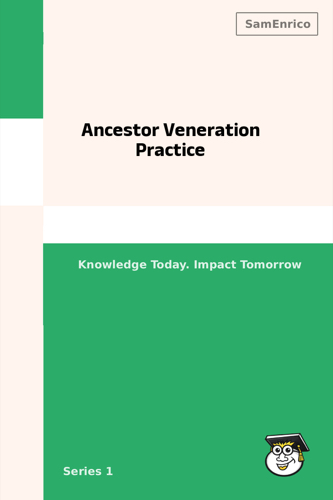
Ancestor Veneration Practice eBook
Honor family elders for stress relief and cultural
Honor family elders for stress relief and cultural continuity.
Formats
Free sample
Chapter 1: The Rootlessness Epidemic--–- You are carrying a grief you have never been taught to name.It does not announce itself like the death of a loved one, with its sharp, immediate pain and the ritualized comfort of funerals and condolences. It is quieter than that, more insidious. It lives in the background of your daily life—a low hum of anxiety that you have learned to ignore, or to medicate with busyness, scrolling, shopping, or numbing.You feel it when you sit in a sterile waiting room, surrounded by strangers, no one speaking. You feel it when you scroll past photographs of other people’s large, laughing family gatherings—Thanksgiving tables crowded with three generations, cousins who know each other’s names, grandparents who are not strangers. You feel it when you realize you do not know the names of your own great-grandparents, let alone where they are buried, what they dreamed about, or how they survived their hardest days.This is rootlessness grief.
And it is making you sick.For the last seventy years, Western culture has been conducting an unprecedented experiment. We have traded extended family networks for geographic mobility, multigenerational households for nuclear families, oral history for digital distraction, and ancestral ritual for individualism. The results are now in, and they are devastating. Rates of anxiety, depression, and loneliness have risen steadily across the same period that family storytelling, elder cohabitation, and ancestral awareness have declined. Correlation is not causation, but the pattern is too consistent to ignore.This book offers a different way.
Not a return to the past—nostalgia is not a strategy—but a recovery of something ancient, adapted for the present. Ancestor veneration is not superstition. It is not religion, though it can be practiced within any faith or none. It is not about worshiping the dead or asking ghosts for favors. It is something simpler and more profound: the intentional practice of remembering, thanking, and learning from those who came before, for the mutual benefit of the living, the dying, and generations not yet born.This chapter will name the condition you have been living with, explain why it matters more than you think, establish the framework for the rest of this book, and give you the first practical tools to begin your own ancestor practice—today.The Great Forgetting Every culture in human history, until very recently, has maintained some form of ancestor practice.
The Chinese sweep graves during Qingming Festival and burn paper offerings for the departed. Mexicans build ofrendas and celebrate Día de los Muertos with marigolds and photographs and bread. West African Vodun traditions involve elaborate ancestor altars and periodic feasts. Japanese families maintain butsudan shrines in their homes and return to ancestral graves for Ohigan. Celtic cultures observed Samhain, the original Halloween, when the veil between worlds was said to thin and the dead were welcomed home with food and fire.These practices are not primitive superstitions that enlightened modernity has outgrown.
They are sophisticated psychological technologies that evolved independently across continents because they solved a universal human problem: how to remain connected to the past while living in the present, and how to prepare for death without being paralyzed by fear.The Great Forgetting—the systematic erosion of these practices in the West over the last century—is not an accident of progress. It is the result of industrialization (which moved people from farms to cities, away from ancestral lands), of mobility (which scattered families across states and countries), of secularization (which threw out the baby of communal ritual with the bathwater of dogma), and of consumer capitalism (which profits from your loneliness by selling you distractions instead of connection).You were not born rootless. Rootlessness was done to you. And that means it can be undone.The Three Symptoms of Rootlessness Grief Rootlessness grief manifests in three distinct but overlapping symptoms. Recognizing these in your own life is the first step toward healing.Symptom One: The Floating Self Without a clear sense of where you come from, you experience yourself as floating—unmoored, unanchored, subject to every passing wind of opinion and crisis.
The floating self has no intergenerational context for its problems. Every failure feels catastrophic because there is no memory of ancestors who failed and survived anyway. Every success feels hollow because there is no lineage to share it with. Every decision feels weightless because there is no one looking over your shoulder, no one whose approval you seek beyond the immediate validation of peers.The floating self is anxious because it believes it is alone. It has forgotten that it stands on the shoulders of survivors.Symptom Two: The Burden Frame When you view aging parents and grandparents through the lens of individualism, they become burdens.
Their needs become problems to solve, their presence becomes an interruption, their decline becomes a logistical nightmare. This frame is not natural—it is learned. And it is killing you. Caregivers who view elders as burdens report significantly higher rates of depression, anxiety, and physical illness than those who view elders as assets. The frame creates the stress, not the elder.Symptom Three: The Story Hunger The average person knows only ten to fifteen stories about their grandparents and almost nothing about their great-grandparents.
This is a historical anomaly. For most of human history, children grew up surrounded by oral history—stories of ancestors told and retold until they became part of the child's own identity. Story hunger is the gnawing sense that you are missing something essential, that your life is thinner than it should be, that you have been cut off from a source of nourishment you cannot quite name.Story hunger drives people to genealogy websites, to DNA tests, to obsessions with ancestry that never quite satisfy because data is not the same as story. Names and dates are not the same as values and trials.The One Consistent Definition (Used Throughout This Book)Before we go further, we need a shared language. Inconsistent definitions have plagued ancestor literature for decades, with some authors using "veneration" to mean worship, others using it to mean simple remembrance, others using it to mean ongoing relationship.
This book uses one definition, applied consistently from this chapter through the final page:Veneration is the intentional practice of remembering, thanking, and learning from those who came before—for the mutual benefit of the living, the dying, and generations not yet born.Let us break this down.Intentional practice: Veneration is not vague sentiment or occasional nostalgia. It is something you do, on purpose, with structure and repetition. A practice, not a feeling.Remembering: The first act of veneration is simply to remember that they existed. Not to idealize them—some ancestors were flawed, some were cruel—but to acknowledge that they lived, and that because they lived, you are here.Thanking: Gratitude is the emotional engine of veneration. You do not have to approve of everything an ancestor did.
You can grieve their failures while still being grateful for the gift of existence they passed down. Gratitude and critique can coexist.Learning: Ancestors are not just to be remembered and thanked. They are to be learned…
This is the end of the free sample. Get the eBook to keep going. Buy now
About this book
Details
- Author
- Purvis Nakita
- Publisher
- SamEnrico
- Language
- English
- Genre
- Non-Fiction, Health & Wellness, Cultural
- Released
- 2026-06-06
- Pages (approx.)
- 126
- Available as
- eBook, Audiobook

Read better in the ZLOADR app
Your eBooks on your phone or tablet. Sign in with your SamEnrico account and start reading.
More by Purvis Nakita
 Talent Migration in Financial ServicesPurvis Nakita$11.99
 Gambling Addiction and Self WorthPurvis Nakita$11.99
 Emotional Suppression RecoveryPurvis Nakita$11.99
 The Amanda Knox Appeal Victory GuidePurvis Nakita$11.99
 The Dragon’s Bride: A Love Forged in FirePurvis Nakita$11.99
 Real Estate Distressed Assets GuidePurvis Nakita$12.99
 One Page Value Proposition WorkbookPurvis Nakita$12.99
 Understanding Leukemia SubleukemicPurvis Nakita$17.99
 How to Become a Collar-turner OperatorPurvis Nakita$11.99
You may also like
 Hong Kong Handover 1997Dunn Johnnie$11.99
 Zumba For Postnatal Recovery CourseNeal Christian$11.99
 Zumba for BeginnersLadner Nikia$11.99
 YouTube Comment Mining GuideHumes Pandora$12.99
 Worry Box MeditationCarlin Rudy$11.99
 Workplace Stress MeditationNguyen Lynn$11.99
 Workplace Stress and Sleep RepairHawley Ivory$11.99
 Workplace Perfectionism CureDelaney Jeffry$11.99
 Workplace Injustice Anger GuideWallen Isabelle$11.99
 Work Addiction and Burnout LinkGreenwood Ester$11.99
 Women in Yoga and WellnessBeattie Galina$11.99
 Women in Stand Up ComedyChun Evangeline$11.99