
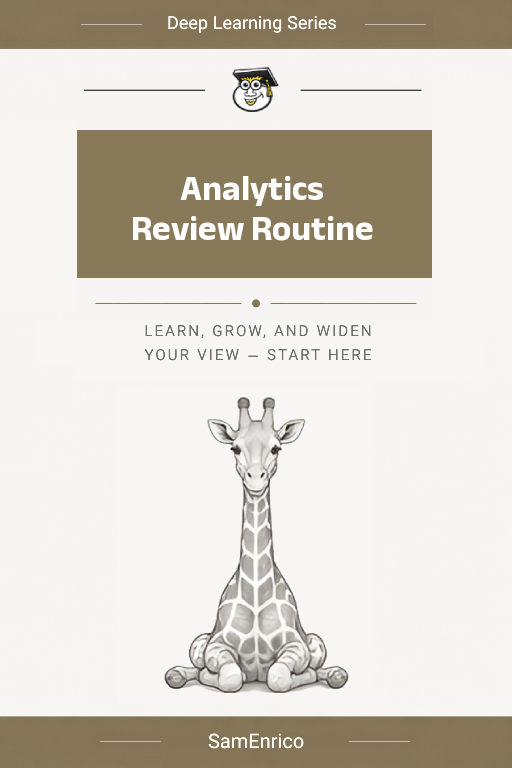
Analytics Review Routine eBook
Check retention graphs and best times to post ever
Check retention graphs and best times to post every Sunday.
Formats
Free sample
Chapter 1: The Sunday Trap--You are posting too much, and it is destroying your growth.Let me repeat that, because it sounds like heresy in an era where every social media guru screams “post daily or die.” The algorithm does not reward frequency. It rewards relevance. And relevance requires reflection—something you cannot do while you are scrambling to produce content seven days a week.I have worked with over three hundred creators, solopreneurs, and marketing teams across five years of analytics consulting. The ones who grow the fastest are almost never the ones who post the most. They are the ones who have mastered a single, counterintuitive skill: the ability to step away from the content factory, open their dashboards, and actually understand what the data is telling them.This book is about that skill.
But before we get to the how, we need to talk about the when.Why Sunday?Not because Sunday is magical. Not because the algorithms favor Sunday. But because Sunday is the single most underleveraged day in the entire creator economy.Let me paint a picture that you will recognize immediately. It is Thursday afternoon. You just posted a Reel that you spent three hours editing.
You check your phone seventeen times in the first hour. The view count climbs slowly, then stalls. Your stomach drops. You open the retention graph, but you do not really know what you are looking for. So you scroll through comments looking for validation.
You find three emojis and a complaint about your lighting. You close the app, defeated, and immediately start brainstorming tomorrow’s post because you are terrified of missing a day.That is not a growth strategy. That is a panic response dressed up as productivity.Now imagine a different scene. It is Sunday morning. Your coffee is hot.
Your phone is on Do Not Disturb. You open your dashboards not to post, not to scroll, but to analyze. You have sixty minutes blocked on your calendar. You are not competing with anyone because most creators are resting on Sunday. The comment sections are quiet.
The feeds are slower. The pressure is off.In that sixty minutes, you identify exactly what worked last week and why. You pinpoint the exact second where you lost half your audience. You discover that your best time to post is not Tuesday at 11 AM like the generic articles claim, but 8 PM on Sunday because your audience is full of parents who only scroll after bedtime. You queue up five posts for the coming week, including one old winner that ninety percent of your current followers have never seen.You close your dashboards.
You do not open them again until next Sunday.That is the Sunday Advantage. And it is not about the day of the week. It is about the ritual.The Three Lies You Have Been Told Before we go any further, I need to clear out some garbage. The creator economy runs on bad advice that feels good but works poorly. These three lies are the reason you are exhausted and stuck.Lie Number One: Post Every Day or the Algorithm Will Punish You.This is the most destructive lie in social media.
Platform algorithms do not care about your posting frequency. They care about whether people watch, share, and save your content. A single post that keeps people on the app for sixty seconds is worth more than thirty posts that lose attention in three seconds. In fact, posting too frequently can hurt you because you spread your limited creative energy too thin, producing mediocre content instead of great content. The creators who post daily are often the ones who have never looked at their retention graphs.
They are mistaking activity for progress.Lie Number Two: You Need More Data.No, you do not. You have plenty of data. What you lack is a framework for interpreting it. Most creators check their analytics the way someone might stare at a dashboard in a foreign language—they recognize the numbers but have no idea what story the numbers are telling. More data will not help you.
Better questions will. This entire book is built on three questions, not three hundred metrics.Lie Number Three: Going Viral Is the Goal.Viral posts feel amazing. They also teach you almost nothing about your audience. A viral spike is often driven by random factors—a celebrity share, a lucky algorithmic push, a cultural moment that passes in seventy-two hours. The creators who build sustainable careers do not chase viral waves.
They build systems that produce consistent, predictable growth week after week. Viral posts are the lottery. The Sunday routine is the salary.The 60-Minute Commitment Here is what I am asking you to do. It is small, but it is not easy.Block sixty minutes every Sunday on your calendar. Not Saturday.
Not Monday. Sunday. Put it in your phone right now if you are reading this on a digital device. Name it “Analytics Review” or “The Sunday Routine” or something that sounds important enough that you will not skip it.During that sixty minutes, you will not post anything immediately to your feed. Immediate posting is prohibited on Sunday.
You will not scroll your home feed. You will not reply to comments unless there is an emergency. You will not look at what your competitors posted.You will observe. You will interpret. And you will schedule.Observing means opening your dashboards and looking at retention graphs, engagement numbers, and timing data without judgment.
You are not looking for validation. You are not looking for proof that you are good enough. You are looking for patterns.Interpreting means asking the three questions that will become the spine of your Sunday routine: What worked? What flatlined? What does that tell me about their state of mind?
These are not complicated questions, but they are surprisingly difficult to answer honestly. Most creators cannot answer the third question at all because they have never stopped to consider their audience as actual humans with moods, schedules, and attention spans.Scheduling means loading your content queue for the coming week. You can schedule posts for Monday through Saturday. You can even schedule posts for next Sunday if you want. But you will not publish anything live during your Sunday block.
Publishing live on Sunday defeats the entire purpose of the routine because it pulls you out of analysis mode and into performance mode.One critical distinction before we proceed: scheduling is not posting. When you schedule a post for Tuesday at 10 AM, you are not posting on Sunday. You are preparing. This distinction matters because many creators will try to convince themselves that queuing counts as posting. It does not.
Posting means hitting publish and having the content appear on your feed immediately. That is banned on Sunday. Queuing means setting content for future dates. That is not only allowed but encouraged.The Science of Low Competition Why does this work? There is actual data behind the Sunday Advantage.Researchers have analyzed billions of social media interactions across platforms, and one pattern emerges consistently: user engagement on Sundays is surprisingly high, but creator supply is surprisingly low.…
This is the end of the free sample. Get the eBook to keep going. Buy now
About this book
Details
- Author
- Bernal Eugene
- Publisher
- SamEnrico
- Language
- English
- Genre
- Non-Fiction, Non-Obvious Career, Analytics Review, Optimization
- Released
- 2026-06-01
- Pages (approx.)
- 140
- Available as
- eBook, Audiobook

Read better in the ZLOADR app
Your eBooks on your phone or tablet. Sign in with your SamEnrico account and start reading.
More by Bernal Eugene
 Batch Contract Processing AI GuideBernal Eugene$11.99
 Homelessness DBT GuideBernal Eugene$11.99
 Kenya AGPO Grant GuideBernal Eugene$11.99
 Women Imposter Phenomenon GuideBernal Eugene$11.99
 Headache Relief GuideBernal Eugene$11.99
 Performance Review Anxiety GuideBernal Eugene$11.99
 Indigenous Spiritual Crisis TrainingBernal Eugene$11.99
 The Breath And CreativityBernal Eugene$11.99
 Active Listening in ConflictBernal Eugene$11.99
 The Secret Crown: The Princess Who Defied a DynastyBernal Eugene$11.99
 The Silent Storm: The Unsung Hero of the Battle of BritainBernal Eugene$11.99
 The Silent Cartographer: Mapping Death in the AbyssBernal Eugene$11.99