
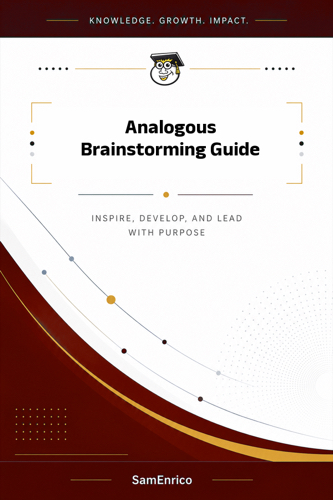
Analogous Brainstorming Guide eBook
Solve problems by comparing to unrelated fields.
by Cates Riva
Solve problems by comparing to unrelated fields.
Formats
Free sample
Chapter 1: The Obvious Trap--–- The product manager had spent three weeks optimizing the checkout flow. He had reduced the confirmation screen from five seconds to two, streamlined the form fields from twelve to seven, and added a progress indicator. His dashboard showed a 4% improvement in completion rates. He was proud.A junior designer walked by, glanced at his screen, and asked, “Why not just remove the confirmation screen entirely?”The room went quiet. The product manager opened his mouth, then closed it.
He had no good answer. The confirmation screen had always been there. Every competitor had one. He had never thought to question it.They removed the screen. Completion rates jumped 17% in one week.The obvious solution—making the existing flow faster—had actively blocked the better solution: eliminating the unnecessary step.
This is not a story about stupidity or oversight. It is a story about how the human brain works against us when we face problems.Welcome to the trap of the obvious.The Pattern Recognition Engine Your brain is the most sophisticated pattern-matching machine ever assembled. It processes eleven million bits of information per second from your senses, compares incoming data to stored memories, and delivers a coherent experience of reality. This is a miracle of evolution. Without it, you could not cross a street, recognize a face, or boil an egg.But this same machinery becomes a liability when you need to solve novel problems.Here is what happens inside your head when you encounter a problem: Your brain rapidly scans your memory for similar situations from the past.
It retrieves the most recent, most frequent, or most emotionally charged solution that worked before. Then it presents that solution to your conscious mind as “the answer.” This happens in milliseconds, long before you have time to reflect.The problem is not that this first answer is always wrong. Sometimes it is perfectly fine. The problem is that this first answer then actively suppresses alternative pathways. Your brain, having found a plausible solution, reduces cognitive resources allocated to the problem.
You stop searching because you believe you have found the answer.This is what psychologists call the Einstellung effect—a German word roughly translating to “attitude” or “set.” It describes how established mental patterns block better solutions from emerging.The Expert’s Paradox If you think expertise protects you from this trap, you are dangerously mistaken.Experts are more vulnerable to the Einstellung effect than novices. This seems counterintuitive. Shouldn’t more knowledge lead to better problem-solving? Not when the problem requires fresh thinking.Here is why: Experts have more well-worn neural pathways. Their brains have solved thousands of similar problems in their domain.
Each successful solution reinforces the same mental circuits. When a new problem arrives—especially one that superficially resembles past problems but has a different underlying structure—the expert’s brain fires the familiar pattern even faster than a novice’s would.In one famous study, chess masters were given puzzles that had a winning move sequence that was not obvious. They found the winning move quickly. But when researchers gave them puzzles where the obvious, familiar sequence was a trap—where a counterintuitive move was actually winning—the masters performed worse than intermediate players. Their expertise blinded them to the better path.This is the expert’s paradox: The same knowledge that makes you fast and accurate in routine situations makes you rigid and blind in novel ones.Consider the product manager again.
He was not incompetent. He was an expert in e-commerce optimization. His brain had solved hundreds of checkout problems using familiar patterns: faster loading, fewer fields, better labels. That pattern had worked before. So his brain delivered it again.
The idea of elimination did not occur because his pattern-matching engine did not have “eliminate the screen” as a stored solution from previous successes.The visitor—the junior designer—had less domain expertise. Her brain did not automatically retrieve the optimization pattern. So she saw what the expert missed.Functional Fixedness: Why You Can’t See the Brick as a Paperweight The Einstellung effect is one mechanism. Functional fixedness is another, closely related trap.Functional fixedness is the inability to see novel uses for familiar objects or concepts. In the classic experiment, researchers gave participants a candle, a box of thumbtacks, and a book of matches.
The task: attach the candle to a wall so it burns without dripping wax on the floor. Most participants tried tacking the candle directly to the wall (failed), melting wax to glue it (failed), or lighting matches near it (failed).The solution? Empty the thumbtack box, tack the box to the wall, and place the candle inside. But participants could not see the box as anything other than a thumbtack container. Its function was fixed in their minds.Functional fixedness applies to concepts as well as objects.
In business, people cannot see their product as anything other than what it currently is. In organizations, people cannot see their role as anything other than what it has always been. In strategy, people cannot see their industry as anything other than how it has always been structured.Every industry is filled with functional fixedness. Kodak could not see its cameras as anything other than film-based devices. Blockbuster could not see its stores as anything other than physical rental locations.
Taxi companies could not see their business as anything other than street-hailed service. In each case, the obvious solution to competitive threats was to do the same thing better, faster, or cheaper. The better solution—reinventing the business model—remained invisible because their brains could not reframe the function of their assets.Vertical vs. Lateral Thinking Edward de Bono, the physician and creativity researcher who coined the term “lateral thinking,” offers a useful distinction. Vertical thinking digs a deeper hole in the same spot.
Lateral thinking moves the hole.Vertical thinking is logical, sequential, and analytical. It takes an existing idea and refines it. It asks: How can we do this better? What is the next logical step? What does the data suggest?
Vertical thinking is essential. It is how you execute, optimize, and improve. Most business education rewards vertical thinking.Lateral thinking is disruptive, associative, and synthetic. It abandons the current hole and digs elsewhere. It asks: Why are we digging here at all?
What if we dug over there? What if we used a shovel differently? What if we did not dig at all?The trap of the obvious is that vertical thinking feels productive while lateral thinking feels wasteful. When you optimize the checkout flow by shaving seconds, you have measurable progress. You can chart the 4% improvement.
When you question whether the confirmation screen should exist at all, you have no immediate metric. You may spend an hour debating only to conclude the screen is necessary. That feels like wasted time.But the asymmetry is brutal. A year of 4% optimizations yields a 60% cumulative improvement if you are lucky. One act of elimination—removing the confirmation screen—yielded a 17% improvement in one week.
Lateral thinking produces discontinuous leaps. Vertical thinking produces incremental steps. Both are necessary. But most of us overuse vertical because it feels…
This is the end of the free sample. Get the eBook to keep going. Buy now
About this book
Details
- Author
- Cates Riva
- Publisher
- SamEnrico
- Language
- English
- Genre
- Non-Fiction, Self-Help, Analogy
- Released
- 2026-06-06
- Pages (approx.)
- 150
- Available as
- eBook, Audiobook

Read better in the ZLOADR app
Your eBooks on your phone or tablet. Sign in with your SamEnrico account and start reading.
More by Cates Riva
 Ergonomic WorkspaceCates Riva$11.99
 Steeple Hand GestureCates Riva$11.99
 Immigrant Child Acting CareerCates Riva$11.99
 Remote Work Focus Apps GuideCates Riva$11.99
 Dream Exam LogCates Riva$11.99
 Anger at Childs PartnerCates Riva$11.99
 Conversation Starters for CarpoolCates Riva$11.99
 The Samurai Fans of Japan: How Soccer Ultras Transformed a Nation (1960s-1970s)Cates Riva$11.99
 The Last Stand of the Varangian Guard: Byzantium's Forgotten Heroes at ManzikertCates Riva$11.99
 How to Start a Exfoliated Vermiculite Business (Beginners Guide)Cates Riva$11.99
 Citation for Legal Cases Quick GuideCates Riva$12.99
 Launching A Youtube Channel For Your Brand HandbookCates Riva$12.99
You may also like
 Hong Kong Handover 1997Dunn Johnnie$11.99
 Zumba For Postnatal Recovery CourseNeal Christian$11.99
 Zumba for BeginnersLadner Nikia$11.99
 YouTube Comment Mining GuideHumes Pandora$12.99
 Worry Box MeditationCarlin Rudy$11.99
 Workplace Stress MeditationNguyen Lynn$11.99
 Workplace Stress and Sleep RepairHawley Ivory$11.99
 Workplace Perfectionism CureDelaney Jeffry$11.99
 Workplace Injustice Anger GuideWallen Isabelle$11.99
 Work Addiction and Burnout LinkGreenwood Ester$11.99
 Women in Yoga and WellnessBeattie Galina$11.99
 Women in Stand Up ComedyChun Evangeline$11.99