
Non-FictionStudent's ShortcutAMS Style
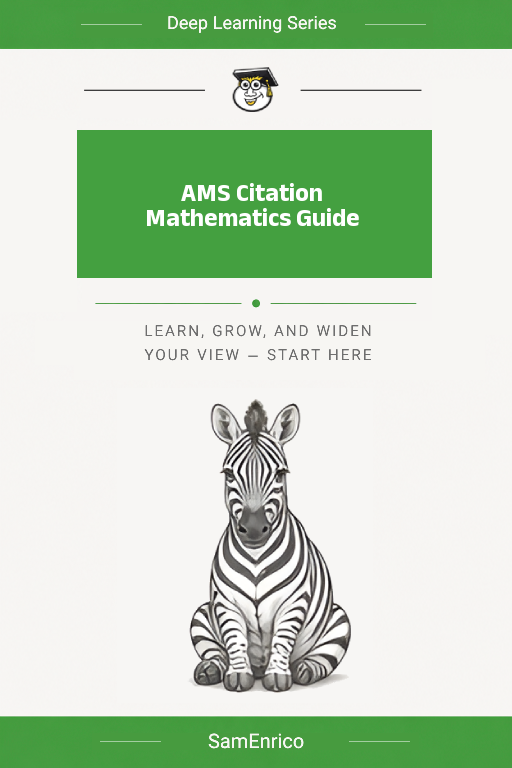
AMS Citation Mathematics Guide
Cite mathematical papers using AMS style including
Cite mathematical papers using AMS style including arXiv preprints and theorem numbering.
Formats
About this book
Free sample
Chapter 1: The Citation Compass--Mathematics is often described as a universe of abstract truths, where a single proof can stand for centuries and a single theorem can unlock entire fields of inquiry. But even in this rarefied realm, one mundane reality persists: without proper attribution, the entire edifice crumbles. Citations in mathematics are not mere academic formalities—they are the invisible threads that weave individual results into a coherent, verifiable, and cumulative body of knowledge. This chapter argues that mastering AMS citation style is not an exercise in pedantry but an essential skill for participating in the mathematical community. We will explore why citation integrity matters, how mathematical citation practices differ from those in other disciplines, and why the American Mathematical Society (AMS) has become the gold standard for mathematical publishing.The Unseen Architecture of Mathematical Knowledge Imagine a cathedral built over centuries.
Each generation adds a new chapel, a taller spire, or a reinforced flying buttress. No architect could design the entire structure at once; instead, each addition must anchor itself securely to what came before. Mathematical research operates the same way. A theorem proved in 2025 may depend crucially on a lemma from 1995, which in turn relies on a definition from 1850. Citations are the architectural drawings that show how each new result connects to the existing structure.When a mathematician writes, "By Theorem 3.2 in [14], we have...", they are doing far more than giving credit.
They are inviting the reader to retrace a logical pathway, to verify that each step rests on solid ground. If the citation is incorrect—if Theorem 3.2 actually appears in [15] or if [14] has been retracted—the entire argument becomes suspect. This is why mathematical citation standards are among the most stringent in all of academia.Consider a cautionary tale. In the early 2000s, a well-respected analyst published a striking new result in a top journal. The proof seemed elegant and concise, relying heavily on a single lemma from a 1987 paper.
Six months after publication, a graduate student discovered that the lemma had been misquoted: the 1987 paper proved a weaker statement under stricter hypotheses. The analyst had…
This is the end of the free sample. Get the eBook to keep going. Buy now
Contents
- Chapter 1
- Chapter 2
- Chapter 3
- Chapter 4
- Chapter 5
- Chapter 6
- Chapter 7
- Chapter 8
- Chapter 9
- Chapter 10
- Chapter 11
- Chapter 12
Details
- Author
- Barrios Amado
- Publisher
- SamEnrico
- Language
- English
- Genre
- Non-Fiction, Student's Shortcut, AMS Style
- Released
- 2026-05-26
- Pages (approx.)
- 151
- Available as
- eBook, Audiobook

Read better in the ZLOADR app
Your eBooks on your phone or tablet. Sign in with your SamEnrico account and start reading.
More by Barrios Amado
 Financial Stress and HealthBarrios Amado$11.99
 Jimmy Hoffa Cold Case Modern InvestigationBarrios Amado$11.99
 Funeral Anxiety GuideBarrios Amado$11.99
 Falklands War Peace CampaignerBarrios Amado$11.99
 Trello Card Cover Images GuideBarrios Amado$11.99
 Backwards Goal PlanningBarrios Amado$11.99
 Mastodon Decentralized ComparisonBarrios Amado$11.99
 Job Loss and MedicationBarrios Amado$11.99
 The Silk Road Phantom: The Great Escape from Baghdad's Central PrisonBarrios Amado$11.99
 The Silk and the Sword: A Marriage of EmpiresBarrios Amado$11.99
 How to Produce Multi-game TablesBarrios Amado$11.99
 A Collector's Handbook to the Rover 80Barrios Amado$11.99
You may also like
 Hong Kong Handover 1997Dunn Johnnie$11.99
 Zumba For Postnatal Recovery CourseNeal Christian$11.99
 Zumba for BeginnersLadner Nikia$11.99
 YouTube Comment Mining GuideHumes Pandora$12.99
 Worry Box MeditationCarlin Rudy$11.99
 Workplace Stress MeditationNguyen Lynn$11.99
 Workplace Stress and Sleep RepairHawley Ivory$11.99
 Workplace Perfectionism CureDelaney Jeffry$11.99
 Workplace Injustice Anger GuideWallen Isabelle$11.99
 Work Addiction and Burnout LinkGreenwood Ester$11.99
 Women in Yoga and WellnessBeattie Galina$11.99
 Women in Stand Up ComedyChun Evangeline$11.99