
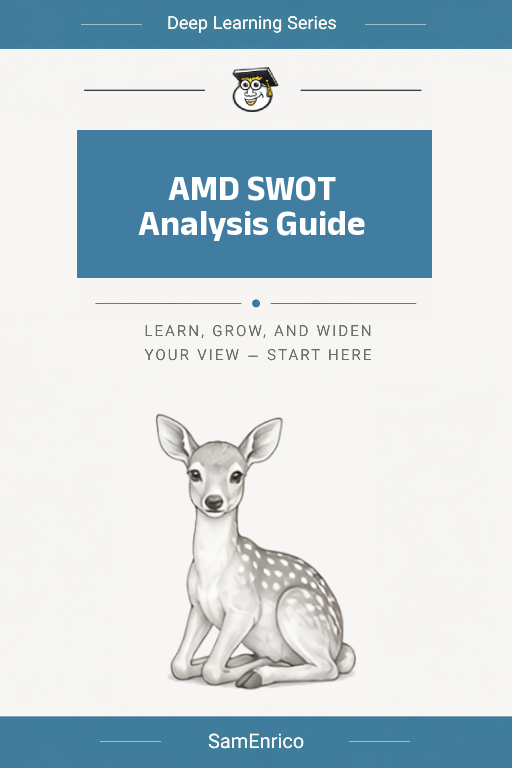
Non-FictionStrategic AtlasSemiconductor
AMD SWOT Analysis Guide Audiobook
Evaluate CPU/GPU gains, data center share growth,
by Payne Marcos
Evaluate CPU/GPU gains, data center share growth, competitive threat from Nvidia, and AI software stack.
Formats
Free sample
Chapter 1: The Silent Inflection--The most dangerous moment in any industry is not when the leader is challenged openly—it is when the rules of the game change so quietly that only a handful of strategists notice. For most of the past decade, the semiconductor industry operated under a simple binary: Intel versus AMD in the central processing unit (CPU) market, and Nvidia versus everyone else in the graphics processing unit (GPU) market. That binary is now obsolete. As of the first quarter of 2026, a new competitive architecture has emerged—one where the old rivals find themselves on unexpected terrain, where the lines between CPU and GPU markets have blurred into a single battlefield for artificial intelligence (AI) dominance, and where a company that nearly went bankrupt a decade ago finds itself holding one of the most strategic positions in the global economy.This book is about Advanced Micro Devices (AMD) at that precise inflection point. It is not a history book, though history matters.
It is not a cheerleading exercise for the stock, though financial outcomes matter enormously. It is a strategic analysis grounded in the four pillars that will determine AMD's trajectory over the next twenty-four to thirty-six months: CPU performance, GPU performance, data center share growth, and AI software stack maturity. These four pillars form the backbone of everything that follows. Before we examine them in detail, however, we must understand why AMD matters at this specific moment, what has changed in the competitive landscape, and how this book will equip you to make your own judgments about the company's future.The central argument of this chapter—and indeed of the entire book—is that we have entered the era of Agentic AI, and that this shift has fundamentally reset the economics of the data center. Agentic AI refers to artificial intelligence systems that do not simply respond to prompts but actively execute complex, multi-step tasks: booking travel, writing and deploying code, managing supply chains, or orchestrating other AI agents.
These systems require a radically different ratio of compute resources than the generative AI models that preceded them. Where a large language model (LLM) like GPT-4 might require one CPU core for every four to eight GPUs during inference, an Agentic AI workload demands roughly a one-to-one ratio of CPU cores to GPU accelerators. This seemingly technical detail has profound strategic implications—because it has doubled the effective total…
This is the end of the free sample. Get the Audiobook to keep going. Buy now
About this book
Details
- Author
- Payne Marcos
- Publisher
- SamEnrico
- Language
- English
- Genre
- Non-Fiction, Strategic Atlas, Semiconductor
- Released
- 2026-06-01
- Pages (approx.)
- 139
- Available as
- eBook, Audiobook

Listen in the VoxFlicks app
Audiobooks and audio dramas wherever you go. Sign in with your SamEnrico account and press play.
More by Payne Marcos
 Secondhand Family LifePayne Marcos$11.99
 Gratitude for FamiliesPayne Marcos$11.99
 Senior Opinion Esteem GuidePayne Marcos$11.99
 Emotional Intelligence for ManagersPayne Marcos$11.99
 The Self Esteem After Partner's BetrayalPayne Marcos$11.99
 Banksy: The Unseen Hand - How a Mysterious Artist Shaped Modern Protest ArtPayne Marcos$11.99
 How to Start a Music Directors - Independent BusinessPayne Marcos$11.99
 Access Control System TechnicianPayne Marcos$11.99
 Accounting Formulas for Exam SuccessPayne Marcos$12.99
 Understanding Myelodysplastic SyndromesPayne Marcos$17.99
You may also like
 Hong Kong Handover 1997Dunn Johnnie$11.99
 Zumba For Postnatal Recovery CourseNeal Christian$11.99
 Zumba for BeginnersLadner Nikia$11.99
 YouTube Comment Mining GuideHumes Pandora$12.99
 Worry Box MeditationCarlin Rudy$11.99
 Workplace Stress MeditationNguyen Lynn$11.99
 Workplace Stress and Sleep RepairHawley Ivory$11.99
 Workplace Perfectionism CureDelaney Jeffry$11.99
 Workplace Injustice Anger GuideWallen Isabelle$11.99
 Work Addiction and Burnout LinkGreenwood Ester$11.99
 Women in Yoga and WellnessBeattie Galina$11.99
 Women in Stand Up ComedyChun Evangeline$11.99