
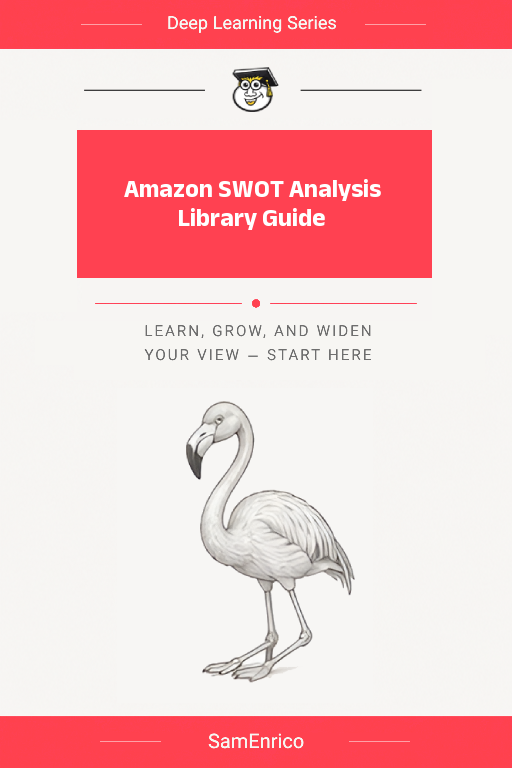
Non-FictionStrategic AtlasEcommerce
Amazon SWOT Analysis Library Guide eBook
Evaluate e-commerce dominance, AWS profitability,
Evaluate e-commerce dominance, AWS profitability, labor relations, and retail margin pressures.
Formats
Free sample
Chapter 1: The Invisible Handcuffs--–- The moment Sarah Chen realized she was trapped, it was already too late. She wasn't in a physical prison. She was sitting on her couch in Phoenix, Arizona, scrolling through her bank statement on a Wednesday evening in March 2024. The numbers blurred as she added them up: 347at Amazonin January,347 at Amazon in January, 347at Amazonin January,412 in February, and now, with nine days left in March, already $289. Her son's birthday presents.
Her own impulse buys at 11 PM when she couldn't sleep. The "subscribe and save" items she had forgotten to cancel—lavender-scented trash bags, gluten-free protein bars no one in her family would eat, a twelve-pack of AAA batteries even though her last battery order was still sealed in a drawer.She had not planned to spend $1,048 in three months. She had not budgeted for it. She could not explain where the money went, only that each individual purchase had seemed reasonable at the time. Nine dollars for a phone charger cable.
Fourteen dollars for a book she never read. Twenty-two dollars for a kitchen gadget that was now collecting dust. Individually, these were rounding errors. Collectively, they were a leak in her household budget that had drained over ten thousand dollars in the past three years.When she tried to cancel her Prime membership the next morning, Amazon presented her with a screen that listed everything she would lose: free two-day shipping, Prime Video, Prime Music, Prime Reading, free grocery delivery from Whole Foods, exclusive deals on baby products, early access to Lightning Deals, and a photo storage service she had forgotten existed. The cancel button was small and gray, positioned below a large yellow button that read, "Continue My Membership." She closed the browser tab.
The trap held.This chapter reveals the true nature of Amazon's most powerful strength: not its logistics network, not its cloud computing profits, but its ability to manufacture loyalty through behavioral engineering so sophisticated that customers cannot tell where their choices end and the algorithm's predictions begin. The Prime ecosystem is not a loyalty program. It is a set of invisible handcuffs, and most members wear them willingly because the process of removal has been made more painful than the confinement.The Architecture of Dependency To understand how Amazon locks in customers, one must first abandon the concept of voluntary choice. Classical economics assumes that consumers rationally evaluate costs and benefits, then select the option that maximizes their utility. Amazon's behavioral scientists—and yes, the company employs dozens of Ph Ds in cognitive psychology and behavioral economics—have spent two decades demonstrating that this assumption is false.
Human decision-making is riddled with systematic biases, and each bias can be exploited to create attachment.The most powerful bias in Amazon's arsenal is what psychologists call status quo bias. Humans prefer the current state of affairs over change, even when change would objectively improve their situation. In one classic study, researchers gave participants a coffee mug and then offered to trade it for a chocolate bar of equal value. Only eleven percent accepted the trade, even though when another group was given the chocolate bar first, only ten percent wanted to trade for the mug. The mug was not inherently more valuable.
It was simply the status quo.Amazon weaponizes this bias through its cancellation flow. The company's own internal data, leaked to the Wall Street Journal in 2022, showed that each additional click in the cancellation process reduced membership cancellations by seven percent. The current process requires three clicks and two confirmation screens. That means cancellations are approximately twenty percent lower than they would be with a one-click process. Multiply that by two hundred million Prime members, and the additional revenue from friction alone exceeds one billion dollars annually.But the architecture runs deeper than clicks.
Amazon has engineered what addiction researchers call variable reinforcement schedules. When a gambler pulls a slot machine lever, they do not know whether they will win. The unpredictability of the reward increases dopamine release and strengthens the behavioral loop. Amazon's "Buy Box" works the same way. The customer does not know which seller's offer will appear as the default purchase option.
They do not know whether the price will drop tomorrow. They do not know whether the item they are viewing will still be in stock in an hour. Each click is a lever pull, and the reward—a good price, fast shipping, a serendipitous recommendation—arrives unpredictably.The result is a behavioral loop that neuroscientists have measured directly. In a 2019 f MRI study conducted at Stanford University, participants who browsed Amazon showed elevated activity in the nucleus accumbens, the brain's reward center, identical to the activity observed in problem gamblers viewing slot machines. The study's lead author, Dr.
Anna Lembke, later testified before Congress that Amazon's interface "exploits the same neurobiological pathways as cocaine, but without the social stigma."The Prime Membership as Sunk Cost Trap The annual Prime fee of 139isnotamembershipcostinanyconventionalsense.Itiswhatbehavioraleconomistscalla∗∗sunkcost∗∗—aninvestmentthatcannotberecoveredandshouldthereforehavenobearingonfuturedecisions.Inrationalchoicetheory,thedecisiontorenew Primeshoulddependonlyonwhethertheexpectedbenefitsoverthenextyearexceed139 is not a membership cost in any conventional sense. It is what behavioral economists call a **sunk cost**—an investment that cannot be recovered and should therefore have no bearing on future decisions. In rational choice theory, the decision to renew Prime should depend only on whether the expected benefits over the next year exceed 139isnotamembershipcostinanyconventionalsense.Itiswhatbehavioraleconomistscalla∗∗sunkcost∗∗—aninvestmentthatcannotberecoveredandshouldthereforehavenobearingonfuturedecisions.Inrationalchoicetheory,thedecisiontorenew Primeshoulddependonlyonwhethertheexpectedbenefitsoverthenextyearexceed139. The fact that you paid $139 last year is irrelevant.Humans are not rational. The sunk cost fallacy is one of the most robust findings in behavioral economics: people who have paid for something are more likely to continue using it, even when continuing makes no sense.
In one famous experiment, researchers sold season tickets to a theater company at full price to one group and at a discount to another. The full-price group attended significantly more plays, even though both groups had the same schedule and the same financial incentive to attend. The higher sunk cost created a psychological obligation to "get their money's worth."Amazon exploits this fallacy through what the company internally calls the accelerated break-even threshold. The algorithm tracks each customer's purchase history and estimates, in real time, how many more orders they need to place to "justify" their annual membership. This estimate appears nowhere in the user interface—Amazon is too sophisticated to show customers a countdown clock.
But the estimate drives the recommendation engine. A customer who has not yet reached their break-even threshold sees more aggressive promotions for household staples (diapers, paper towels, batteries) because those items have high purchase frequency and low price sensitivity. The algorithm is not recommending what the customer wants. It is recommending what the customer needs to buy to avoid feeling wasteful.The effectiveness of this technique is measurable. Prime members spend two to three times more annually than non-members, but the spending curve is not linear.
The first ninety days after joining show a modest increase in spending—perhaps twenty to thirty percent. The second quarter shows a steeper increase. By the end of the first year, the typical Prime member is spending more than double their pre-Prime baseline. They have not discovered new needs. They have been guided into a…
This is the end of the free sample. Get the eBook to keep going. Buy now
About this book
Details
- Author
- Byrne Margarite
- Publisher
- SamEnrico
- Language
- English
- Genre
- Non-Fiction, Strategic Atlas, Ecommerce
- Released
- 2026-06-01
- Pages (approx.)
- 144
- Available as
- eBook, Audiobook

Read better in the ZLOADR app
Your eBooks on your phone or tablet. Sign in with your SamEnrico account and start reading.
More by Byrne Margarite
 Gratitude for Past SelfByrne Margarite$11.99
 Senior Gratitude Esteem GuideByrne Margarite$11.99
 Emotional Intelligence for BurnoutByrne Margarite$11.99
 Birthday Without PartyByrne Margarite$11.99
 Mindfulness for Insomnia Beginners GuideByrne Margarite$11.99
 The Lioness of Djenne: The Untold Love and War of Queen TassaditByrne Margarite$11.99
 Understanding Myocardium DisorderByrne Margarite$17.99
 Interest Formula HandbookByrne Margarite$12.99
 How to Become a Label RemoverByrne Margarite$11.99
 Automotive Finance And Insurance ManagerByrne Margarite$11.99
You may also like
 Hong Kong Handover 1997Dunn Johnnie$11.99
 Zumba For Postnatal Recovery CourseNeal Christian$11.99
 Zumba for BeginnersLadner Nikia$11.99
 YouTube Comment Mining GuideHumes Pandora$12.99
 Worry Box MeditationCarlin Rudy$11.99
 Workplace Stress MeditationNguyen Lynn$11.99
 Workplace Stress and Sleep RepairHawley Ivory$11.99
 Workplace Perfectionism CureDelaney Jeffry$11.99
 Workplace Injustice Anger GuideWallen Isabelle$11.99
 Work Addiction and Burnout LinkGreenwood Ester$11.99
 Women in Yoga and WellnessBeattie Galina$11.99
 Women in Stand Up ComedyChun Evangeline$11.99