
Non-FictionStrategic AtlasRetention Strategy
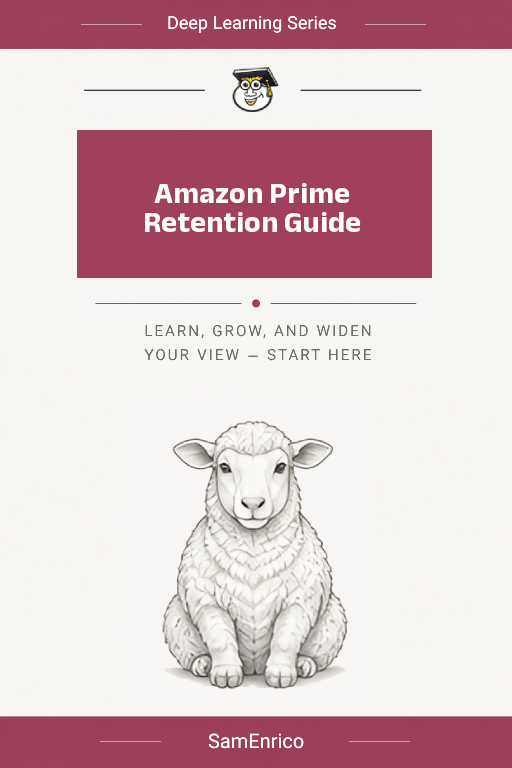
Amazon Prime Retention Guide eBook
Analyze free shipping, video streaming, and Whole
Analyze free shipping, video streaming, and Whole Foods discounts that drive 90%+ renewal rates for membership.
Formats
Free sample
Chapter 1: The $139 Trap–- The first time I canceled Amazon Prime, I lasted eleven days. It was February, cold, and my daughter needed a last-minute science fair board. The store was twenty minutes away. Amazon could deliver it by morning. I logged back in, resubscribed, and told myself it was for the science fair.
It wasn't. The trap had already been set, and I had walked right back into it.This is not a story about convenience. This is a story about how a 139annualfeerewiresthehumanbrain.Mostloyaltyprogramsassumecustomersarerationalcalculatorswhoweighcostsandbenefitsandmakecold,logicaldecisionsaboutwhethertostayorleave.Amazonassumessomethingmuchdarkerandmuchmoreaccurate:customersareemotionalcreatureswhohatewastingmoney,hatemakingdecisions,andwillhappilyspend139 annual fee rewires the human brain. Most loyalty programs assume customers are rational calculators who weigh costs and benefits and make cold, logical decisions about whether to stay or leave. Amazon assumes something much darker and much more accurate: customers are emotional creatures who hate wasting money, hate making decisions, and will happily spend 139annualfeerewiresthehumanbrain.Mostloyaltyprogramsassumecustomersarerationalcalculatorswhoweighcostsandbenefitsandmakecold,logicaldecisionsaboutwhethertostayorleave.Amazonassumessomethingmuchdarkerandmuchmoreaccurate:customersareemotionalcreatureswhohatewastingmoney,hatemakingdecisions,andwillhappilyspend1,000 to avoid feeling like they wasted $139.The $139 annual Prime fee is not a transaction.
It is a psychological handcuff. And once you understand how it works, you will never look at subscription pricing the same way again.The Invention of the Handcuff Before 2005, Amazon offered free shipping on orders over $25. That was it. No membership, no annual fee, no video, no Whole Foods. Customers paid per shipment or bundled their purchases to hit the minimum.
Then a product manager named Greg Greeley (who would later become CEO of Amazon's worldwide Prime business) proposed something radical: what if customers paid a flat annual fee and got unlimited free two-day shipping?The conventional retail wisdom at the time was that this would bankrupt the company. Shipping costs were real, predictable, and per-order. An annual fee would either be too low to cover costs (disaster) or too high to attract customers (also a disaster). Greeley's team ran the numbers and landed on $79—high enough to cover the average shipping costs of frequent shoppers, low enough to feel like a "maybe" for most households.But something unexpected happened when they launched Prime in 2005. Customers didn't just use the free shipping.
They changed their entire shopping behavior. They bought more. They bought more often. They bought things they never would have bought before, simply because the marginal cost of another order was zero. A 10booknolongercost10 book no longer cost 10booknolongercost10 plus 5shipping.Itcost5 shipping.
It cost 5shipping.Itcost10. The shipping was "free," even though they had already paid for it.This is the sunk cost fallacy in its purest form. Behavioral economist Richard Thaler, who later won a Nobel Prize for his work on mental accounting, identified the mechanism decades before Amazon exploited it at scale. Once people pay for something, they want to use it enough to justify the payment. This is why gym memberships are so profitable—people pay upfront, go three times, feel virtuous, and then stop going, but they rarely cancel because that would mean admitting they wasted the money.Amazon turned this psychological quirk into a business model.
The 79fee(now79 fee (now 79fee(now139) sits in the customer's mind as an investment that must be recouped. Every time they buy something on Amazon, they mentally deduct the shipping cost they "saved." After enough purchases, the fee feels justified. And once it feels justified, canceling feels like throwing away something you already earned.The 7.2x Threshold Amazon's internal data reveals a specific mathematical inflection point for retention. It is not a range or a vague feeling. It is a hard number: members need to perceive at least 7.2 times the value of the annual fee to feel secure in their membership.
For the current 139fee,thatmeans139 fee, that means 139fee,thatmeans1,000 in perceived annual benefits.Perceived is the operative word. Actual savings can be much lower. Many Prime members do not save 1,000ayearonshipping.Theymightsave1,000 a year on shipping. They might save 1,000ayearonshipping.Theymightsave200 or $300 in actual postage costs. But Amazon has engineered a system where perceived savings are significantly higher than real savings.
How?First, Amazon shows customers their "savings" at checkout. "You saved 5.99onshippingwith Prime."That5.99 on shipping with Prime." That 5.99onshippingwith Prime."That5.99 is not money the customer would have paid—they would have either bundled items or shopped elsewhere—but it feels real in the moment. Second, Amazon includes the value of non-shipping benefits in its savings calculations. Prime Video, for example, is valued at 8.99permonthin Amazon′sinternalmessaging,eventhoughmanymemberswouldneverpayforitseparately.Third,Amazonuses Prime Dayasajustificationevent(moreonthisin Chapter7).Amemberwhosaves8.99 per month in Amazon's internal messaging, even though many members would never pay for it separately. Third, Amazon uses Prime Day as a justification event (more on this in Chapter 7).
A member who saves 8.99permonthin Amazon′sinternalmessaging,eventhoughmanymemberswouldneverpayforitseparately.Third,Amazonuses Prime Dayasajustificationevent(moreonthisin Chapter7).Amemberwhosaves50 on Prime Day mentally credits that entire $50 to their Prime membership, even though the deals were available only because of Prime.The result is a Value-to-Cost Ratio (VCR) that hovers just above 7.2x for most members. When VCR drops below 5x, cancellation ideation begins. When it stays above 7x, cancellation feels not just unnecessary but actively irrational. Amazon knows this because they have run thousands of A/B tests on cancellation flows, exit surveys, and retention cohorts. The 7.2x threshold is as reliable as gravity.The Spend Escalator Here is where the handcuff tightens.
The sunk cost effect does not stop at the annual fee. It compounds over time through what Amazon calls the Spend Escalator (though they never use that term publicly). Year 1 Prime members spend an average of 1,200on Amazon.By Year3,thatnumberhasclimbedto1,200 on Amazon. By Year 3, that number has climbed to 1,200on Amazon.By Year3,thatnumberhasclimbedto2,800. By Year 5, it exceeds $4,000 for a significant subset of members.Why does spending increase with tenure?
Not because Amazon gets better at selling things. Because the customer's mental accounting becomes more aggressive over time. In Year 1, a member might think, "I paid 139,so Ineedtosave139, so I need to save 139,so Ineedtosave139 to break even." By Year 3, they think, "I have been a member for three years. I have spent 417onfees.Overthattime,Ihavesavedapproximately417 on fees. Over that time, I have saved approximately 417onfees.Overthattime,Ihavesavedapproximately2,100 on shipping (in their mind).
If I cancel now, I lose access to that entire history of savings."This is the most dangerous form of sunk cost: past savings that cannot be taken away but feel like they will be invalidated if you leave. It is the same psychology that keeps people in timeshares. You have already paid. You have already used it. But leaving feels like erasing all the value you extracted.The Spend Escalator has another effect: it increases the perceived switching cost.
A Year 1 Prime member who cancels can move their shopping to Walmart or Target with minimal friction. A Year 5 Prime member who cancels would need to rebuild their entire purchasing history, re-enter shipping addresses for multiple family members, retrain a new algorithm on their preferences, and find new sources for the Subscribe & Save items that arrive automatically every month. That is not a decision. It is a project. And most people do not start projects on a Tuesday afternoon just to save $139.The Rationalization Loop The sunk cost effect creates a self-reinforcing rationalization loop.
Here is how it works:Step 1: You pay $139 for Prime. This is the trigger.Step 2: You feel mild pressure…
This is the end of the free sample. Get the eBook to keep going. Buy now
About this book
Details
- Author
- Ragsdale Carmella
- Publisher
- SamEnrico
- Language
- English
- Genre
- Non-Fiction, Strategic Atlas, Retention Strategy
- Released
- 2026-05-29
- Pages (approx.)
- 140
- Available as
- eBook, Audiobook

Read better in the ZLOADR app
Your eBooks on your phone or tablet. Sign in with your SamEnrico account and start reading.
More by Ragsdale Carmella
 Bipolar Ketogenic Diet EvidenceRagsdale Carmella$11.99
 FERPA Data Breach ReviewRagsdale Carmella$11.99
 Recovery Housing MAT GuideRagsdale Carmella$11.99
 Nurse Imposter Syndrome GuideRagsdale Carmella$11.99
 The Body Image Intimacy GuideRagsdale Carmella$11.99
 The Poisoned Heiress: The Dark Legacy of Doña FranciscaRagsdale Carmella$11.99
 How to Become a Turbine SubassemblerRagsdale Carmella$11.99
 Understanding Primary Tubular Proximal AcidosisRagsdale Carmella$17.99
 Executive Summary Closing Call GuideRagsdale Carmella$12.99
 Corporate Finance and Budgeting SystemsRagsdale Carmella$11.99
You may also like
 Hong Kong Handover 1997Dunn Johnnie$11.99
 Zumba For Postnatal Recovery CourseNeal Christian$11.99
 Zumba for BeginnersLadner Nikia$11.99
 YouTube Comment Mining GuideHumes Pandora$12.99
 Worry Box MeditationCarlin Rudy$11.99
 Workplace Stress MeditationNguyen Lynn$11.99
 Workplace Stress and Sleep RepairHawley Ivory$11.99
 Workplace Perfectionism CureDelaney Jeffry$11.99
 Workplace Injustice Anger GuideWallen Isabelle$11.99
 Work Addiction and Burnout LinkGreenwood Ester$11.99
 Women in Yoga and WellnessBeattie Galina$11.99
 Women in Stand Up ComedyChun Evangeline$11.99