
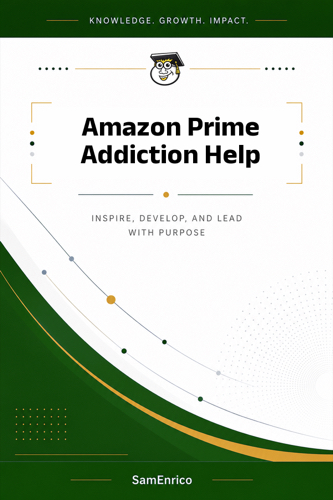
Non-FictionSelf-HelpAmazon Addiction
Amazon Prime Addiction Help eBook
Break free from free shipping triggers and impulse
Break free from free shipping triggers and impulse buys using this practical guide.
Formats
Free sample
Chapter 1: The Dopamine Slot Machine--–- The first time I realized I had a problem, I was standing in my kitchen, holding two identical garlic presses. One had just arrived in an Amazon box. The other had been sitting in the back of a drawer for eighteen months, covered in dried garlic and shame. I had ordered the new one because I couldn't find the old one. I couldn't find the old one because I had so much stuff that nothing had a home.
And I had so much stuff because ordering from Amazon had become something I did without thinking—like breathing, or checking my phone, or apologizing for things that weren't my fault.I returned the new garlic press. But I kept the feeling. That feeling was the real problem.Let me tell you what happened inside your brain the last time you clicked "Buy Now." Then let me show you how to take it back.The Three-Second Heist Every time you make an impulse purchase on Amazon, something remarkable happens in your neurochemistry. Remarkable and terrible. Within three seconds of clicking that yellow button, your brain releases a surge of dopamine—not when the package arrives, not when you open the box, but in the moment of purchase itself.
The anticipation of reward is chemically more powerful than the reward itself. This is not a design flaw. This is the design.Amazon's user interface was not built by people who want you to save money. It was built by people who have studied the exact contours of human impulse control and engineered a system that bypasses it entirely. The one-click button is not a convenience feature.
It is a behavioral weapon. The "Buy Again" section is not a helpful reminder. It is a relapse trigger. The countdown timer on a Lightning Deal is not an honest countdown. It is a manufactured anxiety bomb designed to make your prefrontal cortex—the part of your brain responsible for rational decision-making—shut down completely.We need to understand the machinery before we can dismantle it.The Anatomy of a Hijack Let me walk you through a typical Amazon session.
You're not shopping for anything specific. Maybe you're bored. Maybe you're avoiding an email you should have sent three hours ago. Maybe you're lying in bed at 11:30 PM, tired but unable to sleep, and your thumb just opens the app automatically, the way a thirsty person reaches for water.You see a recommended item. It's a kitchen gadget you didn't know existed thirty seconds ago.
The price is crossed out—originally $39.99, now $24.97. "Limited time deal," it says. "Only 8 left." "Order within 2 hours to get delivery by tomorrow."Your brain registers: scarcity (only 8 left), urgency (2 hours), loss aversion (I'll miss this deal), and social proof (other people are buying this). Four psychological triggers, all in the space of a single product page. Then comes the final stroke: the yellow "Buy Now" button.
No cart. No review. No shipping calculation. One click, and it's done.That click is the most expensive click on the internet. Not because of the $24.97.
Because of what it does to your neural pathways.The Cue-Routine-Reward Loop Reengineered In The Power of Habit, Charles Duhigg introduced a framework that has become foundational to understanding addictive behavior: the cue-routine-reward loop. A cue triggers a routine, and the routine delivers a reward, which reinforces the cue for next time. Smoking works this way. Nail-biting works this way. And compulsive Amazon shopping works this way, but with a dark twist.Let me break it down.The cue is rarely a genuine need.
The cue is a notification badge on your phone's Amazon icon. The cue is an email that says "Your recommendations await." The cue is the moment you feel bored, anxious, lonely, or tired—because those emotional states are the most powerful cues of all. The cue is Amazon's entire persuasion architecture whispering to your limbic system: "Something is missing. We can fix it."The routine is the purchase itself. But note: Amazon has engineered the routine to be as frictionless as humanly possible.
One click. No wallet to open. No PIN to enter (unless you've set up two-factor authentication, and if you haven't, we'll fix that in Chapter 6). The routine takes less than three seconds. Three seconds from cue to completion.
That is faster than the time it takes your conscious brain to say, "Do I really need this?"The reward is not the item. The reward is the anticipation. Dopamine fires not when you receive a reward but when you anticipate one. This is why online shopping is more addictive than physical shopping. When you drive to a store, park, walk inside, find the item, wait in line, and pay with cash, the anticipation is stretched thin.
By the time you get home, the dopamine has faded. But when you click "Buy Now," the anticipation is immediate and intense. Your brain imagines the package arriving. It imagines opening the box. It imagines the new thing solving a problem you didn't know you had.
That imagination is chemically rewarding.And here is the dark twist: the reward does not require the item to be good. It does not require the item to arrive. It does not even require you to remember the purchase a week later. The reward is the click itself. You are training your brain to find satisfaction in the act of buying, not in the act of owning.The Collapse of Delayed Gratification In the 1960s and 70s, psychologist Walter Mischel conducted a series of experiments at Stanford University that would become known as the marshmallow tests.
A child was offered a choice: eat one marshmallow immediately, or wait fifteen minutes and receive two marshmallows. The ability to delay gratification—to choose the larger, later reward over the smaller, sooner one—predicted better life outcomes years later, including higher SAT scores, lower body mass index, and better stress management.Amazon has made the marshmallow test obsolete. Because Amazon offers you the marshmallow now and the marshmallow now and the marshmallow now, all delivered by tomorrow morning. There is no delay. There is no waiting.
There is no opportunity for your prefrontal cortex to step in and say, "Maybe I don't need this."When you collapse the time between wanting and getting, you atrophy the neural circuits responsible for self-control. It's not that you lack willpower. It's that you haven't exercised it. Willpower is like a muscle: use it or lose it. And Amazon's entire business model depends on you never using it.The Variable Reward Schedule Here is something even more insidious.
Amazon does not give you a reward every time you open the app. Sometimes you find something good. Sometimes you don't. Sometimes the Lightning Deal is actually a good price. Sometimes it's not.
This unpredictability is chemically addictive.In the 1950s, psychologist B.F. Skinner discovered that rats would press a lever more compulsively if the reward was delivered unpredictably than if it was delivered every time. A slot machine works this way. You don't win every time. But the possibility of winning keeps you pulling the lever long after you should have walked away.Amazon's recommendation engine…
This is the end of the free sample. Get the eBook to keep going. Buy now
About this book
Details
- Author
- Bordelon Dorene
- Publisher
- SamEnrico
- Language
- English
- Genre
- Non-Fiction, Self-Help, Amazon Addiction
- Released
- 2026-06-10
- Pages (approx.)
- 114
- Available as
- eBook, Audiobook

Read better in the ZLOADR app
Your eBooks on your phone or tablet. Sign in with your SamEnrico account and start reading.
More by Bordelon Dorene
 Stroller Nap SafetyBordelon Dorene$11.99
 Arm Levitation MethodBordelon Dorene$11.99
 Japanese American Return To Hiroshima GuideBordelon Dorene$11.99
 The Wildfire Business Evacuation PlanBordelon Dorene$11.99
 The Silk Road Conspiracy: A Merchant's Shadow WarBordelon Dorene$11.99
 Civil Structural EngineerBordelon Dorene$11.99
 Boilerplate Language DetectionBordelon Dorene$12.99
 Sustainable Materials Capital GuideBordelon Dorene$12.99
 How to Start a Hobby in RailfansBordelon Dorene$11.99
 Understanding Minkowski–chauffard SyndromeBordelon Dorene$17.99
You may also like
 Hong Kong Handover 1997Dunn Johnnie$11.99
 Zumba For Postnatal Recovery CourseNeal Christian$11.99
 Zumba for BeginnersLadner Nikia$11.99
 YouTube Comment Mining GuideHumes Pandora$12.99
 Worry Box MeditationCarlin Rudy$11.99
 Workplace Stress MeditationNguyen Lynn$11.99
 Workplace Stress and Sleep RepairHawley Ivory$11.99
 Workplace Perfectionism CureDelaney Jeffry$11.99
 Workplace Injustice Anger GuideWallen Isabelle$11.99
 Work Addiction and Burnout LinkGreenwood Ester$11.99
 Women in Yoga and WellnessBeattie Galina$11.99
 Women in Stand Up ComedyChun Evangeline$11.99