

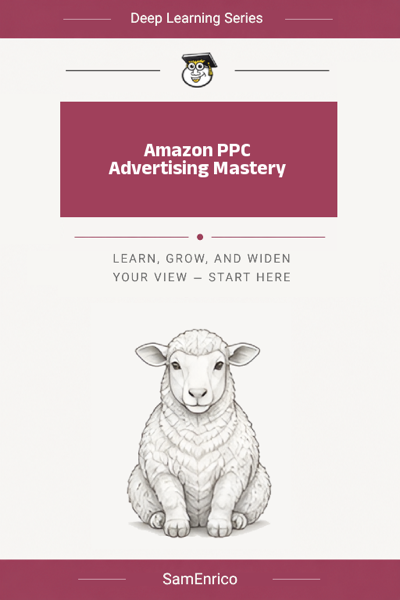
Non-FictionInformativeEducational
Amazon PPC Advertising Mastery eBook
A Coursebook on Amazon PPC Advertising Mastery
A Coursebook on Amazon PPC Advertising Mastery
Formats
Free sample
Chapter 1: The Garlic Press Confession...--If you have ever spent 1,000on Amazonadsandmadeback1,000 on Amazon ads and made back 1,000on Amazonadsandmadeback800, this chapter is your intervention.I know because I lived it. Not once. Not twice. But for six consecutive months across seven different products. The total damage: $47,000 in losses on products like garlic presses, phone cases, and a particularly cursed brand of yoga mats that still gives me a slight twitch when I see the color purple.The worst moment came on a Tuesday evening in March.
My wife opened the garage door to park her car and instead found four hundred units of garlic presses stacked to the ceiling. Each box represented a decision I had made. Each box was proof that I had no idea what I was doing."How much did we lose?" she asked.I did the math while she stood there, her car still idling on the driveway because there was no room to park. COGS: 4,800.Shippingfromthemanufacturer:4,800. Shipping from the manufacturer: 4,800.Shippingfromthemanufacturer:1,200.
Amazon fees: 2,400.PPCspend:2,400. PPC spend: 2,400.PPCspend:12,000. Returns and refunds: $2,000 more."Twenty thousand four hundred dollars," I said.She didn't scream. She didn't cry. She just looked at the garlic presses, then at me, and said something that became the foundation of this book: "You keep trying to drive more people to the garage.
But the garage is full of things nobody wants."That was the moment I realized I had committed the single most expensive mistake in Amazon selling. I had turned on PPC before my product listing was ready. I had used advertising as a solution instead of an amplifier. And I had paid $47,000 for an education that you are about to receive in the next thirty pages.This chapter is called the Garlic Press Confession for a reason. I am going to tell you exactly what I did wrong, exactly how much it cost me, and exactly how to avoid every single one of those mistakes.
By the end of this chapter, you will never launch another PPC campaign without first running a ten-minute diagnostic that would have saved me forty-seven thousand dollars.Let me be clear about something before we continue: this book is not about getting rich quickly. It is not about finding a loophole that Amazon will close next week. It is about understanding the fundamental relationship between your product listing, your advertising, and the algorithm that decides whether you succeed or fail.That algorithm, by the way, does not care about you. It does not want you to win. It does not want you to lose.
It wants one thing and one thing only: to show shoppers the product they are most likely to buy. If your listing convinces the algorithm that shoppers will buy from you, you win. If your listing confuses the algorithm or, worse, teaches it that shoppers leave quickly, you lose. And no amount of advertising spend can reverse that lesson once it is learned.The Amplifier Fallacy Here is the lie that cost me forty-seven thousand dollars: "If I just get more traffic, I will get more sales."This is technically true. If you drive one million people to a product listing, you will eventually get some sales.
But the question is not whether you will get sales. The question is whether you will get sales profitably.PPC is an amplifier. That is all it is. It takes whatever your product listing is doing and makes it happen faster. If your listing converts at eight percent, PPC will deliver eight percent conversions faster.
If your listing converts at one percent, PPC will burn through your budget at the speed of light while delivering one percent conversions.I thought my garlic press listing was fine. It had decent photos. The title included all the keywords. The description listed every feature. I had spent hours on it.
But "fine" is not good enough on Amazon. "Fine" means you are competing against sellers who have spent days optimizing every single character.The amplifier fallacy convinces sellers that traffic is the problem when the listing is the problem. You see low sales and think, "I need more people to see this." But what you should be thinking is, "Why are the people who already see this not buying?"This is the fundamental question that separates profitable sellers from the ones who eventually stack garlic presses in their garages.The Conversion Rate Inversion There is a concept I wish someone had explained to me before I launched that first product. I call it the Conversion Rate Inversion, and it explains why a "better" listing can temporarily kill your organic rank if launched incorrectly.Here is how it works.Amazon's A10 algorithm tracks how shoppers behave when they click on your listing from a search result. Do they stay?
Do they scroll through your images? Do they watch your video? Do they add to cart? Do they buy? Every single one of these actions sends a signal to the algorithm about how relevant your product is for that search term.Now imagine you have a listing that is performing reasonably well.
It converts at three percent. It is ranked on page two for your main keyword. You decide to improve the listing. You add better images. You rewrite the description.
You add A+ content. You launch a video.You have made the listing "better." But here is the inversion: for the first seven to fourteen days after you make these changes, Amazon resets its confidence in your relevance signals. The algorithm treats your listing as partially new because the content has changed significantly. During this reset period, your conversion rate will likely drop. Not because the listing is worse, but because the algorithm is recalibrating.If you turn on aggressive PPC during this recalibration period, you will drive traffic to a listing that is temporarily converting poorly.
The algorithm will see low conversion rates on high traffic and will conclude that your product is not relevant for those search terms. It will drop your organic rank. Sometimes dramatically.This is the Conversion Rate Inversion: a better listing plus aggressive PPC during the wrong window equals worse organic rank.The solution is simple once you understand it. Do not make major listing changes and launch new PPC campaigns in the same week. Give the algorithm seven to fourteen days to recalibrate after listing changes before you increase ad spend.
And conversely, do not change your listing during the first thirty days of a new PPC campaign.I learned this the expensive way. I changed my garlic press listing three times in the first two weeks of my PPC campaign, convinced that each change would fix my conversion problems. Each change reset the algorithm. Each reset dropped my organic rank. And each drop made me spend more on PPC to chase the traffic I had lost.The Ten-Minute Readiness Check Before you spend a single dollar on PPC, you need to run the Ten-Minute Readiness Check.
This is a diagnostic that would have saved me forty-seven thousand dollars. It takes ten minutes. It costs nothing. And it will tell you with surprising accuracy whether your product is ready for paid…
This is the end of the free sample. Get the eBook to keep going. Buy now
About this book
Details
- Author
- Villasenor Denita
- Publisher
- SamEnrico
- Language
- English
- Genre
- Non-Fiction, Informative, Educational
- Released
- 2026-05-09
- Pages (approx.)
- 142
- Available as
- eBook, Audiobook

Read better in the ZLOADR app
Your eBooks on your phone or tablet. Sign in with your SamEnrico account and start reading.
More by Villasenor Denita
 Heart Function Growth HormoneVillasenor Denita$11.99
 Antwerp Heist Book BestsellerVillasenor Denita$11.99
 ADHD Student Stress ManagementVillasenor Denita$11.99
 Peptides And GH ReleaseVillasenor Denita$11.99
 Card Memory SystemVillasenor Denita$11.99
 Giving Bad News to Your TeamVillasenor Denita$11.99
 TM for Group Practice GuideVillasenor Denita$11.99
 Man Coverage Lockdown SkillsVillasenor Denita$11.99
 UK Green Tax Credits HandbookVillasenor Denita$11.99
 The Serpent and the Saint: A Medieval Beast’s RedemptionVillasenor Denita$11.99
 The Dancer's Guide to Lap DanceVillasenor Denita$11.99
 How to Start a Culinary Glassware Business (Beginners Guide)Villasenor Denita$11.99
You may also like
 Hong Kong Handover 1997Dunn Johnnie$11.99
 Zumba For Postnatal Recovery CourseNeal Christian$11.99
 Zumba for BeginnersLadner Nikia$11.99
 YouTube Comment Mining GuideHumes Pandora$12.99
 Worry Box MeditationCarlin Rudy$11.99
 Workplace Stress MeditationNguyen Lynn$11.99
 Workplace Stress and Sleep RepairHawley Ivory$11.99
 Workplace Perfectionism CureDelaney Jeffry$11.99
 Workplace Injustice Anger GuideWallen Isabelle$11.99
 Work Addiction and Burnout LinkGreenwood Ester$11.99
 Women in Yoga and WellnessBeattie Galina$11.99
 Women in Stand Up ComedyChun Evangeline$11.99