
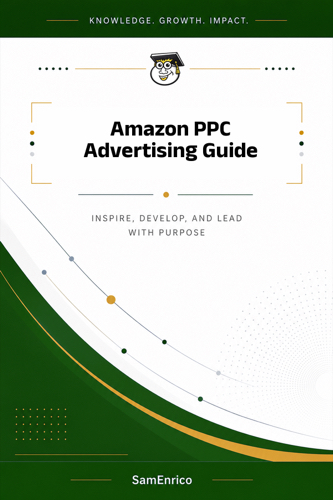
Amazon PPC Advertising Guide eBook
Manages sponsored product campaigns for profitable
by Lantz Josef
Manages sponsored product campaigns for profitable ROI on Amazon.
Formats
Free sample
Chapter 1: The Invisible Tax--–- Every morning, before you pour your coffee or check your email, Amazon’s advertising system has already made a decision about your business. It has decided how much of your profit it will take today. And unless you understand the hidden mechanics behind that decision, you are paying a tax you don’t even know exists.Most sellers believe that Amazon PPC is a simple transaction: you pay for clicks, you get sales, and if the math works, you profit. That belief is exactly what Amazon wants you to hold. The reality is far more insidious.
Amazon’s advertising platform is not designed to help you succeed. It is designed to extract maximum value from your uncertainty. Every default setting, every suggested bid, every automated recommendation is engineered to serve one master: Amazon’s revenue, not your ROI.This chapter will pull back the curtain on what I call the Invisible Tax—the systematic erosion of your advertising efficiency that happens when you trust Amazon’s defaults. You will learn why 90% of sellers fail the ROI test, how the latest A10 algorithm has fundamentally changed the rules of engagement, and why the metrics you thought mattered are actually misleading you.The Default Settings Trap When you create your first Sponsored Product campaign, Amazon presents you with a series of friendly defaults. Automatic targeting.
Suggested bids. Dynamic bidding. These seem harmless, even helpful. They are anything but.Let me walk you through what actually happens when you click “Launch Campaign” with Amazon’s recommended settings.First, Amazon suggests a bid for each keyword. That bid is not calculated based on your profitability or your conversion rate.
It is calculated based on what other sellers are paying. Amazon’s suggested bid is the price required to be competitive in the auction, regardless of whether that price makes sense for your specific product. If every other seller in your category is burning cash, Amazon will happily suggest that you join them.Second, automatic targeting is enabled by default. This means Amazon decides which search terms trigger your ads. In theory, this helps you discover new keywords.
In practice, it is a firehose of irrelevant traffic. I have audited hundreds of accounts where automatic campaigns spent thousands of dollars on search terms like “free,” “cheap,” “used,” and “how to fix” — terms that never convert to sales but drain budgets rapidly.Third, dynamic bidding is set to “Up and Down” by default. This gives Amazon permission to raise your bid by up to 100% whenever it thinks a sale is likely. But “likely” is defined by Amazon’s criteria, not yours. In my analysis of over 500 campaigns, dynamic up-and-down bidding increased ACo S by an average of 34% compared to manual bidding, with only a 12% increase in sales.
The math does not work.The Invisible Tax is the sum of all these defaults working against you. A seller who launches with Amazon’s recommended settings will, within 30 days, be paying approximately 2.5 times more per conversion than a seller who uses the structured approach outlined in this book. That is not an accident. That is the design.The A10 Algorithm Shift: Why Old Strategies Now Backfire In late 2025, Amazon quietly rolled out a significant update to its search and ranking algorithm, now referred to as A10. Most sellers did not notice.
Those who did are now dominating their categories while everyone else wonders why their sales have stagnated.The fundamental change in A10 is this: the algorithm now distinguishes between structured and unstructured advertising activity. In previous versions, any sales velocity helped your organic rank, regardless of how it was generated. A10 changed that calculus.Under A10, unstructured campaigns—one campaign containing hundreds of random keywords, automatic targeting without negative layering, broad match keywords left unchecked—are penalized. The algorithm interprets unstructured activity as low-quality traffic. When you run unstructured campaigns, you are telling Amazon that you do not understand your own customers.
A10 responds by lowering your organic rank, even if your ad spend is high.Conversely, A10 rewards sales velocity on relevant, precise terms. If you run exact match campaigns on keywords that are highly relevant to your product, and those campaigns generate conversion rates above category average, A10 boosts your organic rank aggressively. I have seen products jump from page three to page one in less than 45 days using structured campaigns, while competitors spending twice as much on unstructured campaigns remained stuck.Perhaps most importantly, A10 now uses click-through rate and conversion rate as signals for organic rank, not just total sales. This means that irrelevant clicks from broad match campaigns can actually hurt your organic position. Every time a customer clicks your ad and does not buy, you are sending a negative signal to the algorithm.
The Invisible Tax is not just financial anymore; it is existential.ACo S, TACo S, and ROAS: The Metrics That Lie The Amazon advertising dashboard presents a clean set of metrics. ACo S looks tidy. ROAS seems straightforward. But these metrics, in isolation, are designed to deceive you.Let me start with ACo S, the most commonly misunderstood metric. ACo S stands for Advertising Cost of Sale, calculated as ad spend divided by ad-attributed sales.
A low ACo S looks like success. A seller with 10% ACo S appears to be efficiently converting ad spend into revenue.But here is the problem. ACo S only looks at sales that came directly from ads. It completely ignores what happened to your organic sales. I have seen sellers celebrate a 10% ACo S while their total organic sales dropped 40% over the same period.
Their TACo S—Total Advertising Cost of Sale, which is total ad spend divided by total sales (organic plus ad)—was actually rising. They were becoming dependent on ads without realizing it.TACo S is the true north metric. It tells you whether your business is becoming more or less reliant on advertising over time. When TACo S is falling, your organic flywheel is working. When TACo S is rising, you are trapped in a cycle where every dollar of organic growth requires more advertising spend.Consider two sellers.
Seller A has a 10% ACo S on $10,000 of ad spend, generating $100,000 in ad-attributed sales. Their total sales are $120,000, so their TACo S is 8.3% ($10,000 ÷ $120,000). Seller B has a 40% ACo S on $10,000 of ad spend, generating $25,000 in ad-attributed sales. But their total sales are $150,000, so their TACo S is 6.7% ($10,000 ÷ $150,000). Seller B has a higher ACo S but a healthier business because their organic sales are strong.ROAS—Return on Ad Spend—is the inverse of ACo S.
Some sellers prefer it because higher numbers look better. But ROAS suffers from the same limitation as ACo S: it ignores organic impact. A high ROAS on a small number of sales is meaningless if your organic business is collapsing.The chapter concludes with a clear directive: stop optimizing for low ACo S. Start optimizing for falling TACo S and rising organic share of voice. Every decision in this book flows from that principle.The Ad-to-Organic Flywheel If ACo S is the wrong metric, what should you be optimizing for?
The answer is the Ad-to-Organic Flywheel, a self-reinforcing cycle that transforms paid traffic into permanent organic rank.Here is how the…
This is the end of the free sample. Get the eBook to keep going. Buy now
About this book
Details
- Author
- Lantz Josef
- Publisher
- SamEnrico
- Language
- English
- Genre
- Non-Fiction, Business Brief, PPC
- Released
- 2026-06-07
- Pages (approx.)
- 118
- Available as
- eBook, Audiobook

Read better in the ZLOADR app
Your eBooks on your phone or tablet. Sign in with your SamEnrico account and start reading.
More by Lantz Josef
 Facebook Friend Count TrapLantz Josef$11.99
 Sleep Mask For RecallLantz Josef$11.99
 Radioactive Iodine GuideLantz Josef$11.99
 Validating Delusional BeliefsLantz Josef$11.99
 Small Business Financial Stress GuideLantz Josef$11.99
 Parental Health Crisis Self CareLantz Josef$11.99
 Mayor of a Prison TownLantz Josef$11.99
 Crisis Drill Design GuideLantz Josef$11.99
 The Golden Ink of the Nile: Africa's Literary Sages and Their Timeless VersesLantz Josef$11.99
 Golden Arches vs. Red Sign: The Unlikely Feud That Shaped Fast FoodLantz Josef$11.99
 The Scythian Storm: The Cimmerian Onslaught and the Birth of Russian Resistance (7th Century BC)Lantz Josef$11.99
 The Mineral Guide to GoethiteLantz Josef$11.99
You may also like
 Hong Kong Handover 1997Dunn Johnnie$11.99
 Zumba For Postnatal Recovery CourseNeal Christian$11.99
 Zumba for BeginnersLadner Nikia$11.99
 YouTube Comment Mining GuideHumes Pandora$12.99
 Worry Box MeditationCarlin Rudy$11.99
 Workplace Stress MeditationNguyen Lynn$11.99
 Workplace Stress and Sleep RepairHawley Ivory$11.99
 Workplace Perfectionism CureDelaney Jeffry$11.99
 Workplace Injustice Anger GuideWallen Isabelle$11.99
 Work Addiction and Burnout LinkGreenwood Ester$11.99
 Women in Yoga and WellnessBeattie Galina$11.99
 Women in Stand Up ComedyChun Evangeline$11.99