
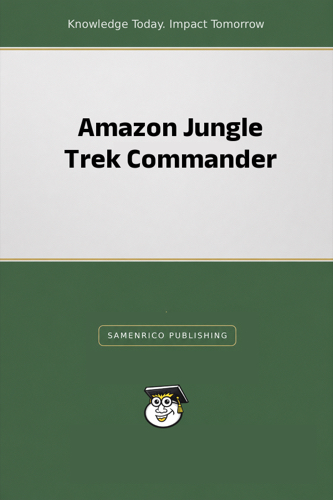
Non-FictionBiographyJungle Exploration
Amazon Jungle Trek Commander eBook
Keep team alive through piranha, anaconda, and dis
Keep team alive through piranha, anaconda, and disease ridden waters.
Formats
Free sample
Chapter 1: The Hygiene Kill Box--–- The first time I watched a man die of diarrhea, I was twenty-three years old. His name was Eduardo. He was our machete man—six feet of muscle, twenty-seven years old, father of two girls back in Manaus. On day three of a planned ten-day jungle traverse, he stopped washing his hands after digging a cat hole. He said it was too cold.
He said he was too tired. He said the water gave him a rash. I was the Assistant Commander then, young and afraid of seeming bossy, so I let it slide. On day five, Eduardo couldn’t keep down water. His eyes had that sunken, glassy look that tells you the body is shutting down.
On day six, he weighed ninety pounds. His skin hung off him like a wet shirt. The helicopter came on day seven, but by then his kidneys had failed. The doctors in Boa Vista said a basic hygiene protocol would have saved him. They said it would have taken three minutes a day.
They said it was the most preventable death they had ever seen in the Amazon.I wrote that protocol down on the flight home. I have used it on every trek since. I have enforced it with Special Forces teams, with university research groups, with documentary film crews, and with one particularly stubborn British lord who thought jungle rot was a myth invented to sell antifungal cream. The protocol has never failed. And I have never, not once, lost another team member to diarrhea.This chapter is about the number one killer in the Amazon.
It is not jaguars. It is not anacondas. It is not even piranhas, despite what Hollywood wants you to believe. The number one killer in the Amazon is the microscopic organisms that live in soil, water, and on your own skin. And the Commander’s primary job—before navigation, before food procurement, before any of the glamorous survival skills—is preventing disease.
If you cannot keep your team clean, you cannot keep your team alive.The Hard Truth: Numbers Don't Lie Let me put this in perspective. The Brazilian Ministry of Health tracks jungle rescue data. Between 2015 and 2020, 347 trekkers required medical evacuation from the Amazon basin. Of those, 218—that is 63 percent—were evacuated for gastrointestinal disease alone. Snakebites accounted for 11 percent.
Animal attacks (jaguars, caimans, anacondas) accounted for 3 percent. The rest were injuries: broken bones, machete cuts, falls.Let me repeat that: you are more than twenty times more likely to be evacuated for diarrhea than to be attacked by any animal in the Amazon.The reason is simple. The Amazon is a hot, wet, organic-rich environment. Bacteria reproduce every twenty minutes in the right conditions. Your hands touch a leaf that a monkey urinated on.
You eat a piece of dried meat without washing first. You dig a cat hole and then adjust your water bottle strap without realizing you transferred fecal bacteria to your hands. Twelve hours later, you are vomiting into your hat while four other team members hold your legs to stop you from rolling into the fire.The Commander who focuses on external threats—the snake on the trail, the growl in the dark—has already lost. The real enemy is invisible, patient, and lives inside every member of your team.The Big Three of Jungle Sickness There are dozens of diseases you can catch in the Amazon, but three categories account for over 90 percent of hygiene-related evacuations. I call them the Big Three.
Understand these, and you understand almost everything you need to prevent.Waterborne Pathogens: Leptospirosis and Giardia Leptospirosis is the silent killer of the Amazon. It is a bacterial infection spread through the urine of infected animals—rats, capybaras, wild pigs. Heavy rain washes the urine into rivers and floodplains. You cross a knee-deep channel, and the water gets into a small cut on your foot, or you accidentally swallow a mouthful, or you simply walk through floodwater that splashes onto your face. The bacteria enter through mucous membranes or broken skin.
Seven to twelve days later, you develop a fever of 103 degrees, your eyes turn yellow, and your muscles ache so badly you cannot stand. If untreated, leptospirosis causes kidney failure and meningitis. The mortality rate is 10 percent even with treatment. Without treatment, it is much higher.Giardia is less deadly but more common. It is a parasite that lives in the intestines of humans and animals.
You get it by drinking unfiltered water from streams that look clean but have been contaminated upstream by a sick animal. Giardia announces itself with explosive, sulfur-smelling diarrhea, stomach cramps, and nausea that lasts for weeks. You do not die from giardia—not directly—but you do become so dehydrated and malnourished that your body cannot fight off other infections. I have seen giardia turn a healthy trekker into a shuffling skeleton in ten days.Fungal Skin Infections: Jungle Rot The Amazon is a fungus factory. The combination of heat (85 to 95 degrees Fahrenheit), humidity (80 to 100 percent), and constant moisture creates the perfect breeding ground for dermatophytes—the family of fungi that cause ringworm, athlete's foot, and jock itch.
In the jungle, these conditions are not uncomfortable. They are dangerous.Jungle rot, medically known as tropical immersion foot, begins when your feet stay wet for more than forty-eight hours. The skin softens, turns white, and begins to peel. Cracks form. Bacteria enter through the cracks.
The foot swells, turns red, and develops a foul smell. If untreated, the infection spreads to the bone. I have seen jungle rot require amputation of two toes on a guide who thought he could tough it out for another week.The same fungi attack the groin and armpits. The skin becomes raw, weeping, and intensely itchy. You scratch.
The broken skin gets infected with bacteria. Now you have a fungal infection and a bacterial infection in the same location. Try walking twenty miles through the jungle with that. Try sleeping.Parasitic Worms: Hookworm and Roundworm Hookworm larvae live in soil contaminated with human or animal feces. You walk barefoot—or in sandals, or in boots that have a hole—and the larvae burrow through the skin of your foot.
They travel through your bloodstream to your lungs, then up your windpipe, then down your throat into your stomach. They attach to the wall of your small intestine and feed on your blood. Each hookworm consumes about 0.2 milliliters of blood per day. A few hundred hookworms can cause severe anemia, fatigue, and cognitive impairment. You do not die quickly from hookworm.
You die slowly, over months, becoming weaker and weaker until a minor injury or illness finishes you off.Roundworms are larger—up to fourteen inches long—and they do not need soil. They spread through direct contact with contaminated hands or food. A team member who does not wash after defecating touches a shared water bottle. You drink from that bottle. Three weeks later, you pass a fourteen-inch worm in your stool.
The psychological damage alone is enough to end a trek.The Commander's Wash Regimen: A Tactical Order The solution to the Big Three is not complicated.…
This is the end of the free sample. Get the eBook to keep going. Buy now
About this book
Details
- Author
- Milam Sharell
- Publisher
- SamEnrico
- Language
- English
- Genre
- Non-Fiction, Biography, Jungle Exploration
- Released
- 2026-06-07
- Pages (approx.)
- 140
- Available as
- eBook, Audiobook

Read better in the ZLOADR app
Your eBooks on your phone or tablet. Sign in with your SamEnrico account and start reading.
More by Milam Sharell
 Family Conflict Cognitive ShiftMilam Sharell$11.99
 Atomic Habits For Habit StreakMilam Sharell$11.99
 Time Blocking for Microsoft OutlookMilam Sharell$11.99
 Body Scan for Sensory OverloadMilam Sharell$11.99
 Egyptian Engineer In DubaiMilam Sharell$11.99
 Metabolic Master GuideMilam Sharell$11.99
 Loci Method For Bible VersesMilam Sharell$11.99
 The Jazz Olympiad: How a Forgotten 1924 Paris Competition Ignited a Musical RevolutionMilam Sharell$11.99
 The Quantum Leap That Wasn’t: The Forgotten Discovery of Dr. Lina VossMilam Sharell$11.99
 How to Produce Alcohol, Hydroxybenzene and EtherMilam Sharell$11.99
 How to Produce Neon SignsMilam Sharell$11.99
 Cross Border Franchisee SelectionMilam Sharell$12.99
You may also like
 Hong Kong Handover 1997Dunn Johnnie$11.99
 Zumba For Postnatal Recovery CourseNeal Christian$11.99
 Zumba for BeginnersLadner Nikia$11.99
 YouTube Comment Mining GuideHumes Pandora$12.99
 Worry Box MeditationCarlin Rudy$11.99
 Workplace Stress MeditationNguyen Lynn$11.99
 Workplace Stress and Sleep RepairHawley Ivory$11.99
 Workplace Perfectionism CureDelaney Jeffry$11.99
 Workplace Injustice Anger GuideWallen Isabelle$11.99
 Work Addiction and Burnout LinkGreenwood Ester$11.99
 Women in Yoga and WellnessBeattie Galina$11.99
 Women in Stand Up ComedyChun Evangeline$11.99