
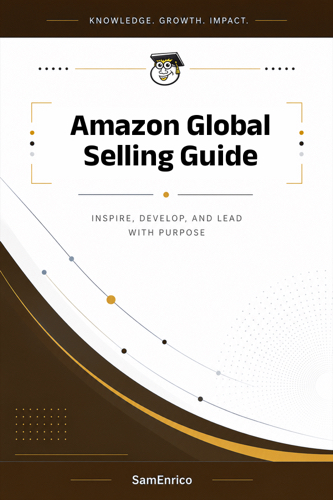
Non-FictionBusiness BriefGlobal Expansion
Amazon Global Selling Guide eBook
Expands to Amazon's European, Japanese, and Austra
Expands to Amazon's European, Japanese, and Australian marketplaces.
Formats
Free sample
Chapter 1: The $300M Blindspot--–- Most Amazon sellers wake up every morning and check the same dashboard. They refresh their .com orders, watch their US rankings, and wonder why profits keep shrinking while competition keeps growing. They are fighting over the same crowded battlefield, unaware that three entire continents are quietly generating fortunes for the sellers smart enough to look beyond their own borders.This book exists because of a single, uncomfortable truth: ninety-seven percent of US-based Amazon sellers never expand beyond the United States. They leave over 300 million active customers on the table—customers in Europe, Japan, and Australia who are actively searching for products just like yours, often paying higher prices than US buyers, and facing far less competition from American sellers who never show up.The question is not whether you can afford to expand globally. The question is whether you can afford not to.The Trifecta by the Numbers Let's start with the raw data, because numbers don't lie.
When we talk about expanding to Europe, Japan, and Australia, we are talking about what this book calls the Trifecta—three distinct regions that together represent the single largest opportunity for US-based sellers in the next five years.Europe is the heavyweight. The combined Amazon marketplaces of the European Union plus the United Kingdom serve over 500 million consumers, with more than 150 million active Amazon customers. Germany and the United Kingdom alone account for over 80 million Prime members—people who have already raised their hands and said, "I am ready to buy, and I expect fast, free shipping."But here is what most US sellers miss: European customers behave differently than American customers. They are less price-sensitive in many categories. They expect higher quality.
They are willing to wait an extra day for delivery if the product is right. And because fewer American sellers compete in these markets, the advertising costs are substantially lower. A $1 cost-per-click on a competitive keyword in the US might cost $0.30 in Germany or the United Kingdom.Japan is the sleeping giant. With 40 to 50 million active Amazon customers, Japan represents the third-largest Amazon marketplace in the world by revenue. Yet most US sellers never touch it.
The language barrier scares them. The cultural differences intimidate them. The perceived complexity of importing to Japan stops them cold.What they don't understand is that Japan has the lowest return rate of any major Amazon marketplace—under five percent, compared to twenty to thirty percent in the United States and Europe. That means less waste, fewer refunds, and higher retained revenue per sale. Japanese customers are meticulous, loyal, and willing to pay premium prices for quality products.
They read every bullet point. They study every image. And when they buy, they rarely return.Australia is the overlooked opportunity. With only 10 to 15 million active Amazon customers, Australia is the smallest of the three regions by population. But that small size comes with a massive advantage: the lowest competition density of any developed Amazon marketplace.
A keyword that requires $5 per click and fifty competing sellers in the United States might cost $0.50 per click with five sellers in Australia.The Australian market is also the easiest entry point for US sellers. English language, similar consumer preferences, familiar legal structures, and Amazon's most streamlined registration process. Many successful global sellers use Australia as their testing ground—launch new products there first, prove the concept, then expand to Europe and Japan with confidence.Together, these three regions represent over 300 million active Amazon customers. That is not a typo. Three hundred million people who are already shopping on Amazon, already trusting the platform, already entering their credit card information—waiting for sellers like you to show up.The Myth of Saturation One of the most dangerous beliefs in e-commerce is that Amazon is "saturated." Sellers look at their US category, see hundreds of competitors, and conclude that there is no room left for new players.
This is both true and false.It is true that the United States marketplace is crowded. It is true that advertising costs have risen. It is true that finding profitable products requires more research and patience than it did five years ago.But here is what the saturation narrative ignores: saturation is local, not global. Your US category might be saturated. But the same category in Germany might have half the competitors.
The same category in Japan might have ten percent of the competitors. The same category in Australia might have almost no competitors at all.Consider a real example. A seller of specialized camping equipment struggled to gain traction in the United States. The keywords were expensive. The established brands were entrenched.
After six months of marginal results, they decided to test the Australian marketplace. Within ninety days, they were selling one hundred units per day—with lower advertising costs, less competition, and higher margins than they had ever achieved in the US.The products were identical. The listings were translated but otherwise the same. The only difference was the marketplace. They stopped fighting for scraps in a saturated pond and started fishing in a nearly empty lake.This pattern repeats across thousands of categories.
The sellers who understand that competition varies dramatically by region are the ones who build sustainable, profitable businesses. The sellers who assume that US conditions apply everywhere are the ones who eventually burn out and quit.Why Most Sellers Never Leave the USIf the opportunity is so obvious, why do ninety-seven percent of US sellers stay home? The answer is a combination of fear, misinformation, and inertia.Fear is the first barrier. Sellers are afraid of the complexity—different tax systems, different languages, different legal requirements. They are afraid of making a mistake that could cost them money or get their account suspended.
They are afraid of shipping inventory across oceans and losing control of their supply chain.These fears are not irrational. Global selling is more complex than domestic selling. There are real risks and real consequences for getting things wrong. But here is what the fearful sellers don't realize: the complexity is manageable. The risks are mitigable.
Thousands of sellers have already done what you are considering, and they have documented every step, every mistake, every solution.Misinformation is the second barrier. Much of what sellers "know" about global expansion is simply wrong. They believe that registering for VAT in Europe costs thousands of dollars and requires months of paperwork. In reality, Amazon's VAT Calculation Service automates most of the process, and services like Taxually can handle registration for a few hundred euros.They believe that translating listings costs a fortune. In reality, professional translation for a standard product listing costs fifty to two hundred dollars and pays for itself within weeks through increased conversion rates.They believe that legal risks are too high.
In reality, the most common legal traps—missing return policies, improper tax registrations, non-compliant product certifications—are completely avoidable with the right checklists and preparation.Inertia is the third and most powerful barrier. Sellers are busy. They have orders to fulfill, customers to serve, inventory to manage. Adding new marketplaces feels like adding new jobs. So they put it off.
They tell themselves they will do it next month, next quarter, next year. And then they never do.This book exists…
This is the end of the free sample. Get the eBook to keep going. Buy now
About this book
Details
- Author
- Driver Marcelina
- Publisher
- SamEnrico
- Language
- English
- Genre
- Non-Fiction, Business Brief, Global Expansion
- Released
- 2026-06-06
- Pages (approx.)
- 135
- Available as
- eBook, Audiobook

Read better in the ZLOADR app
Your eBooks on your phone or tablet. Sign in with your SamEnrico account and start reading.
More by Driver Marcelina
 The Financial Boundaries WorkbookDriver Marcelina$11.99
 Governor's Labor Strike StandoffDriver Marcelina$11.99
 Caffeine Nap Strategy HandbookDriver Marcelina$11.99
 Thyroid and Heat IntoleranceDriver Marcelina$11.99
 Async Communication RatioDriver Marcelina$11.99
 Buy Me a Coffee TrapDriver Marcelina$11.99
 Tech Platform Outage GuideDriver Marcelina$11.99
 ADHD Sleep Memory GuideDriver Marcelina$11.99
 The Northern Socratics: Canada’s Philosophical Pioneers in the WildernessDriver Marcelina$11.99
 The Golden Scalpel: Surgeons of the Nile and BeyondDriver Marcelina$11.99
 Operation Midnight Sun: The Spy Who Fooled the KGBDriver Marcelina$11.99
 How to Become a Hydroelectric-plant MaintainerDriver Marcelina$11.99
You may also like
 Hong Kong Handover 1997Dunn Johnnie$11.99
 Zumba For Postnatal Recovery CourseNeal Christian$11.99
 Zumba for BeginnersLadner Nikia$11.99
 YouTube Comment Mining GuideHumes Pandora$12.99
 Worry Box MeditationCarlin Rudy$11.99
 Workplace Stress MeditationNguyen Lynn$11.99
 Workplace Stress and Sleep RepairHawley Ivory$11.99
 Workplace Perfectionism CureDelaney Jeffry$11.99
 Workplace Injustice Anger GuideWallen Isabelle$11.99
 Work Addiction and Burnout LinkGreenwood Ester$11.99
 Women in Yoga and WellnessBeattie Galina$11.99
 Women in Stand Up ComedyChun Evangeline$11.99