
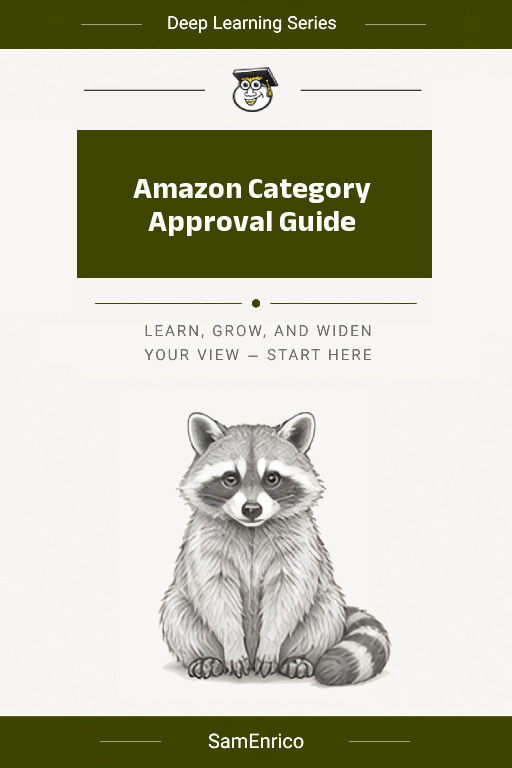
Non-FictionBusiness BriefCategory
Amazon Category Approval Guide eBook
Get ungated in restricted categories on Amazon vs
Get ungated in restricted categories on Amazon vs open categories on Jumia and Alibaba.
Formats
Free sample
Chapter 1: The Approval Wall...--–- Every Amazon seller remembers their first encounter with the wall. You have done everything right. You found a product with healthy margins. You sourced inventory from a supplier who seemed legitimate. You created a listing with professional photos and keyword-rich copy.
You clicked "Save and Finish," expecting to see your new product live in the Amazon catalog. Instead, you saw this: "Listing limitations apply. Approval Required."Your heart sinks. Weeks of work, sometimes months, stopped by a message you did not anticipate. You search online for answers.
You find forum threads filled with conflicting advice. Some sellers say you need invoices from authorized distributors. Others say you need a letter from the brand. A few claim they got approved with nothing more than a receipt from a retail store. You try one approach.
Rejected. You try another. Rejected again. Eventually, you give up and move on to a different product, leaving money on the table that someone else will eventually collect.I wrote this book because I have been rejected more times than I can count. I have been denied for Beauty categories.
I have been blocked from Grocery. I have watched competitors list products I could not touch, even though we sold the exact same item from the exact same supplier. And then I figured out the system.The truth about Amazon's gating is that it is not a punishment. It is not an arbitrary barrier designed to frustrate sellers. It is a filter.
Amazon wants to protect its customers from counterfeit products, unsafe items, and fraudulent sellers. The gating system is how Amazon separates legitimate sellers from everyone else. And once you understand how to pass through that filter, those restricted categories become moats that keep your competitors out.This chapter is about understanding that wall. You will learn why platforms restrict categories in the first place, how Amazon differs from Jumia and Alibaba, and why the most successful sellers do not complain about gating—they plan for it.The Universal Seller Experience Let me describe a scene that plays out thousands of times every day. A seller discovers a product on Alibaba or at a wholesale trade show.
The numbers look promising. The product costs ten dollars to source. Similar products are selling on Amazon for thirty dollars. After Amazon's fees and shipping costs, the seller calculates a tidy eight dollars per unit profit. They order five hundred units.
The inventory arrives. They take professional photos. They write a compelling description. They are ready.Then they try to list the product. The message appears: "Listing limitations apply.
You need approval to sell this product."The seller has two choices. They can abandon the product, eating the cost of five hundred units of dead inventory. Or they can try to get approved. Most sellers try. Most sellers fail.
Not because they are incapable, but because they do not understand what Amazon actually wants.I have seen sellers with perfect products get denied because their invoice was missing a supplier address. I have seen sellers with mediocre products get approved because their documentation was flawless. The difference is not the product. It is the system.The sellers who succeed are the ones who understand that the approval wall is not a barrier to their success. It is a moat protecting their success once they cross it.
Every seller who gives up at the approval wall is one less competitor in that category. Every seller who fails to submit the correct documents is one less seller driving down prices. The wall does not keep you out. It keeps everyone else out.The Three Platforms, Three Different Worlds To master category approvals, you must understand that not all marketplaces are created equal. Amazon, Jumia, and Alibaba each have different priorities, different risks, and different approval processes.
A strategy that works on Amazon may fail on Jumia. A document that satisfies Alibaba may be rejected by Amazon.Amazon gates aggressively. Categories like Beauty, Grocery, Dietary Supplements, Baby Products, Automotive, and Fine Jewelry all require approval before you can list a single product. Within open categories, individual brands may be gated. Nike, Apple, Adidas, Sony, Samsung, and thousands of other brands restrict who can sell their products.
You cannot list a Nike shoe just because you found one at a garage sale. You need authorization.Why does Amazon gate so aggressively? Customer trust. Amazon has spent billions of dollars building a reputation as a place where customers can buy with confidence. Every counterfeit product, every unsafe item, every fraudulent seller erodes that trust.
By limiting who can sell in sensitive categories, Amazon protects its most valuable asset: customer loyalty.Jumia takes a different approach. Operating across Nigeria, Kenya, Egypt, Morocco, Ghana, Ivory Coast, Senegal, Tunisia, Uganda, and South Africa, Jumia's primary challenges are not counterfeits. They are logistics and local market suitability. Can the product be delivered reliably? Does it meet local regulations?
Is it appropriate for the local market?Most categories on Jumia are open to sellers who complete basic onboarding. You do not need special approval for Clothing, Electronics, Home & Kitchen, or Beauty. However, strict listing rules apply. Expired products are strictly prohibited. Incorrect categorization triggers automatic delisting.
Products in the Sexual Wellness category must include 18+ stickers over explicit imagery.Jumia's restrictions are not about keeping sellers out. They are about keeping products appropriate and deliverable. This makes Jumia easier to enter but harder to master. Without approval barriers, competition is fierce. Your success depends on logistics speed, pricing, and customer service.Alibaba is a different animal entirely.
Alibaba is not a selling platform in the same way Amazon and Jumia are. It is a B2B sourcing platform where you find manufacturers and wholesalers. You do not need "ungating" to sell on Alibaba because you are not selling to consumers. You are selling to other businesses.However, Alibaba has its own restrictions. Certain product categories require 资质准入 (qualification access).
You must prove you are a legitimate business before listing. Medical devices require business licenses and medical device registration. Cosmetics require production permits. Food and supplements require food business licenses. These are not arbitrary gates.
They are legal requirements for cross-border trade.The seller who masters all three platforms understands that approval processes are not obstacles. They are filters. And every seller who gives up is one less competitor.Why Amazon Gates Categories Let me go deeper into Amazon's gating logic because this is where most sellers will spend their time. Amazon gates categories for three primary reasons.Customer safety is the first reason. Categories like Baby Products, Dietary Supplements, and Automotive parts can cause serious harm if they are defective or counterfeit.
A baby crib that collapses. A supplement contaminated with heavy metals. Brake pads that fail. Amazon gates these categories to ensure that only sellers who can prove their products are safe can list them.Brand protection is the second reason. Luxury brands like Nike, Apple, and Louis Vuitton spend millions building their reputations.
They do not want unauthorized sellers diluting their brand value or selling counterfeits. Amazon gates these brands to protect the brand's investment and to protect customers from fakes.Customer experience is…
This is the end of the free sample. Get the eBook to keep going. Buy now
About this book
Details
- Author
- Browne Lucrecia
- Publisher
- SamEnrico
- Language
- English
- Genre
- Non-Fiction, Business Brief, Category
- Released
- 2026-05-28
- Pages (approx.)
- 135
- Available as
- eBook, Audiobook

Read better in the ZLOADR app
Your eBooks on your phone or tablet. Sign in with your SamEnrico account and start reading.
More by Browne Lucrecia
 Workaholism Recovery WorkbookBrowne Lucrecia$11.99
 Influence For EducatorsBrowne Lucrecia$11.99
 Night Owl Morning AdaptationBrowne Lucrecia$11.99
 HIIT Warm Up and Cool DownBrowne Lucrecia$11.99
 Fitness Progress ComparisonBrowne Lucrecia$11.99
 Surfer Self Hypnosis GuideBrowne Lucrecia$11.99
 Emotion Focused TherapyBrowne Lucrecia$11.99
 Elderly Burn CareBrowne Lucrecia$11.99
 The Great Penguin Parade: March of the Little EmperorsBrowne Lucrecia$11.99
 Kicks of the Pharaohs: The Lost Sneakers of Ancient EgyptBrowne Lucrecia$11.99
 How to Start a Couch Business (Beginners Guide)Browne Lucrecia$11.99
 How to Produce Fitness and Body Building EquipmentBrowne Lucrecia$11.99
You may also like
 Hong Kong Handover 1997Dunn Johnnie$11.99
 Zumba For Postnatal Recovery CourseNeal Christian$11.99
 Zumba for BeginnersLadner Nikia$11.99
 YouTube Comment Mining GuideHumes Pandora$12.99
 Worry Box MeditationCarlin Rudy$11.99
 Workplace Stress MeditationNguyen Lynn$11.99
 Workplace Stress and Sleep RepairHawley Ivory$11.99
 Workplace Perfectionism CureDelaney Jeffry$11.99
 Workplace Injustice Anger GuideWallen Isabelle$11.99
 Work Addiction and Burnout LinkGreenwood Ester$11.99
 Women in Yoga and WellnessBeattie Galina$11.99
 Women in Stand Up ComedyChun Evangeline$11.99