
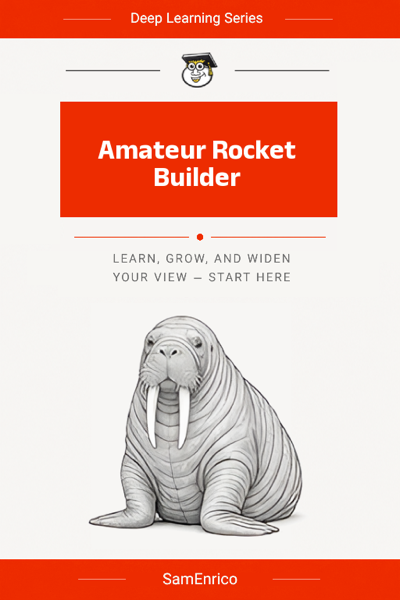
Non-FictionInformativeEducational
Amateur Rocket Builder eBook
A Coursebook on Amateur Rocket Builder
A Coursebook on Amateur Rocket Builder
Formats
Free sample
Chapter 1: The Rocket Gene--The first rocket I ever built did not fly. It spun wildly on the launch rod, sheared off its own fins, and buried its nose cone six inches into the dry California clay. I was fourteen years old, standing behind a makeshift plywood shield my father had insisted on building, and I remember thinking two things simultaneously: I have no idea what just happened and I need to do that again.That contradiction—humiliation followed immediately by obsession—is the rocket gene. Either you have it or you do not. If you are reading this book, you have it.
You have looked up at a night sky and watched a shooting star and thought, I want to make something that does that on purpose. You have held a spent model rocket motor, still warm from a flight, and wondered what was happening inside that cardboard tube. You have ignored the sensible voice in your head that says this is dangerous, expensive, and probably illegal, because the other voice—the louder one—says but what if it works?This book is for you. Not for the sensible voice. For the loud one.But here is the deal you are about to make with yourself.
Amateur rocketry in the 2020s is not the same hobby your grandfather read about in 1960s pulp magazines. You cannot walk into a hardware store, buy a length of pipe and some potassium nitrate, and build a rocket in your backyard. If you try, you will either be arrested, injured, or both. The legal and safety landscape has changed completely. What remains unchanged is the physics, the thrill, and the fundamental human drive to push something off this planet, even if only for a few thousand feet.This chapter exists to answer one question before you cut a single tube or mix a single chemical: Are you ready to do this the right way?Not the easy way.
Not the fast way. The right way.The Two Paths of the Amateur Rocket Builder Before we go any further, you need to understand that amateur rocketry has split into two distinct rivers that flow from the same mountain. Both end at the launch pad, but they take very different routes to get there.Path One: The Commercial Builder This is where ninety-nine percent of you belong. You will buy certified motors from manufacturers like Estes, Aerotech, or Cesaroni. You will build airframes from kits or from commercially available fiberglass and phenolic tubes.
You will use off-the-shelf altimeters and parachute systems. Your rocket will be safe, legal, and certifiable through the Tripoli Rocketry Association (TRA) or the National Association of Rocketry (NAR). You can achieve Level 1, Level 2, and even Level 3 certification without ever mixing your own propellant or designing your own nozzle from scratch.There is no shame in this path. In fact, it is the smart path. The most impressive amateur rockets I have ever seen—the ones that punched through Mach 2 and recovered a mile away with perfect dual deployment—were built largely from commercial components assembled with skill and patience.
The rocket does not care where its parts came from. It only cares that they were assembled correctly.Path Two: The Experimental Builder This is the narrow path. It requires a federal explosives license, an insured workshop, and a bunker for propellant storage. It requires years of experience and mentorship. It requires signing forms that say you understand you might die.
On this path, you design your own motors, cast your own propellant grains, machine your own nozzles, and test everything to destruction before you ever load a rocket onto a launch pad.This book will teach you the theory of this path—the chemistry, the nozzle equations, the chamber pressure calculations—because you need to understand those concepts to pass the NAR/TRA written exams and to troubleshoot problems in commercial motors. But the actual hands-on instruction for propellant mixing and nozzle casting is confined to Chapter 7 and Chapter 10, which are explicitly marked EXPERIMENTAL TRACK and come with warnings that would make a safety inspector weep.If you are a beginner, ignore those chapters for now. Read the safety warnings, appreciate the history, then close the book and go buy a certified motor. You will thank me when you still have all ten fingers.Why Most First Rockets Fail Let me tell you something uncomfortable. Most of the rockets you build will fail on their first flight.
Not catastrophically—not explosions or fires—but they will fail in smaller, more instructive ways. The parachute will deploy too late. The altimeter will not arm. The fins will flutter at transonic speeds and the rocket will corkscrew. The motor will burn unevenly and the rocket will arc over instead of climbing straight.These are not failures.
They are data.The only true failure is the rocket you never finish because you were afraid it might not work. The only true failure is the club you never start because you thought you needed to know everything before you asked for help. The only true failure is the launch you never attempt because you convinced yourself that building the perfect rocket was more important than launching an imperfect one.Captain Bertrand R. Brinley understood this in 1960 when he wrote Rocket Manual for Amateurs. He opened his book with a chapter titled "The Philosophy of Rocketry," and in it he made an argument that was radical for its time and remains true today: teenagers and young adults will build rockets whether you give them permission or not.
The only responsible adult response is to organize, educate, and supervise—not prohibit.Brinley was writing in an era when a teenager could order chemicals by mail and launch rockets from empty desert without asking anyone's permission. That era is gone. But the underlying psychology has not changed. The urge to build something that flies is primal. It does not respond to lectures about liability insurance or FAA waivers.
It responds to mentorship, to structure, and to the promise that if you follow the rules, you will eventually stand on a dry lake bed and watch your creation climb toward the edge of space.That is what this book offers. A path from urge to launch pad.What You Will Learn in This Chapter Before we dive into the mechanics of forming clubs and finding launch sites, let me give you a roadmap of what this chapter actually covers. By the time you finish these pages, you will understand:First, how to find or form a local amateur rocket club, including a model constitution and the roles you need to fill. Second, how to recruit technical advisors—the engineers and machinists who will save you from your own ignorance. Third, how to navigate the insurance and certification requirements of the NAR and TRA, including the three certification levels and why you cannot skip them.
Fourth, Brinley's inviolable rule of safety enforcement, which sounds simple but is violated by almost every new club I have ever visited. And fifth, a set of practical exercises that will force you to apply these concepts before you ever touch a rocket motor.This is not…
This is the end of the free sample. Get the eBook to keep going. Buy now
About this book
Details
- Author
- Valerio Christena
- Publisher
- SamEnrico
- Language
- English
- Genre
- Non-Fiction, Informative, Educational
- Released
- 2026-05-04
- Pages (approx.)
- 133
- Available as
- eBook, Audiobook

Read better in the ZLOADR app
Your eBooks on your phone or tablet. Sign in with your SamEnrico account and start reading.
More by Valerio Christena
 Digital Burnout PreventionValerio Christena$11.99
 Meeting Minutes Template HandbookValerio Christena$11.99
 Governor of the Prison StateValerio Christena$11.99
 Charl Schwartzel Masters BirdiesValerio Christena$11.99
 Data Leak Law Enforcement NotificationValerio Christena$11.99
 The Last Voyage of the Mary Celeste: Ghost Ship or Greatest Maritime Mystery?Valerio Christena$11.99
 The Eyes of the Cosmos: Southeast Asia’s Telescopes and the Dawn of a New AstronomyValerio Christena$11.99
 Okra YC Application TipsValerio Christena$12.99
 Production Schedule CommunicationValerio Christena$12.99
 Understanding Coal Workers' PneumoconiosisValerio Christena$17.99
 How to Become a Irradiated-fuel HandlerValerio Christena$11.99
You may also like
 Hong Kong Handover 1997Dunn Johnnie$11.99
 Zumba For Postnatal Recovery CourseNeal Christian$11.99
 Zumba for BeginnersLadner Nikia$11.99
 YouTube Comment Mining GuideHumes Pandora$12.99
 Worry Box MeditationCarlin Rudy$11.99
 Workplace Stress MeditationNguyen Lynn$11.99
 Workplace Stress and Sleep RepairHawley Ivory$11.99
 Workplace Perfectionism CureDelaney Jeffry$11.99
 Workplace Injustice Anger GuideWallen Isabelle$11.99
 Work Addiction and Burnout LinkGreenwood Ester$11.99
 Women in Yoga and WellnessBeattie Galina$11.99
 Women in Stand Up ComedyChun Evangeline$11.99