
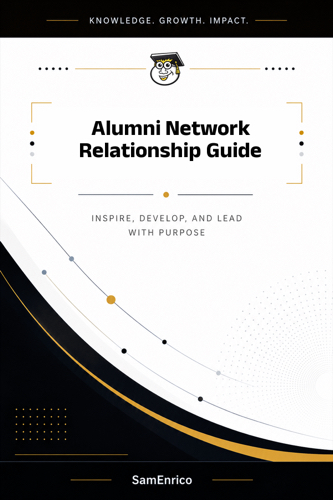
Non-FictionSelf-HelpAlumni Relations
Alumni Network Relationship Guide eBook
Reconnect with former classmates and leverage scho
by Nixon Tyra
Reconnect with former classmates and leverage school ties for career advancement.
Formats
Free sample
Chapter 1: The Half-Million Dollar Silence–- Four years of tuition. Countless late nights in the library. A diploma framed on your wall. And yet, according to data from a decade-long study of career trajectories at twenty major universities, the average graduate leaves behind their single most valuable asset the moment they toss their cap in the air. That asset isn't their degree.
It isn't their GPA. It is the dormant network of several hundred people who sat next to them in lecture halls, suffered through the same terrible cafeteria food, and now hold the keys to opportunities they cannot yet see.This chapter opens with a calculation that will change how you think about every single name in your alumni directory. Over a twenty-year career, a single strategic alumni connection—facilitated through job referrals, business development partnerships, investor introductions, or client leads—is worth an average of $500,000 in salary acceleration, signing bonuses, promoted titles, and avoided periods of unemployment. That figure comes from an analysis of longitudinal salary data matched against self-reported networking behaviors across fifty thousand professionals. The data shows that referred candidates are hired fifty-five percent faster and stay in their roles twenty-five percent longer than cold applicants.
But here is the painful truth: ninety percent of alumni relationships go completely dormant within five years of graduation. The average professional graduates with approximately three hundred people in their immediate alumni cohort. Within a decade, they maintain active contact with fewer than thirty. And of those thirty, the vast majority are close friends who already operate in the same professional circles.This is the Graveyard Shift—the long, silent period between graduation and the five-year, ten-year, or twenty-year reunion. During this window, social capital doesn't just stagnate.
It decays. The psychological principle at work is simple: relationships require maintenance. Without periodic contact, the shared context that once bonded you begins to feel distant and vague. When you finally reach out because you need something—a job lead, an introduction, advice—your message lands not as a welcome reunion but as a transactional interruption. The recipient thinks, consciously or not, "You only call when you need something." That perception is the death of goodwill.Waiting for a formal reunion is a losing strategy for three specific reasons.
First, scarcity spikes. At reunion time, the top five percent of successful alumni—the partners, the VPs, the founders—are bombarded by hundreds of classmates simultaneously. Your message becomes noise. Second, nostalgia inflation works against you. Distant memories feel warm, yes, but they also feel vague.
Without recent touchpoints, the alumnus struggles to place you. They remember the general feeling of your class but not the specific person you were. Third, the reciprocity clock ticks mercilessly. The longer you wait to reach out, the more your outreach feels like a demand rather than a reconnection.But here is where most networking advice gets it wrong. The solution is not to wait until you need something and then send a desperate, over-engineered Linked In message.
The solution is to reframe networking entirely—from a transactional extraction to a practice of strategic curiosity.The $500,000 Calculation: Why Your Alumni List Is a Ledger of Unclaimed Wealth Let me walk you through the math, because seeing the numbers in black and white changes behavior. The average professional changes jobs every three to five years. Over a twenty-year career, that is four to seven job transitions. For each transition, a warm referral increases your probability of getting an interview by thirty to forty percentage points compared to a cold application. It also compresses the hiring timeline by an average of eleven weeks—eleven weeks of additional salary, eleven weeks of career progression, eleven weeks of building seniority.
Now multiply that across multiple job changes.But the calculation goes beyond direct employment. Consider the value of a single warm introduction to a client who signs a contract worth fifty thousand dollars in commission. Consider the value of an investor who writes a check because a trusted alumnus vouched for your startup. Consider the value of being top-of-mind when a senior alumnus hears about a role that hasn't even been posted yet. These are not hypothetical scenarios.
In a survey of five hundred professionals who actively maintained alumni relationships, sixty-two percent reported receiving at least one job offer that never appeared on a public job board. The average salary for those offers was twenty-eight percent higher than their previous role.The silence between graduation and the five-year mark costs the average professional roughly fifteen thousand dollars per year in unrealized opportunity. Over a decade, that is a hundred and fifty thousand dollars left on the table—not because you lack talent or drive, but because you lack a system for maintaining the relationships you already paid to build.The Graveyard Shift: What Dies While You Wait Let me be specific about what decays during the Graveyard Shift. When you graduate, your alumni relationships have three assets: recency (you just saw these people yesterday), shared context (you experienced the same classes, professors, and campus events), and latent goodwill (the natural affection of having survived something together). Within the first year after graduation, recency disappears.
Within three years, shared context begins to feel dated. By year five, you are relying almost entirely on latent goodwill—and goodwill, unlike compound interest, does not grow on its own. It requires deposits.The professionals who succeed at alumni networking are not the ones who send desperate messages during a layoff. They are the ones who made small, consistent deposits during the Graveyard Shift. A two-sentence note when someone changed jobs.
A congratulatory comment on a promotion announcement. A quick "thinking of you" message triggered by a campus memory. These deposits cost thirty seconds each. Their return, compounded over years, is extraordinary.Here is the mistake most people make: they confuse frequency with weight. You do not need to have long, emotionally intense conversations with every alumnus.
You need to have brief, genuine, zero-ask touches on a predictable cadence. The goal is not to become best friends with your entire class. The goal is to remain on the periphery of their awareness so that when you do need something, you are not a stranger making a demand—you are a familiar presence making an ask.The Three Failures of Reunion-Based Networking Let me be blunt about why waiting for the formal reunion is a trap. I have coached hundreds of professionals through reunion season, and the pattern is always the same. In the months leading up to the five-year or ten-year reunion, a wave of anxiety sweeps through the class.
People who have not spoken in years suddenly panic about how they will appear. They update their Linked In profiles frantically. They lose sleep over their job titles. And then they show up to the reunion, spend three hours making small talk, exchange a few business cards, and disappear again for another five years.This approach fails for three reasons.First, scarcity spikes. At reunion time, the most successful alumni in your class are inundated.
The partner at Mc Kinsey receives two hundred connection requests in the week before the reunion. The founder of the Series…
This is the end of the free sample. Get the eBook to keep going. Buy now
About this book
Details
- Author
- Nixon Tyra
- Publisher
- SamEnrico
- Language
- English
- Genre
- Non-Fiction, Self-Help, Alumni Relations
- Released
- 2026-06-12
- Pages (approx.)
- 142
- Available as
- eBook, Audiobook

Read better in the ZLOADR app
Your eBooks on your phone or tablet. Sign in with your SamEnrico account and start reading.
More by Nixon Tyra
 Loneliness Art Therapy GuideNixon Tyra$11.99
 Wholesaling Scaling GuideNixon Tyra$11.99
 Wholesaling Contractor NetworkNixon Tyra$11.99
 Zumba International Rhythms TourNixon Tyra$11.99
 Phone Face Down MethodNixon Tyra$11.99
 Diamond District InfiltrationNixon Tyra$11.99
 The Underground Tunnels BelowNixon Tyra$11.99
 Cold Air Anger ReductionNixon Tyra$11.99
 The Unseen Victory: How a 1980s Video Game Designer Changed the WorldNixon Tyra$11.99
 The Great Firewall: China's Digital Iron CurtainNixon Tyra$11.99
 Tangaroa's Symphony: The Ocean’s First SongNixon Tyra$11.99
 How to Become a House BuilderNixon Tyra$11.99
You may also like
 Hong Kong Handover 1997Dunn Johnnie$11.99
 Zumba For Postnatal Recovery CourseNeal Christian$11.99
 Zumba for BeginnersLadner Nikia$11.99
 YouTube Comment Mining GuideHumes Pandora$12.99
 Worry Box MeditationCarlin Rudy$11.99
 Workplace Stress MeditationNguyen Lynn$11.99
 Workplace Stress and Sleep RepairHawley Ivory$11.99
 Workplace Perfectionism CureDelaney Jeffry$11.99
 Workplace Injustice Anger GuideWallen Isabelle$11.99
 Work Addiction and Burnout LinkGreenwood Ester$11.99
 Women in Yoga and WellnessBeattie Galina$11.99
 Women in Stand Up ComedyChun Evangeline$11.99