
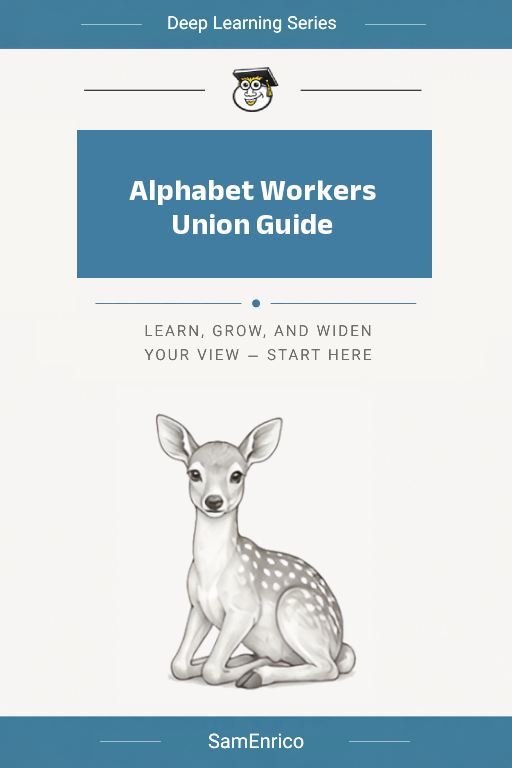
Non-FictionAnnual CheckupGoogleMinority Union
Alphabet Workers Union Guide eBook
Track Alphabet Workers Union minority union model
Track Alphabet Workers Union minority union model organizing at Google including contract campaigns.
Formats
Free sample
Chapter 1: The Walkout Crucible...--–- The afternoon of November 1, 2018, began like any other Thursday at Google’s Mountain View headquarters. Employees sat at their standing desks, sipped kombucha from the microkitchens, and scrolled through internal memos about product launches and OKRs. But by 11:00 AM Pacific time, something extraordinary began to ripple through the company’s global workforce. A Google Doc link was spreading through internal email chains, shared calendars, and encrypted Signal groups. The message was simple and urgent: “Walk out at 11:10 AM.
Do not stay at your desk. Do not let them ignore us.”–- Within minutes, thousands of employees across Google’s offices in Mountain View, San Francisco, Seattle, New York, Los Angeles, London, Tokyo, and Berlin pushed back from their desks. They streamed out of glass-walled buildings, gathering in courtyards and sidewalks. In Mountain View, the crowd grew so large that it spilled from the main amphitheater into adjacent pathways. Organizers later estimated that 20,000 Google employees participated worldwide—roughly one-fifth of the company’s full-time workforce at the time -1.
They carried hand-lettered signs that read “Don’t Be Evil,” “Time’s Up Tech,” and “We Are Not Disposable.” Some wore bright red shirts emblazoned with the words “Google Walkout.” For approximately one hour, the most profitable and celebrated company in the history of the internet ground to a halt.–- The walkout was not spontaneous. It had been brewing for years. And it would become the crucible in which the Alphabet Workers Union was forged.The Erosion of “Don’t Be Evil”–- To understand why 20,000 people would risk their careers at the world’s most desirable employer, one must first understand what Google had promised them. Google’s famous “Don’t Be Evil” motto, written by engineers Paul Buchheit and Amit Patel in 2000, was never just marketing. For a generation of workers who entered the tech industry in the 2000s and 2010s, it was a moral compact.
You could work at Google and believe you were changing the world for the better. You could organize the world’s information and make it universally accessible and useful—without becoming a cog in a morally compromised machine.–- But by 2018, that compact had shattered. The company had grown from a scrappy search engine into Alphabet, a sprawling conglomerate with more than 130,000 employees and countless contractors -1. With growth came bureaucracy. With bureaucracy came distance between the engineers who wrote the code and the executives who signed the contracts.
And with distance came a creeping sense that the people at the top no longer remembered what “Don’t Be Evil” was supposed to mean.–- The first major crack appeared in 2017, when engineer James Damore published a ten-page memo arguing that biological differences explained the gender gap in tech. The memo, which circulated widely inside and outside the company, ignited a firestorm. Google fired Damore, but the damage was done. Female employees who had long complained about a hostile culture suddenly had proof—in the form of a widely distributed internal document—that their concerns were not paranoid fantasies.–- Then came the revelations about Andy Rubin. The former Android lead had left Google in 2014 with a 90millionexitpackage—paidoutinmonthlyinstallmentsof90 million exit package—paid out in monthly installments of 90millionexitpackage—paidoutinmonthlyinstallmentsof2.5 million for four years—despite an internal investigation concluding that a sexual harassment claim against him was credible -1.
When The New York Times reported this in October 2018, the story landed like a bomb. Google had paid a predator nearly nine figures while quietly pushing out the women who had reported him.–- For many employees, this was the breaking point.The Anatomy of a Walkout–- The walkout was organized by a small group of Google employees, including Claire Stapleton, Meredith Whittaker, and Tanuja Gupta. They operated in secret, using encrypted messaging apps and personal email addresses to avoid detection. They created a shared Google Doc—the irony was not lost on them—that outlined demands: an end to forced arbitration for sexual harassment claims, a commitment to pay equity, transparency about sexual harassment investigations, and the creation of a chief diversity officer role reporting directly to CEO Sundar Pichai.–- The document spread like wildfire. Within days, thousands of employees had signed on.
The organizers set the walkout for November 1—just days after the Rubin story broke—to capitalize on the outrage while it was still raw.–- On the day of the walkout, the scene was electric. In Mountain Valley, employees gathered in the central amphitheater, listening to speeches from organizers and from women who had experienced harassment. Some speakers cried. Others shouted. The crowd cheered and clapped and, at times, fell into a stunned silence as one story after another revealed the gap between Google’s public image and its internal reality.–- In New York, employees walked out of the Chelsea Market building and gathered on the High Line, holding signs and chanting.
In London, they gathered outside the Google building on St. Giles High Street. In Tokyo, they stood in a disciplined circle in a corporate plaza. In each location, the same demands echoed.–- The walkout lasted approximately one hour. But its effects would linger for years.The Retaliation That Followed–- Google management initially responded with cautious support.
CEO Sundar Pichai issued a statement saying that employees had “courageously spoken up” and that the company would “review and address” their demands. Within weeks, Google announced that it would end forced arbitration for sexual harassment claims—a significant concession that applied retroactively to all employees.–- But behind the scenes, a different story was unfolding.–- Walkout organizers began to report retaliation. Meredith Whittaker, a co-organizer and respected AI researcher, was told that her role at the company was being eliminated—not because of performance issues, but, she believed, because of her activism. Claire Stapleton, another organizer, was demoted and reassigned to a role with fewer responsibilities. Both eventually left the company -2.–- Other employees who had supported the walkout found themselves under increased scrutiny.
Performance reviews that had always been glowing suddenly contained negative feedback. Managers who had never questioned their teams’ output began demanding detailed justifications for time spent. The message was clear: organize at your peril.–- In September 2019, Google reached a settlement with the National Labor Relations Board in response to complaints filed by Whittaker and Stapleton -2. The settlement required Google to clarify its policies, explicitly stating that employees had the right to act collectively and discuss workplace issues with each other and the press. But the settlement did not restore trust.
If anything, it confirmed what many had suspected: Google saw its employees not as partners in a shared mission but as potential threats to be managed.The Firing of Timnit Gebru–- The walkout and its aftermath created the conditions for radical organizing. But the event that truly catalyzed the formation of the Alphabet Workers Union came two years later.–- Dr. Timnit Gebru was a star. A leading researcher in AI ethics, she co-led Google’s Ethical AI team and was one of the few Black women at her level in the entire tech industry. She had co-authored a groundbreaking paper showing that facial recognition…
This is the end of the free sample. Get the eBook to keep going. Buy now
About this book
Details
- Author
- Andre Shawnda
- Publisher
- SamEnrico
- Language
- English
- Genre
- Non-Fiction, Annual Checkup, Google, Minority Union
- Released
- 2026-06-01
- Pages (approx.)
- 156
- Available as
- eBook, Audiobook

Read better in the ZLOADR app
Your eBooks on your phone or tablet. Sign in with your SamEnrico account and start reading.
More by Andre Shawnda
 Girls Self Esteem WorkbookAndre Shawnda$11.99
 Securities Fraud Compliance ChecklistAndre Shawnda$11.99
 Parenting And Career Balance GuideAndre Shawnda$11.99
 Harassment Hidden in Plain TextAndre Shawnda$11.99
 Retirement Home Energy AuditAndre Shawnda$11.99
 Quantum Leap: The Day Google Broke the CodeAndre Shawnda$11.99
 The Paper Trail: How the 1996 Telecommunications Act Reshaped the InternetAndre Shawnda$11.99
 How to Start a Partnership Agent Business (Beginners Guide)Andre Shawnda$11.99
 Boiler OperatorAndre Shawnda$11.99
 Engineering Brazil GuideAndre Shawnda$12.99
 Understanding Distal MyopathyAndre Shawnda$17.99
You may also like
 Hong Kong Handover 1997Dunn Johnnie$11.99
 Zumba For Postnatal Recovery CourseNeal Christian$11.99
 Zumba for BeginnersLadner Nikia$11.99
 YouTube Comment Mining GuideHumes Pandora$12.99
 Worry Box MeditationCarlin Rudy$11.99
 Workplace Stress MeditationNguyen Lynn$11.99
 Workplace Stress and Sleep RepairHawley Ivory$11.99
 Workplace Perfectionism CureDelaney Jeffry$11.99
 Workplace Injustice Anger GuideWallen Isabelle$11.99
 Work Addiction and Burnout LinkGreenwood Ester$11.99
 Women in Yoga and WellnessBeattie Galina$11.99
 Women in Stand Up ComedyChun Evangeline$11.99