
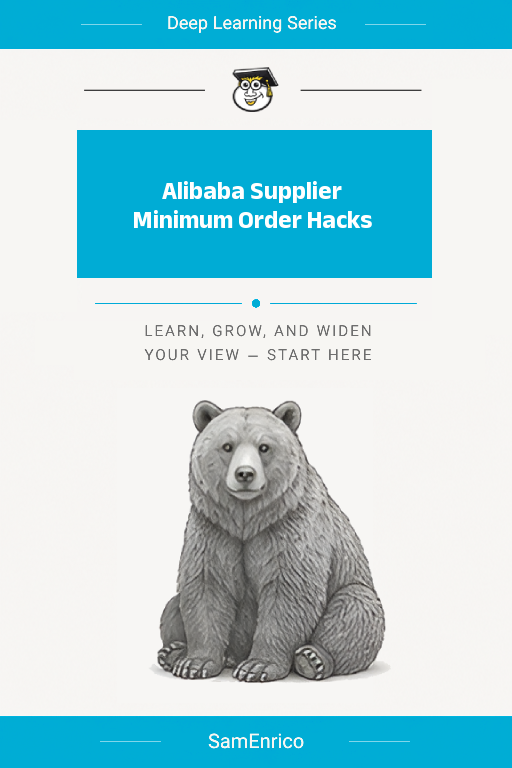
Alibaba Supplier Minimum Order Hacks
Combine products or negotiate sample orders to red
by Dew Maud
Combine products or negotiate sample orders to reduce MOQ risk, comparing inventory commitment to Amazon's on-demand FBA and Jumia's local sourcing.
Formats
About this book
Free sample
Chapter 1: The Inventory Trap--–- In 2018, a first-time entrepreneur named Sarah wired $12,000 to a supplier in Shenzhen for 5,000 custom phone cases. She had never seen the factory. She had never touched the product. She had simply read the supplier's Alibaba page, which listed a Minimum Order Quantity of 5,000 pieces, and assumed that was the price of entry. Nine weeks later, a 40-foot container arrived at her garage.
The phone cases were beautiful. The problem was that she had only sold 47 units in the first three months. The remaining 4,953 cases sat in cardboard boxes, stacked to the ceiling, while Amazon storage fees ate her remaining capital. Within six months, Sarah was out of business. She didn't fail because her product was bad.
She failed because she treated the MOQ as a rule rather than a negotiation.This chapter dismantles the single most destructive belief in global sourcing: that the Minimum Order Quantity printed on an Alibaba supplier's page is a fixed, unchangeable requirement. It is not. It is a flexible expression of the factory's internal constraints, and once you understand those constraints, you can bend the number to your advantage. By the end of this chapter, you will understand why factories set MOQs, how to distinguish between hard and soft limits, and the single most powerful hack—changing shipping terms—that can reduce a 5,000-unit requirement to 300 units without changing the product, the price, or the supplier.The Invisible Math of the Factory Every MOQ on Alibaba is the result of three hidden drivers. None of them are about you or your order size.
They are about the factory's internal economics. Understanding these drivers is the first step to negotiating around them.Driver 1: Raw Material Rolls Factories do not buy raw materials by the unit. They buy them in industrial quantities. Fabric comes in rolls that are hundreds or thousands of meters long. Plastic pellets come in 25-kilogram bags.
Metal sheets come in standardized dimensions. Electronic components come in reels of 1,000, 5,000, or 10,000 pieces. When a supplier gives you an MOQ of 5,000 units, they are often translating a…
This is the end of the free sample. Get the eBook to keep going. Buy now
Contents
- Chapter 1
- Chapter 2
- Chapter 3
- Chapter 4
- Chapter 5
- Chapter 6
- Chapter 7
- Chapter 8
- Chapter 9
- Chapter 10
- Chapter 11
- Chapter 12
Details
- Author
- Dew Maud
- Publisher
- SamEnrico
- Language
- English
- Genre
- Non-Fiction, Business Brief
- Released
- 2026-06-01
- Pages (approx.)
- 128
- Available as
- eBook, Audiobook

Read better in the ZLOADR app
Your eBooks on your phone or tablet. Sign in with your SamEnrico account and start reading.
More by Dew Maud
 Memory Palace for NamesDew Maud$11.99
 Compulsive Spending and BankruptcyDew Maud$11.99
 Suicide Risk Anticipatory GriefDew Maud$11.99
 The Postpartum and Other ChildrenDew Maud$11.99
 Digital Calendar Blocking TutorialDew Maud$11.99
 Self Hypnosis for Shopping HabitsDew Maud$11.99
 Nonverbal Cues for RealtorsDew Maud$11.99
 Digital Crime Scene ReconstructionDew Maud$11.99
 Trollcrossing: The Bridge Between WorldsDew Maud$11.99
 The Last Song of the ValkyrieDew Maud$11.99
 Mice: Rodent Facts, Pest Control & PET CareDew Maud$11.99
 How to Produce Personal LubricantsDew Maud$11.99
You may also like
 Hong Kong Handover 1997Dunn Johnnie$11.99
 Zumba For Postnatal Recovery CourseNeal Christian$11.99
 Zumba for BeginnersLadner Nikia$11.99
 YouTube Comment Mining GuideHumes Pandora$12.99
 Worry Box MeditationCarlin Rudy$11.99
 Workplace Stress MeditationNguyen Lynn$11.99
 Workplace Stress and Sleep RepairHawley Ivory$11.99
 Workplace Perfectionism CureDelaney Jeffry$11.99
 Workplace Injustice Anger GuideWallen Isabelle$11.99
 Work Addiction and Burnout LinkGreenwood Ester$11.99
 Women in Yoga and WellnessBeattie Galina$11.99
 Women in Stand Up ComedyChun Evangeline$11.99