
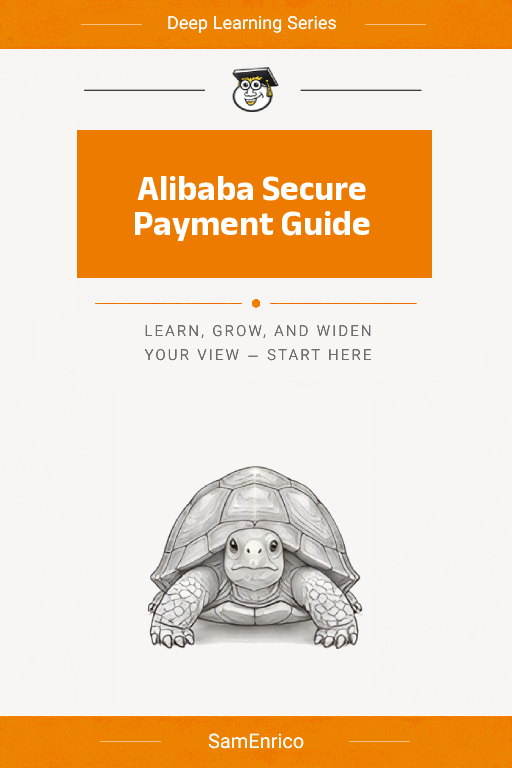
Alibaba Secure Payment Guide eBook
Use Alibaba escrow and secure payment versus Amazo
Use Alibaba escrow and secure payment versus Amazon's A to Z guarantee for buyers.
Formats
Free sample
Chapter 1: The Trust Paradox--–- In the summer of 2016, a veteran importer named Sarah wired 47,000toaseeminglyreputablesupplierin Guangzhouforacontainerofcustomelectronics.Thesupplierhada Gold Supplierbadge,respondedtomessageswithinminutes,andprovidedacommercialinvoicethatlookedflawless.Thirtydayslater,thesupplier’s We Chatwentsilent.Forty−fivedayslater,thephonenumberwasdisconnected.Sixtydayslater,Sarahlearnedwhatexperiencedcross−bordertraderseventuallydiscover:trustisnotastrategy.Sheneversawthemoneyortheproductagain.Thatsameweek,acrossthe Pacific,an Amazonsellernamed Marcusreceivedanotificationthatabuyerhadfiledan A−to−Zclaimona47,000 to a seemingly reputable supplier in Guangzhou for a container of custom electronics. The supplier had a Gold Supplier badge, responded to messages within minutes, and provided a commercial invoice that looked flawless. Thirty days later, the supplier’s We Chat went silent. Forty-five days later, the phone number was disconnected. Sixty days later, Sarah learned what experienced cross-border traders eventually discover: trust is not a strategy.
She never saw the money or the product again. That same week, across the Pacific, an Amazon seller named Marcus received a notification that a buyer had filed an A-to-Z claim on a 47,000toaseeminglyreputablesupplierin Guangzhouforacontainerofcustomelectronics.Thesupplierhada Gold Supplierbadge,respondedtomessageswithinminutes,andprovidedacommercialinvoicethatlookedflawless.Thirtydayslater,thesupplier’s We Chatwentsilent.Forty−fivedayslater,thephonenumberwasdisconnected.Sixtydayslater,Sarahlearnedwhatexperiencedcross−bordertraderseventuallydiscover:trustisnotastrategy.Sheneversawthemoneyortheproductagain.Thatsameweek,acrossthe Pacific,an Amazonsellernamed Marcusreceivedanotificationthatabuyerhadfiledan A−to−Zclaimona29 phone case. The tracking showed “Delivered.” The buyer admitted the package was on their porch. But Amazon refunded the 29anyway,plusa29 anyway, plus a 29anyway,plusa5 gift card for the “inconvenience,” and deducted both from Marcus’s account. Marcus had no recourse.
He could not call anyone. He could not appeal. The money was gone. Sarah lost 47,000becauseshetrustedasystemthathadnosafetynet.Marcuslost47,000 because she trusted a system that had no safety net. Marcus lost 47,000becauseshetrustedasystemthathadnosafetynet.Marcuslost34 because he trusted a system that had too much safety net—for the buyer.
Both learned the same lesson: in e-commerce, the platform that holds the money makes the rules. And neither of them understood the rules before they lost.This book is about those rules. It is not a philosophical exploration of trust. It is a tactical field manual for anyone who moves money across borders in exchange for physical goods. Whether you are a B2B importer sourcing fifty thousand dollars worth of industrial parts from Alibaba, a retail buyer purchasing a hundred-dollar jacket from Amazon, or a seller trying to survive on both platforms simultaneously, you need to understand the fundamental architecture of how these two giants protect—and exploit—your money.The Two Models That Rule Global E-Commerce Every online transaction faces a core problem: the buyer wants to pay only after receiving exactly what they ordered, and the seller wants to be paid before shipping goods that could be lost, stolen, or rejected.
Traditional commerce solved this with face-to-face exchange. International trade solved it with letters of credit that cost thousands of dollars and took weeks to process. Alibaba and Amazon solved it in two completely different ways, and those differences determine everything about who wins and who loses when a transaction goes wrong.Alibaba uses the escrow model. The buyer sends money to Alipay, Alibaba’s payment processor. Alipay holds the money.
The seller ships the goods. The buyer confirms satisfaction. Alipay releases the money to the seller. This is the same logic as a real estate escrow account or a lawyer’s trust account. The platform does not take a position on who is right or wrong until a dispute arises, and when a dispute does arise, the platform adjudicates based on documentary evidence.Amazon uses the insurance model.
The buyer pays Amazon with a credit card. Amazon immediately pays the seller (minus fees). The buyer receives the goods. If anything goes wrong, the buyer files an A-to-Z claim. Amazon investigates, almost always sides with the buyer, refunds the buyer from its own pocket, and then recovers that money from the seller by withholding future payouts.
The platform acts as the judge, jury, and insurer—all at once.These two models create opposite risk profiles. With Alibaba, the seller bears the risk of non-payment if the buyer dishonestly claims quality issues. With Amazon, the buyer bears almost no risk at all, and the seller bears the risk of fraudulent claims, return abuse, and the platform’s automatic bias toward the customer.The Numbers That Explain Everything Before diving into mechanics, understand the scale of what is at stake. Alibaba’s Trade Assurance program processed over $100 billion in transactions in 2023 alone. Amazon’s A-to-Z Guarantee covers more than 600 million products sold by third-party sellers.
Combined, these two protection systems govern more money than the GDP of most countries.But the numbers that matter more are the dispute outcomes. Internal data leaked from Amazon in 2022 showed that A-to-Z claims were decided in favor of the buyer 78% of the time, even when sellers provided tracking information. For claims under $100, the buyer win rate jumped to 91%. For “Significantly Not as Described” claims—the most subjective category—buyers won 84% of disputes. Alibaba’s internal metrics, shared with major sellers under nondisclosure agreements, paint a different picture: buyers win approximately 55% of Trade Assurance disputes, sellers win 35%, and 10% are split or settled.
But the key difference is not the win rate—it is the basis of the decision. Amazon decides based on customer satisfaction. Alibaba decides based on documents.A buyer who receives a blue shirt when they ordered a red shirt will almost certainly win an Amazon claim and almost certainly lose an Alibaba claim if the packing slip says “blue shirt” and the order confirmation says “blue shirt,” even if the product page had a red photo. Amazon asks: “Is the customer happy?” Alibaba asks: “Did the paperwork match?”The Unified Value Framework Throughout this book, we will use a consistent framework for evaluating which payment method to use and when to trust the platform’s protection. This framework is essential because the original confusion around thresholds—some guides say 500,otherssay500, others say 500,otherssay5,000, others say $10,000—has cost merchants millions in preventable losses.Low-stakes transactions are those under 500.Fortheseamounts,thecostofdisputeresolutionoftenexceedsthevalueofthegoods.A500.
For these amounts, the cost of dispute resolution often exceeds the value of the goods. A 500.Fortheseamounts,thecostofdisputeresolutionoftenexceedsthevalueofthegoods.A40 dispute that requires two hours of your time at 50perhourcostsyou50 per hour costs you 50perhourcostsyou100 to fight—more than the dispute itself. For low-stakes transactions, speed and convenience matter more than perfect protection.Mid-stakes transactions range from 500to500 to 500to5,000. In this zone, the decision depends on the nature of the product. Commodity items with objective specifications—steel bolts, memory cards, standard batteries—can be verified against clear standards.
Subjective products—clothing, artwork, custom goods—cannot. The former favors Alibaba’s documentary system. The latter favors Amazon’s customer-satisfaction system.High-stakes transactions exceed 5,000.Fortheseamounts,youcannotaffordtorelyon Amazon’sinsurancemodelbecause Amazon’smaximumclaimpayoutistypicallylimitedto5,000. For these amounts, you cannot afford to rely on Amazon’s insurance model because Amazon’s maximum claim payout is typically limited to 5,000.Fortheseamounts,youcannotaffordtorelyon Amazon’sinsurancemodelbecause Amazon’smaximumclaimpayoutistypicallylimitedto2,500 for most third-party sales (exceptions apply for FBA and certain categories). Alibaba’s Trade Assurance, by contrast, offers coverage up to 100,000ormoreforverified Gold Suppliers.Above100,000 or more for verified Gold Suppliers.
Above 100,000ormoreforverified Gold Suppliers.Above5,000, Alibaba’s escrow model with pre-shipment inspection is the only rational choice.This framework will appear throughout the book. Chapter 12 presents the complete decision trees, but internalize these thresholds now: 500,500, 500,5,000. They are the difference between walking away and going bankrupt.How Alibaba’s Escrow Actually Works Most users think they…
This is the end of the free sample. Get the eBook to keep going. Buy now
About this book
Details
- Author
- Mccracken Lovie
- Publisher
- SamEnrico
- Language
- English
- Genre
- Non-Fiction, Business Brief, Secure
- Released
- 2026-05-30
- Pages (approx.)
- 156
- Available as
- eBook, Audiobook

Read better in the ZLOADR app
Your eBooks on your phone or tablet. Sign in with your SamEnrico account and start reading.
More by Mccracken Lovie
 The Pediatric AED GuideMccracken Lovie$11.99
 The Autoimmune Micronutrient GuideMccracken Lovie$11.99
 Molar Pregnancy Emotional RecoveryMccracken Lovie$11.99
 Glass Fragment DatingMccracken Lovie$11.99
 Comparison Culture At WorkMccracken Lovie$11.99
 Sudden Child Death ShockMccracken Lovie$11.99
 Dakar African Independence HubMccracken Lovie$11.99
 The Alchemist Who Unlocked the Cosmos: Robert Boyle and the Birth of Modern ChemistryMccracken Lovie$11.99
 The Poisoning Priestess: Belle Gunness and the Butcher of LaPorteMccracken Lovie$11.99
 How to Produce Scanner Circuit BoardsMccracken Lovie$11.99
 Irish Setter: Enthusiastic & ScatteredMccracken Lovie$11.99
 A Collector's Handbook to the Austin A55-Mccracken Lovie$11.99