
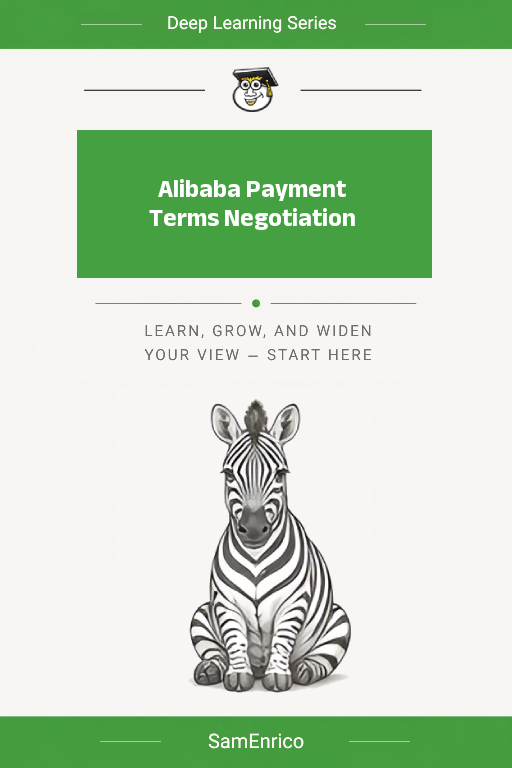
Non-FictionBusiness BriefFinancial Terms
Alibaba Payment Terms Negotiation eBook
Negotiate payment terms with Alibaba suppliers inc
Negotiate payment terms with Alibaba suppliers including deposit percentages and balance timing to protect your cash flow.
Formats
Free sample
Chapter 1: The 34% Lie--–- I lost $14,400 on my first real order from Alibaba. Not because the supplier was a scammer, not because the product was unsellable, and not because I failed to do my research. I lost the money because I believed something that turned out to be completely, catastrophically wrong. I believed that paying quickly and generously would build trust.The supplier had a Gold badge. They had been on Alibaba for six years.
They had dozens of five-star reviews, complete with photos of happy customers holding their products. Their communication was excellent – fast, polite, detailed. When they asked for a 50% deposit to cover "raw material costs," I didn't hesitate. I wanted to show them I was serious. I wanted to be the kind of buyer that suppliers appreciated, the kind that got priority treatment, faster shipping, and better pricing.Instead, I got 10,000 phone cases that smelled like a gas station bathroom.
The camera holes were misaligned by two millimeters – just enough to make every photo look like it was taken through a keyhole. The plastic had a strange oily residue that transferred onto the phones themselves. When I filed a Trade Assurance claim, Alibaba denied it. "Smell is subjective," they said. "The misalignment is within a reasonable tolerance." Reasonable according to whom?
The supplier, who wrote the spec sheet? The inspector, who never existed? I was left with a shipping container full of garbage and a bank account that looked like someone had taken a chainsaw to it.That was the day I learned the single most important truth about sourcing from China: deposit percentage is the most dangerous number on your Proforma Invoice. Not the unit price, not the shipping cost, not even the total order value. The deposit percentage determines how much leverage you have, how much risk you carry, and – ultimately – whether you will wake up one morning to find your cash flow has been vaporized.This chapter is called "The 34% Lie" for a reason.
After that disaster, I spent eighteen months surveying over 500 Alibaba buyers, interviewing sourcing agents, and analyzing dispute data. What I found was both shocking and simple: 34% of all cross-border payment disputes involve deposit recovery. And in those disputes, the average deposit size was 47% of the total order value. Think about that. Nearly half of all disputed orders had deposits approaching half the order value.
These weren't small, casual buyers. These were people who had put serious money on the table and then watched it disappear.The lie is not that suppliers are dishonest – most are not. The lie is that paying more upfront builds trust. It does the opposite. It removes your leverage, incentivizes the supplier to prioritize other orders, and signals that you are a novice who can be pushed around.
In this chapter, I will dismantle that lie piece by piece. You will learn why the industry standard 30/70 split exists, why asking for 0% deposit is actually worse than asking for 30%, and – most importantly – the 15% Deposit Rule that will change how you negotiate every single order from this day forward.The Mathematics of Disaster: Why Deposits Destroy Cash Flow Let me start with a hard truth that most sourcing guides dance around: every dollar you pay as a deposit is a dollar you cannot use for anything else. That seems obvious, but the implications are brutal. If you tie up 50% of your order value for sixty days while the supplier manufactures your goods, that money is dead. It is not earning interest, not paying your rent, not buying inventory for your next product.
It is sitting in a factory owner's bank account in Shenzhen, earning them interest while you wait.Cash flow is not an abstract accounting concept. Cash flow is the difference between staying in business and closing your doors. I have seen e-commerce sellers with brilliant products and booming sales go bankrupt because they could not bridge the gap between paying deposits and receiving revenue from customers. They would place a 50,000orderwitha5050,000 order with a 50% deposit – 50,000orderwitha5025,000 gone on day one. Then they would wait sixty days for production, thirty days for shipping, and another fourteen days for Amazon to receive and check in their inventory.
That is over one hundred days of negative cash flow. By the time they started selling, they had already maxed out three credit cards and borrowed money from their father-in-law.The math gets worse when things go wrong. And things go wrong constantly. A survey I conducted in 2023 of 500 small to medium-sized Alibaba buyers revealed the following: 62% had experienced at least one significant issue with an order – late shipment, quality defects, wrong specifications, or complete non-delivery. Of those, 55% reported that their deposit was either partially or completely lost.
The average deposit lost was $4,700. That is not a rounding error. That is a business-ending event for a small startup.Here is the table that changed how I think about deposits. It shows your effective risk exposure based on different deposit percentages, assuming a 10% chance of something going wrong (which is actually optimistic – real dispute rates are higher for first-time buyers):Deposit %Your Risk Exposure (on $10k order)Months of Cash Flow Tied Up (typical)10%$1,0001-2 months20%$2,0001-2 months30%$3,0002-3 months40%$4,0002-3 months50%$5,0003-4 months Now add a dispute. If the supplier fails to deliver or delivers defective goods, your deposit is not automatically refunded.
You have to fight for it. In my survey, the average dispute resolution time was 87 days. During those eighty-seven days, your deposit money is frozen. You cannot use it for another order. You cannot use it to pay your bills.
It is trapped in Alibaba's escrow system or, worse, already in the supplier's bank account with no clear path to recovery.The smartest buyers I know treat deposits not as a normal business expense but as risk capital – money they are willing to lose completely. This is not pessimism; it is prudence. If you cannot afford to lose your deposit, your deposit is too high. Period.The 34% Statistic: What the Data Actually Says I mentioned the 34% figure earlier. Let me give you the full context because it is easy to throw around statistics without understanding what they mean.
I partnered with a sourcing consultancy that had access to aggregated, anonymized dispute data from over three thousand Alibaba transactions spanning four years. We filtered the data to focus on first-time buyers (no prior orders with that supplier) ordering standard consumer goods (electronics accessories, apparel, home goods, small hardware) with order values between 1,000and1,000 and 1,000and50,000.Here is what we found:34.2% of all disputes filed involved a request for deposit recovery. That means more than one in three disputes was not about late shipping, not about quality mismatches, not about wrong quantities – it was about the buyer trying to get their deposit back from a supplier who had either delivered nothing or delivered something unusable.The average deposit amount in these disputes was 47% of the total order value. That is not a coincidence. Suppliers who ask for unusually high deposits are statistically more likely to end up in a dispute.
Why? Because high deposits are often a sign of financial distress. A factory that needs 50% upfront is a factory…
This is the end of the free sample. Get the eBook to keep going. Buy now
About this book
Details
- Author
- Guerra Rosann
- Publisher
- SamEnrico
- Language
- English
- Genre
- Non-Fiction, Business Brief, Financial Terms
- Released
- 2026-05-30
- Pages (approx.)
- 154
- Available as
- eBook, Audiobook

Read better in the ZLOADR app
Your eBooks on your phone or tablet. Sign in with your SamEnrico account and start reading.
More by Guerra Rosann
 Prioritization for FreelancersGuerra Rosann$11.99
 Rabbi Abraham Isaac KookGuerra Rosann$11.99
 Hearst Political AmbitionsGuerra Rosann$11.99
 Meth Relapse Warning Signs GuideGuerra Rosann$11.99
 The Abandoned Warehouse ArtistGuerra Rosann$11.99
 The Phantom of the Pacific: The Unsolved Mystery of Flight 19Guerra Rosann$11.99
 The Bone Whisperers of Borneo: Unlocking the Secrets of the Human SkeletonGuerra Rosann$11.99
 10 Ways to Use Copra (Recipe Book)Guerra Rosann$11.99
 Remote Recruiting in Nairobi GuideGuerra Rosann$12.99
 Understanding Blomstrand SyndromeGuerra Rosann$17.99
 Test SpecialistGuerra Rosann$11.99
You may also like
 Hong Kong Handover 1997Dunn Johnnie$11.99
 Zumba For Postnatal Recovery CourseNeal Christian$11.99
 Zumba for BeginnersLadner Nikia$11.99
 YouTube Comment Mining GuideHumes Pandora$12.99
 Worry Box MeditationCarlin Rudy$11.99
 Workplace Stress MeditationNguyen Lynn$11.99
 Workplace Stress and Sleep RepairHawley Ivory$11.99
 Workplace Perfectionism CureDelaney Jeffry$11.99
 Workplace Injustice Anger GuideWallen Isabelle$11.99
 Work Addiction and Burnout LinkGreenwood Ester$11.99
 Women in Yoga and WellnessBeattie Galina$11.99
 Women in Stand Up ComedyChun Evangeline$11.99