
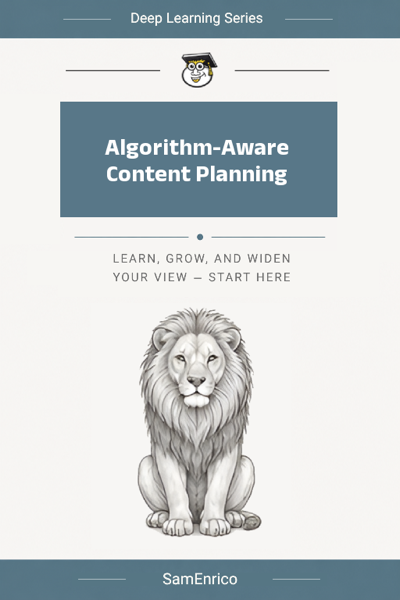
Algorithm-Aware Content Planning eBook
A Coursebook on Algorithm-Aware Content Planning
A Coursebook on Algorithm-Aware Content Planning
Formats
Free sample
Chapter 1: The Great Betrayal...--The notification arrived at 9:47 AM on a Tuesday. Sarah had been posting to her Instagram audience of 104,000 followers for three years—daily videos, meticulously edited, engagement rates that would make most influencers weep with envy. She had done everything right. She posted when her analytics said to post. She used the hashtags her research suggested.
She replied to every comment within an hour. She had built a community.The notification was from a fellow creator: "Hey, did your reach just collapse? I'm at 2% of followers seeing my posts. WTF is happening?"Sarah opened her own analytics. Her heart stopped.The previous week, her average post reached 34,000 followers—about 33% of her audience.
The week before that, 37,000. The week before that, consistent as a metronome. But the post she had published yesterday, a 60-second Reel she had spent four hours editing, had been seen by exactly 1,847 followers. That was 1.8% reach. Her story views had dropped from 12,000 to 400.She hadn't changed anything.
Her content was better than ever. Her audience was more engaged than ever. And yet, the platform had simply decided to stop showing her work to the people who had chosen to follow her.This was 2016. Instagram had just switched from a chronological feed to an algorithmic ranking system. Nobody had warned her.
Nobody explained the new rules. She was playing a game where the rules had changed overnight, and she didn't even know there were new rules until she was already losing.Sarah's story is not unique. It is the story of every creator, marketer, and business owner who has woken up to find that the platform they built their livelihood on has shifted beneath their feet. It happened on Facebook in 2009 with Edge Rank. It happened on You Tube in 2012 with the shift from view count to watch time.
It happened on Linked In in 2018. It happened on Tik Tok in 2020 as their recommendation engine matured. It will happen again on whatever platform emerges next.And it is happening to you right now, in smaller increments, every single day. The algorithm does not announce its updates. It does not send you a calendar invite.
It simply changes, and your content either adapts or disappears.This chapter is not a history lesson. It is an autopsy of the old way of thinking—the "batch and blast" mentality that still infects most content planning. Before you can learn to work with algorithms, you must first understand why everything you thought you knew about content distribution is now actively hurting you.The Old World: Chronological Feed and the Illusion of Control Let us travel back to a simpler time. The year is 2009. Facebook has just introduced something called the "News Feed" – a reverse-chronological list of everything your friends and followed pages have posted, in the order they posted it.
If you posted at 3:00 PM, your content appeared at the top of your followers' feeds at 3:00 PM. If they opened the app at 4:00 PM, they saw your post below everything posted between 3:00 PM and 4:00 PM, but above everything older.This was a deterministic system. Cause and effect were linear and predictable. If you wanted more eyes on your content, you posted more often. If you wanted to reach a specific audience, you posted when they were most active.
The math was brutal but simple: Reach = (Number of followers) × (Frequency of posting) × (Probability they open the app within the next hour).Content planners built entire careers on this model. They hired social media managers whose primary job was to schedule posts at "peak hours." Agencies sold "viral marketing" packages guaranteed to increase reach—usually by simply posting more garbage more often. The strategy was called "batch and blast": produce a batch of content, blast it to all followers, repeat daily.The batch and blast mindset rests on three assumptions, all of which are now dead:Assumption One: Your followers see everything you post. In a chronological feed, every post appears in every follower's feed, in order. The only filtering is time.
If they scroll far enough, they see everything. This assumption died the moment platforms realized that users were missing 70% of their friends' content simply because there was too much to scroll through.Assumption Two: Frequency equals reach. In a chronological feed, posting more often means occupying more slots in the feed. More slots mean more chances to be seen. This assumption died when platforms realized that users were abandoning feeds overwhelmed by low-quality, high-frequency content from brands.Assumption Three: Timing is the primary variable.
In a chronological feed, the only question is "when will they see it?" Not "will they see it?" Just "when?" This assumption died when platforms replaced the clock with relevance as the primary ranking signal.The batch and blast mentality persists today like a phantom limb. You can see it in the way most marketing departments still operate. They create a monthly content calendar. They assign posting times. They schedule everything through a tool like Hootsuite or Buffer.
They measure success by impressions and likes. They are optimizing for a world that no longer exists.And they are losing.The Invention of the Black Box Why did platforms abandon the chronological feed? The answer is simple and brutal: attention scarcity.In 2009, the average Facebook user had 130 friends and followed 40 pages. The average user generated 90 pieces of content per day that could potentially appear in their feed. By 2015, the average Facebook user had 338 friends, followed 200 pages, and was exposed to more than 1,500 potential feed items per day.
The human brain cannot process 1,500 pieces of information in a single session. Users were abandoning the platform because they felt overwhelmed.The platform had a problem: too much content, not enough attention. If users left because they couldn't find what mattered to them, Facebook lost advertising revenue. The solution was algorithmic ranking—a system that would predict which content each user was most likely to engage with, and show them that content first.Facebook's first algorithm was called Edge Rank. In retrospect, it was laughably simple.
Edge Rank scored every piece of content using three variables:Affinity: How close is the relationship between the user and the creator? (You have high affinity with your spouse, low affinity with a brand you liked once in 2011.)Weight: What type of content does this user engage with most? (Photos and videos were weighted higher than links and status updates.)Time Decay: How old is the content? (Fresh content got a boost, but relevance could overcome age.)Edge Rank was a crude tool, but it worked. Users spent more time on Facebook because they saw more of what they actually wanted to see.
Other platforms took notice. Instagram introduced an algorithmic feed in 2016—the year of Sarah's nightmare notification. Linked In followed in 2018. You Tube had been algorithmically ranking search results since 2012 but moved to algorithmic homepage recommendations soon after. Tik Tok launched in 2016 with an algorithmic "For You" page as its primary interface, never even offering a chronological option.Today, no major platform uses a chronological feed as its primary distribution mechanism.
Even Twitter—the last holdout—introduced algorithmic "Top Tweets" as the default view in 2018 and has only doubled down since.But here…
This is the end of the free sample. Get the eBook to keep going. Buy now
About this book
Details
- Author
- Moeller Berniece
- Publisher
- SamEnrico
- Language
- English
- Genre
- Non-Fiction, Informative, Educational
- Released
- 2026-05-11
- Pages (approx.)
- 157
- Available as
- eBook, Audiobook

Read better in the ZLOADR app
Your eBooks on your phone or tablet. Sign in with your SamEnrico account and start reading.
More by Moeller Berniece
 Free Creator Community BuildingMoeller Berniece$11.99
 Solar Temple Star Chamber PrimerMoeller Berniece$11.99
 Migraine Meditation ReliefMoeller Berniece$11.99
 LBO Model Macros GuideMoeller Berniece$11.99
 Gluten Free Pasta Making GuideMoeller Berniece$11.99
 The Billionaire's Secret War: How Mike Lazaridis Built BlackBerry and Lost It AllMoeller Berniece$11.99
 The Frozen Cartographers: Mapping the Last Unknown Shores of AustraliaMoeller Berniece$11.99
 Understanding Cerebellar AgenesisMoeller Berniece$17.99
 Australian University Dubai GuideMoeller Berniece$12.99
 ESG Controversy Tracker GuideMoeller Berniece$12.99
 How to Become a Automatic-machine AttendantMoeller Berniece$11.99