
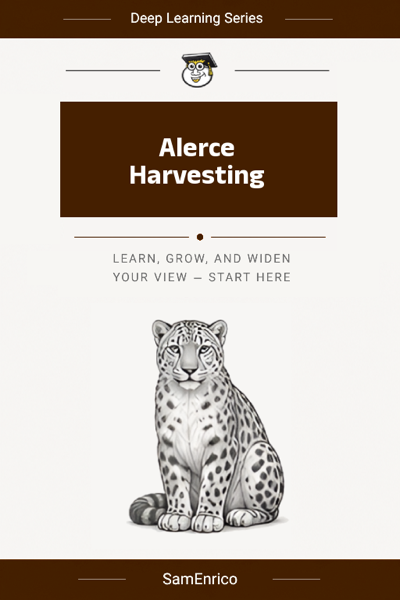
Non-FictionInformativeEducational
Alerce Harvesting eBook
A Coursebook on Alerce Harvesting
A Coursebook on Alerce Harvesting
Formats
Free sample
Chapter 1: The Patagonian Giant--The first time I touched an Alerce, I wept.It was not a dignified response. I had flown 5,000 miles from New York to Santiago, then taken a puddle-jumper to Puerto Montt, then driven six hours over gravel roads that clung to the flanks of the Andes like a half-stitched wound. I had arranged permits through the Chilean forestry service, hired a local guide named Elías who looked at me with the patient tolerance of someone who had watched dozens of foreigners make the same pilgrimage. I had read the scientific papers. I knew, intellectually, that Fitzroya cupressoides was one of the oldest living organisms on earth.
I knew that some specimens had germinated when the Roman Republic was still fighting the Punic Wars. I knew that the species had watched continents drift apart.None of that prepared me for the moment when my palm met the bark.The tree stood in a hidden valley within Alerce Costero National Park, a place that does not appear on most maps of Chile. To reach it, we had walked three hours through a forest that seemed designed by a particularly ambitious god of rain and shadow. The canopy overhead was so dense that daylight arrived as a rumor—occasional coins of brightness that fell on moss so deep it swallowed the sound of our footsteps. The air smelled of wet earth and decaying leaves and something else, something sweeter and older, like the inside of a cathedral that had never known a roof.Then Elías stopped.
He pointed.I looked up.And up.The trunk rose from the forest floor like a column in a dream. It was not merely large—I had seen redwoods in California and sequoias in the Sierra Nevada—but something about this tree felt different. The redwoods I had visited were celebrities, roped off from visitors, their groves turned into outdoor museums. This Alerce was simply there, unmarked, uncelebrated, growing as it had grown for sixty centuries, indifferent to my presence. The bark was a deep reddish-gray, furrowed into vertical channels that my fingers could disappear into.
The base of the trunk was wider than my outstretched arms. Above that, the tree narrowed slowly, almost imperceptibly, rising to a crown that I had to crane my neck to see.I pressed my hand to the bark. It was cool and slightly damp, like river stone in the shade.And then, absurdly, I started to cry.Elías pretended not to notice. He squatted down, pulled out a thermos of mate, and began the slow ritual of pouring the bitter tea into a hollowed gourd. He had grown up in these forests, he told me later, and had learned to recognize tree age by the sound it made when you knocked on the trunk—a high, clear note for young trees, a dull thud for the ancients.
"This one sounds like a dead drum," he said, and meant it as a compliment.I asked him how old the tree was.He shrugged. "Three thousand? Four thousand? Older than your country, gringo. That is all you need to know."The Botanical Identity of a Living Fossil To understand why that tree reduced a grown man to tears, you must first understand what Fitzroya cupressoides actually is—and what it is not.
The confusion begins with the name. "Alerce" is Spanish for larch, a completely different genus of conifer native to Europe and Asia. When Spanish colonists first encountered Fitzroya in the 16th century, they saw a tall, cold-tolerant tree with needle-like leaves and assumed it was a larch. They were wrong. The two species are not even distant cousins in the botanical family tree.The correct taxonomy places Alerce firmly in the Cupressaceae—the cypress family.
This puts it in the same clan as junipers, arborvitae, and the giant sequoias of California. But within that family, Fitzroya stands alone, the sole surviving species in its genus. Botanists call such species "monotypic genera," a term that carries a whiff of lonely distinction. Imagine being the last member of your family line, with no cousins anywhere on earth, and you will begin to understand the Alerce's taxonomic isolation.The genus name honors Robert Fitz Roy, the captain of the HMS Beagle—yes, that Beagle, the one that carried a young Charles Darwin on his voyage around South America. Fitz Roy was a complicated figure: a brilliant naval officer, a pioneering meteorologist, and ultimately a suicide.
But his name now belongs to a tree that will almost certainly outlast any human memory of him. The species name, cupressoides, simply means "resembling a cypress"—a nod to the tree's superficial similarity to its more famous relatives.But taxonomy tells us only the name, not the nature. To understand the Alerce's true strangeness, we must go deeper, into the cellular machinery that allows a living thing to persist for three thousand, four thousand, perhaps even five thousand years. What does it mean to be a tree that germinated when the Buddha was still alive? How does an organism avoid the accumulated damage of millennia?The answers begin with wood.The Slowest of the Slow Alerce grows at a rate that would bankrupt a timber investor.
In ideal conditions—deep volcanic soil, consistent rainfall, protection from wind—a young Alerce might add 2-3 millimeters to its diameter in a single year. But most Alerce do not live in ideal conditions. They live on steep Andean slopes, in poorly drained basins, in places where the rain falls so heavily that other trees rot at the roots. In these marginal environments, growth slows to less than one millimeter per year.Let me put that number in human terms.Your fingernails grow at roughly 3-4 millimeters per month. When you clip them, you are discarding more organic material in a single snip than an Alerce produces in a month of photosynthesis.
A typical sheet of printer paper is 0.1 millimeters thick. It would take an Alerce a little over a month to grow the thickness of a single sheet of paper. A stack of twenty sheets—two millimeters—would require two years.For you to grow a paper-thin layer around your entire body, every year, for three thousand years.This slowness is not a defect. It is an adaptation, and a brilliant one at that. Fast-growing trees like poplars and pines invest their energy in quick height gains, racing for sunlight in crowded forests.
But they pay a price: their wood is soft, porous, and vulnerable to decay. A poplar log left on the forest floor will rot to nothing in five years. An Alerce log, by contrast, can lie in a damp ravine for a century and still be millable.The secret lies in the wood's cellular structure. Alerce has an exceptionally high density of tracheids—the long, hollow cells that transport water from roots to leaves. These tracheids are thick-walled and tightly packed, leaving little room for the fungal hyphae that cause rot.
More importantly, Alerce heartwood is saturated with chemical compounds that are toxic to decomposers. The most important of these is nothofagin, a polyphenol found in only a handful of plant…
This is the end of the free sample. Get the eBook to keep going. Buy now
About this book
Details
- Author
- Blackwell Antony
- Publisher
- SamEnrico
- Language
- English
- Genre
- Non-Fiction, Informative, Educational
- Released
- 2026-05-09
- Pages (approx.)
- 131
- Available as
- eBook, Audiobook

Read better in the ZLOADR app
Your eBooks on your phone or tablet. Sign in with your SamEnrico account and start reading.
More by Blackwell Antony
 Single Parent Healing GuideBlackwell Antony$11.99
 Curiosity Shift TechniqueBlackwell Antony$11.99
 Constraint ThinkingBlackwell Antony$11.99
 The French Wars Religion PrimerBlackwell Antony$11.99
 Assertiveness for Wedding PlannersBlackwell Antony$11.99
 Iron Behemoths of Cambrai: The First Tank Assault That Shook the WorldBlackwell Antony$11.99
 Understanding Piebald Trait Neurologic DefectsBlackwell Antony$17.99
 How to Start a Chemistry Research and Experimental Development Business (Beginners Guide)Blackwell Antony$11.99
 Customer Support VA Hiring GuideBlackwell Antony$12.99
 JEE Inorganic Chemistry MasteryBlackwell Antony$12.99
You may also like
 Hong Kong Handover 1997Dunn Johnnie$11.99
 Zumba For Postnatal Recovery CourseNeal Christian$11.99
 Zumba for BeginnersLadner Nikia$11.99
 YouTube Comment Mining GuideHumes Pandora$12.99
 Worry Box MeditationCarlin Rudy$11.99
 Workplace Stress MeditationNguyen Lynn$11.99
 Workplace Stress and Sleep RepairHawley Ivory$11.99
 Workplace Perfectionism CureDelaney Jeffry$11.99
 Workplace Injustice Anger GuideWallen Isabelle$11.99
 Work Addiction and Burnout LinkGreenwood Ester$11.99
 Women in Yoga and WellnessBeattie Galina$11.99
 Women in Stand Up ComedyChun Evangeline$11.99