
Non-FictionSelf-HelpHarm Reduction
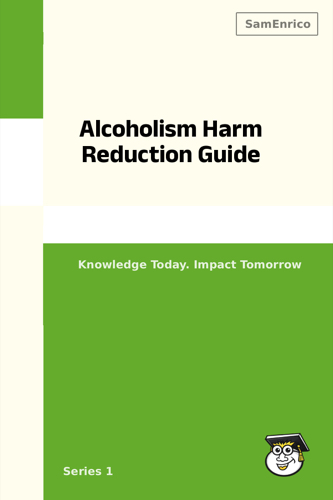
Alcoholism Harm Reduction Guide eBook
Offers safer drinking strategies for those not rea
Offers safer drinking strategies for those not ready for abstinence.
Formats
Free sample
Chapter 1: The Abstinence Trap...--–- I woke up on my bathroom floor at 3:47 AM on a Tuesday. The tile was cold against my cheek. My mouth tasted like a chemistry experiment. My phone showed fourteen missed calls, three from my sister, and one text that said, “Please just tell me you’re alive.” I had no memory of dialing her number at midnight, no memory of slurring words I would never say sober, no memory of the shame I had broadcast into her voicemail. I remember only this: waking up, crawling to the toilet, and promising myself—for the hundredth time—that I would quit.
Forever. This time I meant it.I did not quit. Not that week, not that month, not that year. And for a very long time, I believed that made me a failure.The alcohol treatment industry, the twelve-step fellowship, the bestselling quit-lit books, and even my own well-meaning doctor had all pointed to the same binary: either you stop drinking completely, or you are not really trying. Abstinence was the gold standard.
Abstinence was the only respectable goal. And every time I failed to achieve it, I drank more to drown the shame of that failure. I was trapped in a cycle that the abstinence-only model had actually worsened, not improved.If you are reading this book, you may know exactly what I am describing. You have tried to quit. Maybe you have tried five times.
Maybe fifty. Maybe you have never tried because you already suspect that “forever” is a door you cannot walk through. You want to drink less. You want to drink safer. You want to stop waking up with that clawing regret.
But you are not ready to raise your hand and declare yourself an alcoholic who will never touch another drop. And you have been told, explicitly or implicitly, that this means you lack willpower, courage, or honesty.That is a lie. And this chapter exists to expose it.The abstinence-only approach fails millions of people not because those people are weak, but because the approach itself is incomplete. It ignores the science of behavior change. It weaponizes shame when shame is already the fuel of the addiction.
And it leaves no dignified middle ground for the vast majority of drinkers who are not clinically dependent but who are still causing harm to themselves and those they love.This book offers a different path. It is called harm reduction. And the first step on that path is understanding why the abstinence trap has kept you stuck for so long.The Myth of the One True Way In 1935, when Alcoholics Anonymous was founded, the science of addiction was in its infancy. The prevailing belief was that alcoholism was a moral failing or a weakness of character. AA’s revolutionary insight was to reframe it as a disease—one that could be managed only through complete abstinence and spiritual surrender.
For many people, this approach has saved their lives. It continues to do so every single day. I am not here to argue that abstinence is wrong. I am here to argue that it is not the only right answer.The problem is that the abstinence model has become so culturally dominant that alternatives have been dismissed as enabling, dangerous, or cowardly. Twelve-step groups control the vast majority of publicly funded treatment referrals in the United States.
Rehabs discharge patients with the instruction to attend ninety meetings in ninety days. Sober literature dominates the self-help shelves with titles that promise liberation through total cessation. And anyone who says, “I want to cut down, not quit,” is met with the same response: “That’s your addiction talking.”But here is what the data actually shows. According to a landmark study published in the journal Addiction, approximately 40 percent of people who recover from alcohol problems do so without formal treatment or twelve-step involvement. Many of them achieve what researchers call “moderate drinking” rather than abstinence.
A long-term study from the University of North Carolina followed individuals with alcohol use disorder for twenty years and found that over half of those who recovered were able to return to low-risk drinking without becoming abstinent. These are not outliers. They are a silent majority who learned to change their relationship with alcohol without swearing it off forever.The abstinence trap is the belief that these people do not exist. Or that they are deluded. Or that they will eventually relapse into full-blown addiction.
But the evidence tells a different story: many people can and do learn to drink less, drink slower, and drink safer, without needing to quit entirely.Shame as Fuel, Not Solution Here is the cruel irony of the abstinence-only mandate. Shame is meant to motivate change. But for someone who drinks to escape difficult emotions, shame is a direct trigger for more drinking. I saw this in my own life. I would fail at abstinence—usually within a week—and then I would tell myself that I had no willpower, that I was broken, that I was the kind of person who could not control anything.
That story, repeated often enough, became a permission slip to drink even more. Why bother trying if I was already a failure?This is not just anecdotal. The research on shame and addiction is unequivocal. A 2018 meta-analysis in Clinical Psychology Review found that shame-proneness is a stronger predictor of relapse than almost any other psychological variable. People who feel ashamed of their drinking are more likely to drink again, not less.
By contrast, guilt—the feeling that a specific behavior was harmful—can be productive. Guilt says, “I did something bad.” Shame says, “I am bad.” The abstinence model, with its emphasis on powerlessness and the “alcoholic” identity, often inadvertently fosters shame rather than guilt.Harm reduction takes the opposite approach. It says: you are not bad. You are a person who has developed a pattern of drinking that is causing problems. And you can change that pattern without needing to hate yourself first.
In fact, self-compassion is a better predictor of successful change than self-punishment. When you stop telling yourself that you are a failure for not quitting, you free up the mental energy to actually reduce your drinking.The Hidden Majority: Who Harm Reduction Serves Let me be very clear about who this book is for. It is for the person who drinks four or five beers every night and knows that number should be lower, but cannot imagine watching television without a drink in hand. It is for the mother who drinks two bottles of wine over the course of a long Sunday and wakes up Monday with a pounding headache and a vague memory of snapping at her children. It is for the professional who has never missed a day of work but has also never attended a happy hour without blacking out.
It is for the college student who binge drinks on weekends and has started to worry about what happens during those missing hours.It is also for the person who meets full criteria for alcohol use disorder—who shakes in the morning until they have a drink, who has lost jobs and…
This is the end of the free sample. Get the eBook to keep going. Buy now
About this book
Details
- Author
- Schmidt Yvonne
- Publisher
- SamEnrico
- Language
- English
- Genre
- Non-Fiction, Self-Help, Harm Reduction
- Released
- 2026-06-09
- Pages (approx.)
- 138
- Available as
- eBook, Audiobook

Read better in the ZLOADR app
Your eBooks on your phone or tablet. Sign in with your SamEnrico account and start reading.
More by Schmidt Yvonne
 The Caretaker AdultSchmidt Yvonne$11.99
 Dream Alchemy MethodSchmidt Yvonne$11.99
 Anger Master WorkbookSchmidt Yvonne$11.99
 Galileo's Celestial Symphony: The Music of the SpheresSchmidt Yvonne$11.99
 Internet Reliability and InfrastructureSchmidt Yvonne$12.99
 Spurrite MiningSchmidt Yvonne$11.99
 How to Produce Contact CleanerSchmidt Yvonne$11.99
 Ultimate Handbook Guide to Zaria : (Nigeria) Travel GuideSchmidt Yvonne$11.99
You may also like
 Hong Kong Handover 1997Dunn Johnnie$11.99
 Zumba For Postnatal Recovery CourseNeal Christian$11.99
 Zumba for BeginnersLadner Nikia$11.99
 YouTube Comment Mining GuideHumes Pandora$12.99
 Worry Box MeditationCarlin Rudy$11.99
 Workplace Stress MeditationNguyen Lynn$11.99
 Workplace Stress and Sleep RepairHawley Ivory$11.99
 Workplace Perfectionism CureDelaney Jeffry$11.99
 Workplace Injustice Anger GuideWallen Isabelle$11.99
 Work Addiction and Burnout LinkGreenwood Ester$11.99
 Women in Yoga and WellnessBeattie Galina$11.99
 Women in Stand Up ComedyChun Evangeline$11.99