
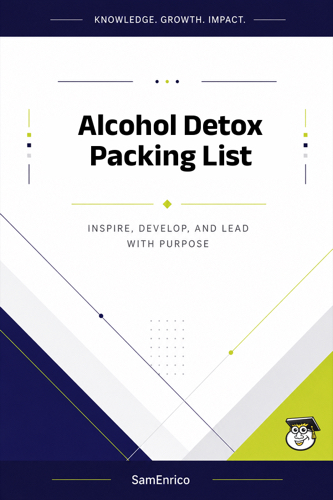
Non-FictionHealth & WellnessPreparation
Alcohol Detox Packing List eBook
What to bring to inpatient detox facility.
by Leake Darwin
What to bring to inpatient detox facility.
Formats
Free sample
Chapter 1: The Paperwork Precipice...--–- The first thing they take from you is not your dignity. It is your driver's license.You will stand at an intake window, shaking—from withdrawal, from fear, from the cold institutional air that smells of bleach and floor wax—and a nurse or admissions coordinator will slide a small tray toward you. On it, you will place your wallet. Not your phone. Not your keys.
Your wallet. And in that moment, you will learn something that no recovery memoir ever mentions: the single most common reason people are turned away from inpatient detox is not a full bed, not a lack of insurance, not even active intoxication. It is the wrong identification.This chapter is not about feelings. It is about paperwork. It is about the cold, bureaucratic, unforgiving machinery of medical admission.
You may be in crisis. You may have finally summoned the courage to ask for help. You may have driven three hours in a borrowed car with a shaking hand on the wheel. None of that matters to the admissions computer. If your identification is expired, if your insurance card is a photo on your phone, if your name does not match exactly across all documents, you will be told to leave.
Not because they are cruel. Because they cannot bill your insurance without matching identifiers. Because state regulations require a physical, government-issued ID for the dispensing of controlled substances. Because a photograph of a license is not a license.This chapter will save you from that fate. It will walk you through every piece of paper, every card, every bill, and every form you must bring.
It will explain why facilities have these rules—not to punish you, but to protect themselves and you. And it will introduce you to the first and most important of the three bags you will pack: Bag 1, the Essentials Bag, which will be opened only at intake and then locked away until discharge.Let us begin with the single most failed item at detox admissions desks across the country.The Expired License Trap You look at your driver's license. It expired three months ago. You meant to renew it, but drinking was a full-time job, and the DMV requires a vision test, and there was always a reason to put it off. Now you are standing at a detox intake desk, and the woman behind the glass is sliding your license back to you with a flat expression."I'm sorry, we can't admit you with an expired ID."You explain that you are here voluntarily.
You explain that you haven't driven in months. You explain that you are shaking so badly you can barely stand. She nods. She understands. The answer is still no.This scenario plays out thousands of times every year.
The reason is not cruelty; it is regulatory compliance. Detox facilities are licensed medical providers. They dispense controlled substances—benzodiazepines, barbiturates, anticonvulsants—that are tightly regulated by state and federal agencies. To dispense these medications, they must positively identify every patient. An expired ID is not valid identification.
A temporary paper ID from the DMV? That depends on the facility. Some accept it. Some do not. You must call ahead.The rule is simple: Your government-issued photo ID must be current.
Not expired by one day. Not expired by one year. Current. If your license expired during your drinking years—and for many readers, it has—you have two options. First, renew it before you go to detox.
This may feel impossible when you are drinking heavily, but a friend or family member can drive you to the DMV. Second, if you cannot renew in time, call the facility and ask: "Do you accept temporary paper IDs from the DMV, or do you require the hard plastic card?" Write down the answer. Get the name of the person you spoke to.What counts as valid ID? A state-issued driver's license. A state-issued identification card (non-driver).
A passport (current). A military ID. A resident alien card (green card). That is the list. A Costco card does not count.
A work ID does not count. A library card does not count. A photo of your license on your phone—which people try surprisingly often—does not count. Physical, government-issued, current.What about a passport that expired during COVID? No.
Expired is expired.What if I have no ID at all? This is more common than you might think. People in active addiction lose wallets. Wallets get stolen. Purses get left in bars.
If you have no government-issued ID, you are not entirely without options. Some state-funded detox facilities will accept a combination of other documents: a birth certificate (original or certified copy) plus a social security card plus a piece of mail with your name and address. But this is facility-specific and requires advance approval. Call before you arrive. Do not show up with a birth certificate and expect admission.
You will be disappointed.The Insurance Card Trinity You have your ID. Good. Now open your wallet again. You are looking for three cards, not one. Most people bring only their medical insurance card.
That is a mistake.Card One: The Medical Insurance Card. This is the card with your name, your member ID number, and the name of your insurance company—Blue Cross, Cigna, Aetna, United Healthcare, Medicaid, or whatever plan you have. It may also have a group number and a payer ID. Bring this card. Not a photo of it.
Not a photocopy. The actual card.Card Two: The Pharmacy Benefit Card. Many insurance plans subcontract their prescription drug coverage to a separate company. Express Scripts, Optum Rx, CVS Caremark—these are pharmacy benefit managers (PBMs). Your medical card may not have your pharmacy information on it.
You need the separate pharmacy card. Why? Because detox facilities will be administering medications to you. They need to bill your pharmacy benefit for those drugs. Without that card, you may be billed the cash price for your Librium or phenobarbital.
That cash price can be hundreds of dollars per day.Card Three: The Prescription Discount Card. This is optional but smart. If you have no insurance, or if your insurance has a high deductible, bring a Good Rx card or a Single Care card. These are free to obtain online. They can reduce the cost of detox medications by 50 to 80 percent.
Some facilities will not accept them—they have contracts with specific PBMs—but many will. It costs nothing to bring one.The name match rule. Here is where people get turned away. Your ID says "Robert J. Smith." Your insurance card says "Rob Smith." Your pharmacy card says "Robert Smith." These are not matches.
Insurance companies are strict about name matching. If your legal name is Robert, but your insurance card says Rob, you need to call your insurance company and ask them to issue a corrected card. Do this before you go to detox. Do not assume the admissions nurse will "figure it out." She will not. She cannot.
The computer will reject the claim, and you will be asked to return with corrected documents.What about Medicaid? Medicaid rules…
This is the end of the free sample. Get the eBook to keep going. Buy now
About this book
Details
- Author
- Leake Darwin
- Publisher
- SamEnrico
- Language
- English
- Genre
- Non-Fiction, Health & Wellness, Preparation
- Released
- 2026-06-08
- Pages (approx.)
- 139
- Available as
- eBook, Audiobook

Read better in the ZLOADR app
Your eBooks on your phone or tablet. Sign in with your SamEnrico account and start reading.
More by Leake Darwin
 Threat Hunting Year ReportLeake Darwin$11.99
 Creator Collaboration PlaybookLeake Darwin$11.99
 The Secret Sugar in Processed FoodsLeake Darwin$11.99
 Lawyer Imposter SyndromeLeake Darwin$11.99
 The Last Second: How a 1972 Trade Changed the NFL ForeverLeake Darwin$11.99
 RSPO Palm Oil Export CertificationLeake Darwin$12.99
 GA4 Annotations Feature GuideLeake Darwin$12.99
 How to Start a Cable Television Equipment Business (Beginners Guide)Leake Darwin$11.99
 Compactor OperationLeake Darwin$11.99
 Understanding Premature Aging, Okamoto TypeLeake Darwin$17.99
You may also like
 Hong Kong Handover 1997Dunn Johnnie$11.99
 Zumba For Postnatal Recovery CourseNeal Christian$11.99
 Zumba for BeginnersLadner Nikia$11.99
 YouTube Comment Mining GuideHumes Pandora$12.99
 Worry Box MeditationCarlin Rudy$11.99
 Workplace Stress MeditationNguyen Lynn$11.99
 Workplace Stress and Sleep RepairHawley Ivory$11.99
 Workplace Perfectionism CureDelaney Jeffry$11.99
 Workplace Injustice Anger GuideWallen Isabelle$11.99
 Work Addiction and Burnout LinkGreenwood Ester$11.99
 Women in Yoga and WellnessBeattie Galina$11.99
 Women in Stand Up ComedyChun Evangeline$11.99