
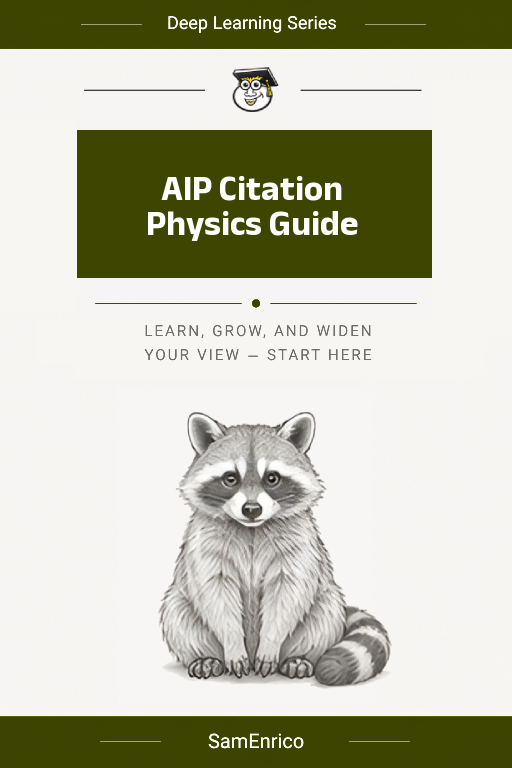
Non-FictionStudent's ShortcutAIP Style
AIP Citation Physics Guide eBook
Cite physics papers using American Institute of Ph
Cite physics papers using American Institute of Physics style with journal abbreviations quickly.
Formats
Free sample
Chapter 1: The Sacred Formula--–- Every physics paper tells a story. The introduction sets the stage. The methods describe the experiment. The results reveal the discovery. But the references?
They are the ghostly fingerprints of every scientist who came before—the invisible foundation upon which your entire argument rests. Get them wrong, and no one will trust a single equation you write.Here is the uncomfortable truth that no advisor tells you on your first day of graduate school: citation formatting is not an academic nicety. It is a test. When you submit a manuscript to an American Institute of Physics journal—Physical Review Letters, Journal of Applied Physics, Applied Physics Letters, or any of the seventeen AIP journals—the editors will check your references before they read your abstract. They will look for bolded volume numbers, missing periods, incorrect abbreviations, and page ranges that should be single pages.
And if they find errors, your paper will be returned to you without review. Desk rejection. Not because your science was bad, but because your et al. was in the wrong place.This chapter gives you the one tool you will ever need to pass that test: the Sacred Formula. Master these twelve elements, and you will never again lose sleep over a misplaced comma at 2 AM.Why Most Physicists Get Citations Wrong (And Why It's Not Their Fault)Before we build the formula, let us acknowledge a systemic failure.
Physics graduate programs spend years teaching quantum mechanics, statistical thermodynamics, and computational methods. They spend approximately zero hours teaching citation style. The official AIP Style Manual was last updated in 1990—before the World Wide Web, before ar Xiv, before DOIs, before most of you were born. It is 296 pages of dense typographic rules, written for copyeditors, not for exhausted postdocs trying to submit a paper before a funding deadline.The result is a hidden curriculum. Students learn citation rules by imitating papers they read, which often contain errors themselves.
They copy from Bib Te X files that were last updated in 2005. They trust Zotero and End Note to magically produce correct output, only to discover that their reference list contains Physical Review Letters written out in full while the journal requires Phys. Rev. Lett. They submit their paper, wait three weeks, and receive a form email: “Technical issues with your submission.
Please correct the references and resubmit.”This chapter ends that cycle. You will learn not just what the rules are, but why they exist. And you will leave with a single formula that works for 90 percent of the citations you will ever write.The Sacred Formula: Your New Best Friend Here it is. Memorize it. Write it on a sticky note and attach it to your monitor.
Tattoo it on your forearm if you must:text Copy Download[#] Author Initials. Last Name, Journal Abbrev. **Volume**, Page (Year). doi:XXXXXThat is the complete skeleton of an AIP journal article citation. Every element serves a purpose.
Every piece of punctuation is a deliberate signal to the reader. Let us dissect each component with the precision of a laser cutter.The Anchor: The Citation Number in Brackets Everything begins with the citation number, written in square brackets and followed by a space. [1] not 1. or (1) or #1. Why brackets?
Because AIP uses superscript numbers in the text (more on that in Chapter 5), and the brackets in the reference list visually distinguish the citation number from the volume number that comes later. It is a small distinction, but a critical one.When you cite the same source multiple times in your paper, you use the same number each time. Reference [1] stays [1]. Do not renumber. Do not create [1a].
The system is designed for economy: one number, one source, forever.The Author Element: Initials, Periods, and the Vanishing First Name Here is where most novices stumble. AIP requires initials only, no full first names. J. C. Maxwell not James Clerk Maxwell.
A. Einstein not Albert Einstein. M. Curie not Marie Curie.There are three exceptions to this rule, and they are so rare that you will likely never encounter them. First, when two authors share the same last name and identical initials—J.
C. Maxwell and J. C. Maxwell from different institutions—you may add a middle initial or use a distinguishing footnote. The journal editor will tell you if this is necessary.
Second, some authors publish under a single name (e.g., Plato or Homer). Use that single name without initials. Third, authors with compound last names (e.g., van der Waals) keep the compound name but still use initials only: J. van der Waals.Punctuation alert: Place a period after each initial, with a space between initials. J.
C. Maxwell not J.C.Maxwell or J C Maxwell. Then a period after the final initial, then a space, then the last name. So the pattern is: First Initial. Space Second Initial.
Space Last Name.Multiple authors: List the first three authors exactly as described, then add a comma and et al. (with a period after al. because it is an abbreviation for et alii). The threshold is non-negotiable: three authors maximum before et al. For example: [1] J.
C. Maxwell, A. Einstein, M. Curie, et al. Note the comma before et al.
Many physicists omit it. They are wrong.Corporate authors: Some papers are authored by collaborations with hundreds or thousands of members—CERN, LIGO, the Particle Data Group. In these cases, use the collaboration name as the author: [1] CERN Collaboration, or [1] LIGO Scientific Collaboration, Do not list individual names. Do not use et al. The collaboration name stands alone.The Journal Abbreviation: Where Good Citations Go to Die If there is a single element that causes more desk rejections than any other, it is the journal abbreviation.
AIP demands that journal titles be abbreviated according to the CASSI (Chemical Abstracts Service Source Index) or Appendix G of the official AIP manual. You cannot guess. You cannot invent. You cannot copy what you saw in a paper from 1987.The rule is simple: every word in the journal title that can be abbreviated, must be abbreviated. Physical Review Letters becomes Phys.
Rev. Lett. Journal of Applied Physics becomes J. Appl. Phys.
The Astrophysical Journal becomes Astrophys. J.The One-Word Rule: Some journals are never abbreviated. They appear in full, in italics. This list includes *Nature*, *Science*, and *Physics Today*. That is it.
Every other journal title gets abbreviated.The trap: Many journals have abbreviations that look similar but are distinct. Physical Review B abbreviates to Phys. Rev. B (no period after B because it is a single letter). Physical Review B: Condensed Matter and Materials Physics abbreviates to Phys.
Rev. B as well—the subtitle is dropped entirely. Physical Review Special Topics: Accelerators and Beams became Phys. Rev. ST Accel.
Beams (note the periods after ST and the abbreviation of Accelerators).Chapter 3 is entirely devoted to journal abbreviations, including a complete table of the top 100 physics journals and their correct abbreviations. For now, just know that you cannot skip this step. An incorrect abbreviation is like a typo in your abstract—it signals carelessness, and editors notice.The Volume Number: Bold or Bust Here is the single most…
This is the end of the free sample. Get the eBook to keep going. Buy now
About this book
Details
- Author
- Huffman Karyn
- Publisher
- SamEnrico
- Language
- English
- Genre
- Non-Fiction, Student's Shortcut, AIP Style
- Released
- 2026-05-29
- Pages (approx.)
- 132
- Available as
- eBook, Audiobook

Read better in the ZLOADR app
Your eBooks on your phone or tablet. Sign in with your SamEnrico account and start reading.
More by Huffman Karyn
 Financial Self Care GuideHuffman Karyn$11.99
 Jimmy Hoffa Retirement And Return Bid ManualHuffman Karyn$11.99
 Burnout Recovery Guide For MenHuffman Karyn$11.99
 The Collaborative Confidence CourseHuffman Karyn$11.99
 OnlyFans Body Comparison CrisisHuffman Karyn$11.99
 Spin Bike SetupHuffman Karyn$11.99
 OKR for Learning SkillsHuffman Karyn$11.99
 Bosnia No Fly Zone ProtesterHuffman Karyn$11.99
 The Tides of Trafalgar: Nelson’s Last Stand Against the Leviathans of the DeepHuffman Karyn$11.99
 Glitch in the Grid: The Day the Internet VanishedHuffman Karyn$11.99
 How to Start a Meteorological Instruments (non-electronic) Business (Beginners Guide)Huffman Karyn$11.99
 How to Produce RamsHuffman Karyn$11.99
You may also like
 Hong Kong Handover 1997Dunn Johnnie$11.99
 Zumba For Postnatal Recovery CourseNeal Christian$11.99
 Zumba for BeginnersLadner Nikia$11.99
 YouTube Comment Mining GuideHumes Pandora$12.99
 Worry Box MeditationCarlin Rudy$11.99
 Workplace Stress MeditationNguyen Lynn$11.99
 Workplace Stress and Sleep RepairHawley Ivory$11.99
 Workplace Perfectionism CureDelaney Jeffry$11.99
 Workplace Injustice Anger GuideWallen Isabelle$11.99
 Work Addiction and Burnout LinkGreenwood Ester$11.99
 Women in Yoga and WellnessBeattie Galina$11.99
 Women in Stand Up ComedyChun Evangeline$11.99