
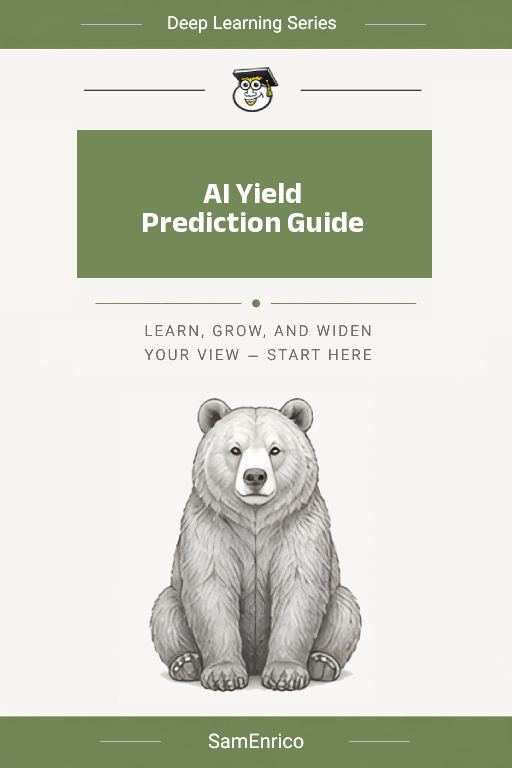
Non-FictionForecast & OutlookYield Forecasting
AI Yield Prediction Guide Audiobook
Learn machine learning models forecasting harvest
Learn machine learning models forecasting harvest volume using satellite imagery, weather, and historical data.
Formats
Free sample
Chapter 1: The Broken Crystal Ball...--Most farmers still trust a 200-year-old lie.It is not their fault. The “Old Farmer’s Almanac” approach—averaging the last thirty years of rainfall, temperature, and yield—has been passed down through generations like a family Bible. But in an era of climate volatility, historical averages are not just inaccurate. They are dangerously misleading.Imagine driving a car while looking exclusively in the rearview mirror. You would crash within minutes.
Yet that is precisely what traditional yield forecasting does: it assumes the future will look like the past. When a July heatwave arrives that has no precedent in the last three decades, the historical average model does not adjust. It cannot adjust. It has no mechanism for novelty.This chapter dismantles the old way of thinking. You will learn why yield prediction is fundamentally a regression problem, not a classification problem.
You will understand the critical difference between estimating where your crop is right now versus forecasting where it will be at harvest. And you will see, through a real-world disaster, how a dynamic AI model caught what the almanac missed.By the end of this chapter, you will never look at a thirty-year average the same way again.The Seduction of Historical Averages The human brain craves patterns. Give a farmer thirty years of rainfall data, and they will find an “average.” Give them a yield history, and they will project it forward. This is not stupidity; it is cognitive efficiency. For most of agricultural history, the climate was sufficiently stable that last year was a reasonable guess for next year.That stability is gone.Consider the data.
Between 1950 and 1980, a 1-in-50-year heatwave (defined as a temperature anomaly exceeding two standard deviations from the local mean) occurred roughly once every five decades. Between 2000 and 2025, the same heatwave occurs every five to seven years in major agricultural regions, including the US Midwest, the Indo-Gangetic Plain, and the Brazilian Cerrado. The statistical distribution has shifted, but historical averages treat it as stationary.This is the stationarity assumption: the idea that the underlying processes governing weather and yield do not change over time. It is the foundational assumption of every almanac-based forecast. And it is wrong.A 2023 study published in Nature Climate Change examined corn yield predictions across twenty-seven major producing countries.
Models trained exclusively on historical averages (the “naïve almanac baseline”) missed 62% of yield anomalies—years where actual harvest deviated by…
This is the end of the free sample. Get the Audiobook to keep going. Buy now
About this book
Details
- Author
- Iverson Marcell
- Publisher
- SamEnrico
- Language
- English
- Genre
- Non-Fiction, Forecast & Outlook, Yield Forecasting
- Released
- 2026-05-30
- Pages (approx.)
- 140
- Available as
- eBook, Audiobook

Listen in the VoxFlicks app
Audiobooks and audio dramas wherever you go. Sign in with your SamEnrico account and press play.
More by Iverson Marcell
 OKRs for Meditation PracticeIverson Marcell$11.99
 Heygen Avatar Production HandbookIverson Marcell$11.99
 Pinterest Home Decor ComparisonIverson Marcell$11.99
 Widow Self Worth Recovery GuideIverson Marcell$11.99
 The Art of Saying No to DrinksIverson Marcell$11.99
 The Waltz of Emperors: Vienna's Golden Age of Music and MajestyIverson Marcell$11.99
 Renewals ManagerIverson Marcell$11.99
 Understanding Idiopathic Facial PalsyIverson Marcell$17.99
 Micro Influencer Compliance ManualIverson Marcell$12.99
 How to Start a Casting Machines for Foundries Business (Beginners Guide)Iverson Marcell$11.99
You may also like
 Hong Kong Handover 1997Dunn Johnnie$11.99
 Zumba For Postnatal Recovery CourseNeal Christian$11.99
 Zumba for BeginnersLadner Nikia$11.99
 YouTube Comment Mining GuideHumes Pandora$12.99
 Worry Box MeditationCarlin Rudy$11.99
 Workplace Stress MeditationNguyen Lynn$11.99
 Workplace Stress and Sleep RepairHawley Ivory$11.99
 Workplace Perfectionism CureDelaney Jeffry$11.99
 Workplace Injustice Anger GuideWallen Isabelle$11.99
 Work Addiction and Burnout LinkGreenwood Ester$11.99
 Women in Yoga and WellnessBeattie Galina$11.99
 Women in Stand Up ComedyChun Evangeline$11.99